« January 2007 | Main | March 2007 »
February 28, 2007
ESDC-released documents from Forest City lack vital information
Atlantic Yards Report explains that the documents released today leave a lot out, concluding that, "The same lack of transparency apparently persists."
The Empire State Development Corporation released three pages of Forest City Ratner-prepared documents estimating investment returns over 12 years.
I'll have more analysis later, but it's important to remember that these pages differ greatly from the financing plan that the Metropolitan Transportation Authority required from bidders for the Vanderbilt Yard, and which Develop Don't Destroy Brooklyn and other organizations tried in vain to see.
Firstly, that financial plan covered 20 years, not little more than a decade. Secondly, the MTA required (p. 15, or PDF p. 18) the developer to account for "sources and uses"--in other words, the combination of subsidies, investment funds, and internal funds that would be used.
Posted by lumi at 11:21 PM
BREAKING NEWS: Actual results may vary
 We can't decide who has the more highly developed sense of humor, Norman Oder or Bruce Ratner.
Today, "The Mad O" noticed this disclaimer on the Atlantic Yards Combined Returns Summary (link).
Which leads us to wonder, when do actual results NOT vary?
 Bruce Ratner's flagship project, Metrotech, wasn't supposed to be a campus for NYC bureaucrats, and the original plans for the Atlantic Center never envisioned the Department of Motor Vehicles as the anchor tenant.
Heck, even Frank Gehry's concert hall in Springfield, USA was repurposed into a prison.
"Ex-cellent!"
[Hey kids! Is that an "environmental compliance monitor" in the foreground of the Monty Burns Prison construction site?]
UPDATE: Norman Oder has been overkilling us on Thursday morning, pointing out that the DMV isn't "the" anchor tenant of the Atlantic Center Mall because it doesn't lease the greatest square footage. It's "an" anchor tenant. He's provided us with this link from Forest City Ratner's web site to prove his point.
We still contend that it is "the" metaphorical anchor tenant because it's the "store" that brings in the widest range of people who will shop in the other specialty stores.
Before the Mad O gets on our case, we should also explain that Frank Gehry never really built a project in Springfield. We don't even know where Springfield is. And that guy is probably just some guy, not an environmental compliance monitor.
What would we do without the Mad O to keep everyone honest? But it's ok, having to explain one's joke in detail usually makes people think it's funnier, right?
Posted by lumi at 10:54 PM
Nets for sale? Document suggests cash flow stops in 2013
Atlantic Yards Report
Norman Oder comes up with a possible explanation for why Ratner's financial projections, released today, only run until 2013 for the NJ Nets.
Could the Nets be for sale after the Atlantic Yards project is under way? There's certainly a hint of that in the Combined Returns Summary prepared by Forest City Ratner and released by the Empire State Development Corporation. The document estimates cash flow and investment internal rate of return starting in 2004 for both the "Team and Arena Investment" and also the "Real Estate Investment."
The "Team and Arena Investment" ends in 2013.
This wasn't the first hint either. Read on.
NoLandGrab: It would really suck if Ratner built the arena, sold the team and the new team owner threatened to move the team to Piscataway, unless the city built a newer state-of-the-artier arena.
Posted by lumi at 10:37 PM
FOREST CITY RATNER SPONSORS FREE NETS BASKETBALL CLINIC
Guests include former Net Darryl “Chocolate Thunder” Dawkins and New York State Assembly Member Vito Lopez
(Brooklyn, NY) – On February 21 st, Forest City Ratner Companies hosted a free Nets basketball clinic at the Ridgewood/Bushwick Youth Center in Brooklyn. Bruce Ratner, President and CEO of FCRC said, “Forest City is committed to supporting sports and athletics at all levels throughout Brooklyn. Nets basketball clinics emphasize the importance of teamwork, dedication and hard work – skills that are crucial for success – on and off the court.”
Darryl Dawkins, known for shattering backboards during his NBA days, helped coach the young athletes on the court but also gave them lessons on the importance of studying and working hard at school. New York State Assembly Member Vito Lopez, who represents Bushwick and other Brooklyn communities, also arrived to visit with players and coaches. Prizes and medals were given at the end of each session for a variety of team and individual achievements.
Participants were chosen from public and parochial schools (private schools did not attend because they were in session on the clinic date) as well as youth organizations and Amateur Athletic Union (AAU) Programs in Brooklyn. Today’s was the most recent installment in a series of FCRC-sponsored Nets basketball clinics for school-age children.
Posted by lumi at 10:35 PM
Financial documents
Three whole pages of financial documents were released by the Empire State Development Corporation today. The fact that only three pages cover a $4 billion project implies that more was left unsaid than revealed.
The analysis is still forthcoming, but there are some really interesting comments on Brownstoner, which got the documents up online first.
AY Financial Projections: We Got 'Em
Also posted earlier on Brownstoner, ESDC Forced to Cough Up Financial Docs on AY
Shahn Andersen, the savior/developer of Broken Angel, has been keeping up to date on the topic, posting expert commentary on Brownstoner.
Early this morning, Andersen provided a lesson on Development Financials 101:
Forget about the big number that they will make (I'd estimate it at around a billion dollars), what is their real return on investment when they have been given atleast $300 million dollars up front from various city and state agencies to do the deal? Even if they end up spending $50 or a $100 million of their own equity outside of financing, at the end of the day, they will make 1000% to 2000% ROI from what they actually invested.
Andersen's reaction to the documents released today:
Would anyone really go through all of this trouble for a measly 9.6 IRR?
Here are the documents:
Total Project Cash Flows
Combined Returns Summary
Nets Arena Cash Flows
Posted by lumi at 6:42 PM
Press Release: "Atlantic Yards" Financial Projections Fail to Shed Light on Forest City Ratner's Potential Profit
Figures Released By ESDC Under Threat of Legislators' Lawsuit Leave Many Questions Unanswered, Appear to Grossly Understate Profit
BROOKLYN, NY- Financial projections released today by the Empire State Development Corporation (ESDC) purporting to show Forest City Ratner's (FCRC) projected profit for the proposed "Atlantic Yards" project appear to raise more questions than they answer - and to severely understate the developer's profit.
The financial documents, which were released only after State Assemblyman Jim Brennan and State Senator Velmanette Montgomery sued the ESDC for the information, fail to provide sufficient details or underlying assumptions, including information on "sources and uses" typically provided for a project receiving significant amounts of public funding. In some cases, the documents omit information altogether, for example, assigning no projected value to the project's planned hotel. The true value of the assets, once built, would appear to be much higher than the values outlined; several elements of the plan appear to be estimated below market value, let alone future value.
At least one local real estate developer who has reviewed the documents had serious questions about the conclusions contained in the documents. Shahn Andersen, in comments posted to the web site Brownstoner.com, stated that he believed FCRC would earn approximately a billion dollars, and questioned how much money of its own the developer was actually putting up. He also questioned FCRC's purported rate of return as being severely understated.
The documents only project out eight years, to 2015, one year before the project's officially projected completion date. (In comparison, the MTA, in its Request for Proposals for the Vanderbilt rail yards, had required 20-year pro forma projections, although FCRC failed to provide the MTA with the requested information.) Some people with knowledge of the project, including "Atlantic Yards" landscape architect Laurie Olin, have said they expect construction to last 20 years.
The financial projections do reveal some interesting information about the arena, including the fact that the New Jersey Nets are currently losing some $40 million dollars a year. "It appears that the taxpayers are being asked to bail out a professional sports franchise that's currently a complete money loser," said Candace Carponter, spokesperson for Develop Don't Destroy Brooklyn. "While the city and state are bending over backwards to subsidize Bruce Ratner, it seems that it should be the other way around."
According to the documents, the act of relocating the Nets from New Jersey into an arena in Brooklyn will allow Ratner and the Nets' co-owners to essentially double their initial investment by 2013, providing the money-losing team's investors with a publicly subsidized golden parachute.
It's also unclear as to whether the ESDC has analyzed and verified the projections released today, or if they simply rubberstamped this submission, just as they have every other aspect of the "Atlantic Yards" project. Given the vast public subsidies that this project is slated to receive, the public has the right to expect some assurance from the government that the developer's numbers are comprehensive and based upon valid business assumptions," said DDDB's Carponter. "The footnote on these documents says 'For discussion purposes only - actual results may vary.'"
Posted by lumi at 6:40 PM
Skybox muscle slips for stadiums
Suites that aren't paying off get boot
Wall St. Journal, via Myrtle Beach Sun
By Russell Adams
On the eve of the release of financial projections for Bruce Ratner's Atlantic Yards plan, this article revealed that skybox revenue ain't what it used to be.
It was like watching an era of sports history being erased. In early December, construction workers sawed through the multiple layers of drywall and metal studs separating a row of skyboxes at the Seattle Mariners' Safeco Field. They tore up the suites' beech-hardwood floors and carted away their oriental rugs and leather furniture. By the end of the week, the eight skyboxes were gone.
In a reversal that strikes at a cornerstone of pro-sports finances - and of the way corporate America entertains - teams around the country are ripping out luxury suites. These perches have been used to justify billions of dollars in stadium construction over the past two decades. But in many cities, they are losing luster with surprising speed, partly the result of factors that couldn't have been predicted five or 10 years ago, from changes in tax laws to scandal-driven reforms on corporate entertaining.
NoLandGrab: In contrast to this article and current nationwide trends, Ratner estimates, in the documents released today by the ESDC, that "suite and loge box revenue" will nearly pay for the arena's construction.
Posted by lumi at 6:26 PM
Links to demolition permits status in CB8, 6 and 2
Yesterday, BrooklynSpeaks.net posted two links for the status of all pending demolition permits in Brooklyn Community Boards 8 and 6.
Here's the link for CB 2, which contains the one property, 179 Flatbush Ave., for which the application has been approved.
Posted by lumi at 9:35 AM
A dozen planned demolitions would create "facts on the ground," isolate plaintiffs
Atlantic Yards Report
With the filing of papers preliminary to the demolition of 12 properties it owns within the Atlantic Yards footprint, developer Forest City Ratner--even as a pending eminent domain case constrains it from construction work on the planned arena--seems poised to create "facts on the ground," empty lots that would foster both a perception of isolation and a sense of the project's inevitability.
 [Click map to enlarge.]
The demolitions would include the Ward Bakery on Pacific Street, which preservationists have hoped to see saved for adaptive reuse, but instead would be razed for an interim surface parking lot.
Among those most starkly impacted would be the residents still within the 22-acre footprint.
...
While a 2/20/07 Forest City Ratner press release announced the beginning of site preparation work and the commencement of demolition of one building, 179 Flatbush Avenue, papers filed by the developer with the Department of Buildings (DOB), mainly in the past week, indicate much greater ambitions. The demolitions have not yet been approved by the DOB.
Posted by lumi at 8:47 AM
As ESDC waits to name AY environmental monitor, Dean Street residents lose water supply, face FCR obfuscation
Atlantic Yards Report
Norman Oder publishes the scoop on yesterday's events in and around the Atlantic Yards footprint, by way of an eye-witness account from the President of the Dean Street Block Association, Peter Krashes.
Krashes spent the greater part of the day dealing with a mishap caused by a Forest City Ratner (FCR) contractor. The Dean St. resident remained unstymied by the bald-faced assertion put forth by FCR's VP of Public Affairs, who claimed that an existing problem was spotted by the Department of Environmental Protection thanks to the work being done by Forest City Ratner.
On February 5, the Empire State Development Corporation (ESDC) issued a request for proposals for an environmental monitor to oversee construction activities within the Atlantic Yards project. Responses were due February 26, with selection expected in two weeks.
However, for residents of Dean Street between Carlton and Vanderbilt avenues—a block that on the south side borders the project footprint and on the north side is within the footprint—that oversight seems already overdue.
On Tuesday, they lost their water supply for four hours owing to a worker’s error, and found the inconvenience compounded by a lack of information available from Forest City Ratner’s newly-established Atlantic Yards Community Liaison Office. The likelihood of at least a dozen building demolitions within the next few months makes the issue even more pressing.
Posted by lumi at 8:26 AM
Lawmakers Push for the Release of Atlantic Yards Financial Documents
The NY Sun
By Eliot Brown
A lawsuit filed by two Brooklyn legislators is forcing the public release of long-awaited documents regarding finances surrounding the Atlantic Yards project.
An ESDC spokeswoman told The New York Sun it now intends to release the documents to Mr. Brennan, likely this week, which include development company Forest City Ratner's business plan for the $4.2 billion project in Brooklyn. Assemblyman James Brennan, joined by state Senator Velmanette Montgomery, filed a lawsuit Monday against the Empire State Development Corporation alleging that the agency was improperly withholding documents detailing the project's finances.
Critics of the project for at least two years have been attempting to determine the amount developer Bruce Ratner stands to profit, and they say the hundreds of millions in city and state subsidies should justify its status as public information.
...
"Ratner's basic premise for having to build this so large and so dense was that it has to be to make this financially feasible," a spokeswoman for the advocacy group Develop Don't Destroy Brooklyn, Candace Carponter, said. Without knowing Mr. Ratner's potential profit, the public has been unable to properly evaluate his claims, Ms. Carponter said.
...
A spokeswoman for Forest City Ratner said the company had no comment regarding the lawsuit, and has complied with government agencies in the public approval process.
Posted by lumi at 7:59 AM
After Brennan's lawsuit, ESDC poised to release Ratner’s profit projections
Atlantic Yards Report
Brooklyn Assemblyman Jim Brennan, joined by State Senator Velmanette Montgomery, has gone to court in an attempt to force the Empire State Development Corporation (ESDC) to answer his Freedom of Information Law (FOIL) request to see the projected costs, revenues, and profits for Forest City Ratner’s Atlantic Yards plan--a prelude to arguing for a reduction in the project’s size.
While Brennan's effort had been rejected by the ESDC under the administration of Gov. George Pataki, the New York Sun reports today that new Gov. Eliot Spitzer's administration has indicated that it's willing to comply--and the documents should be released shortly.
...
[Brennan] said last October, “So that is a critical public question: how much money do they think they’re going to make on their market-rate housing, and how much money do they think the arena is going to make? How much money does the affordable housing need and where are they going to get it? Without that information, the public is shortchanged.”
NoLandGrab: Brennan makes good points on two fronts:
1. It is important to know how much taxpayer money will be committed to Atlantic Yards and what the taxpayers will get in return. For example, the public has a right to know if Atlantic Yards affordable housing might end up costing more than other affordable housing solutions.
2. It is important to understand how much Bruce Ratner stands to make. Ratner is not only asking for the public to sacrifice taxpayer money for Atlantic Yards, but also to put up with the densest residential housing community in the nation. If the density issue is driven by the need for the developer to make a profit, then the public has a right to know what Ratner will earn in exchange for the public's acquiescence to an urban planning experiment of historical proportions.
Posted by lumi at 7:51 AM
NO-PARK SLOPE
1 HOUR TO FIND SPOT IN B'KLYN NABE
NY Post
By Rich Calder
You think traffic will be bad if Atlantic Yards gets built. What about now?
Nearly half the cars clogging Park Slope's streets at any given time are going nowhere - except in quest of a parking spot, a new study shows.
And drivers spend an average of half an hour to an hour trying to find a spot on the Brooklyn neighborhood's brownstone-lined streets, according to the advocacy group Transportation Alternatives, which conducted the study.
...
Councilman David Yassky (D-Brooklyn) cautioned that parking in Park Slope will only get worse once the $4 billion Atlantic Yards project - which includes an NBA arena and 16 skyscrapers - is built between 2009 and 2017 in neighboring Prospect Heights.
NoLandGrab: David Yassky can complain all he wants about traffic and Atlantic Yards — the historical 22-acre mega-project has been moving forward because of the failure of many key elected officials, like himself, to make any significant changes to the project, or to try to stop it.
The failure to implement a comprehensive traffic plan for Central Brooklyn not only haunts local residents, it also negatively impacts regional commercial transportation. Elected officials get credit for that as well.
Posted by lumi at 7:35 AM
Source: FCR plans to start demolition "within 6 weeks"
Atlantic Yards won't be the cause of significant construction-related impacts on the surrounding neighborhood. And if it did, the Atlantic Yards Community Liaison Office is there to assist you, right? Right??
Congratulations, you weren't born yesterday! And neither were residents of Dean St. who were stuck without water for several hours yesterday, gratis Caring Bruce.
BrooklynSpeaks.net is reporting that "A source told BrooklynSpeaks yesterday that Forest City Ratner plans to start demolitions on the Atlantic Yards site 'within 6 weeks.'"
One of the buildings slated to be demolished is the historic Ward Bakery building. Hopefully this third-stream coalition of neighborhood and civic groups will step up to the plate in a last-minute effort to save the historical building, now that the political process has yielded no results (except for Ratner).
Keeping a close eye on things, BrooklynSpeaks.net also reported the water service shut down to the neighborhood and noted:
At the same time, the Community Liaison Office has told residents that it is “too early” to release a schedule for work that is going to take place on the site.
Residents near and in the footprint are now being seriously impacted by impending demolition and construction, with no official coordinating public entity and the developer's Community Liaison Office so far inadequate.
The group warned that this Community Liaison Office stuff wasn't promising in a previous entry on the group's web site. A snarky comment follows:
More like the Convention & Visitors Bureau than 311.
Posted by lumi at 6:18 AM
THE EDUCATION OF YVETTE CLARKE PART 22: IS YVETTE THINKING LOGICALLY?
Hardbeat News commentator Arthur Piccolo has been spearheading a campaign to name a new Nets arena after Jackie Robinson. This week he's recapping the Brooklyn Papers coverage of Yvette Clarke's outrage over the naming-rights deal with Barclays Bank and is cautioning the freshman congressional representative from taking a position that might seriously undermine her credibility:
CongressWoman (sic) you cannot hold out the possibility of damaging Congressional Hearings that will explore possible wrong doing by a major worldwide corporation but choose not to do so if they will “donate” more money to Brooklyn whether or not you decide who gets the money.
...
Here is a good simple accurate definition of Extortion from Encyclopedia, “extortion is more widely defined to include the obtaining of money or property of another by inducing his consent through wrongful use of fear, force, or authority of office.” And from the Encyclopedia Britannica this definition, “ Unlawful exaction of money or property through intimidation or undue exercise of authority. It may include threats of physical harm, criminal prosecution, or public exposure.” And from Wikipedia “The simple four words "pay up or else" are sufficient to constitute the crime of extortion. These are third party definitions not the law itself but should give Yvette reason to pause before considering being involved in a “deal” with Barclay’s that includes Barclay’s altering its current naming rights offer.
Posted by lumi at 6:15 AM
February 27, 2007
NY Times to blame for what "Brownstoners" don't know about Atlantic Yards?
Commentary, from "Anonymice" on Brownstoner, regarding Jennifer Egan's Op-Ed in the Saturday Times, made us realize that Egan's piece was the very first mention in The NY Times that Atlantic Yards, if built, would be the densest residential community in the nation.
Two commenters posting on Brownstoner found that hard to believe; one even accused Egan of "creating 'facts' out of whole cloth."
This incredulity made us realize that unless these readers were receiving the DDDB newsletter, or were regular readers of NoLandGrab or Atlantic Yards Report, they had no clue. How could they? The New York Times never told them.
Here's how several voices in the public conversation on Atlantic Yards uncovered this amazing fact in the Summer of '06.
 STARTS WITH STUCKEY
The questions about density arose when Forest City Ratner (FCR) VP Jim Stuckey was trying to make folks understand that Atlantic Yards wasn't all that big. In a May 15, 2006 interview with Brian Lehrer of WNYC, Stuckey claimed that the FAR (floor area ratio) of Atlantic Yards was around 8, and was close to that of the Downtown Brooklyn Plan.
FACTCHECKING STUCKEY
Stuckey's claims just didn't sound right to Jonathan Cohn from Brooklyn Views, who had been studying the plan and posting commentary from the point of view of an experienced architect. Cohn did a little analysis and calculated what he termed "real FAR" (as opposed to "FCR FAR?") and came up with an estimate more like 9 (see, "How Big Is It Now?"). Cohn also extended an offer to the 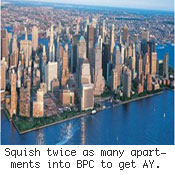 developer to provide more accurate figures in order to nail down the actual figure — he's still waiting by the phone.
ODER UNVEILS STARTLING COMPARATIVE ANALYSIS
This revelation, and a quick lesson in the myriad of ways in which planners measure density, sent Norman Oder of Atlantic Yards Report sniffing around, comparing Atlantic Yards to other large-scale housing projects in New York City. Oder didn't find any developments in NYC that had nearly the population density of the Atlantic Yards plan (see, "Extreme density: Atlantic Yards plan would dwarf Battery Park City, other projects"). To the Brownstoner/NY Times readers, that includes Battery Park City. Imagine, BPC with, like, twice as many buildings sandwiched into the open space.
 A CITY PLANNING EXPERT WEIGHS IN
Then former City Planning Commissioner and Develop Don't Destroy Brooklyn Advisory Board member Ron Shiffman pointed out Atlantic Yards's dirty little secret, "If Forest City Ratner’s proposal proceeds at the current scale, it would constitute the densest residential community in the United States and, perhaps, Europe, with the exception of some of the suburbs of Paris."
DENSEST RESIDENTIAL COMMUNITY? C'MON! SCHUERMAN LOOKS AT THE DATA
Oder's article and Ron Shiffman's pronouncement got New York Observer reporter Matthew Schuerman wondering if that could be true. Schuerman checked out the latest census data ("Prisoner of Atlantic Avenue") and found that the densest census tract in the nation is a single two-block project in West Harlem that has "229,713 inhabitants per square mile." Atlantic Yards, according to the figures released by the developer at the time, clocked in "between 436,363 and 523,636 inhabitants per square mile (based on estimated population of between 15,000 and 18,000 residents over 22 acres)."
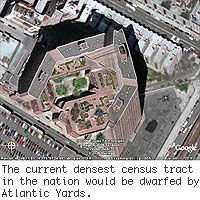 Atlantic Yards has been shaved down since then, but the fact remains that it would handily eclipse the residential density of any place in the nation.
Why is residential density important? Because residential areas place a heavier load on city services. Those same city services that the Atlantic Yards Evironmental Impact Statement has amazingly concluded would not be significantly impacted by the project.
So thank you Jim Stuckey, Jonathan Cohn, Norman Oder, Ron Shiffman and Matthew Schuerman for putting your heads together and helping Brooklynites who read blogs written by what Senator Schumer calls "self-appointed people" to understand that Atlantic Yards is an experiment in urban density of historical proportions.
Oh, and thanks to Brownstoner readers for illustrating what happens to inquiring minds when the "Paper of Record" gets its info from developer press releases. We can only apologize for The NY Times for not keeping their readers in the loop, especially those who live in Central Brooklyn.
Posted by lumi at 10:00 AM
Lawyers claim AY wasn't Ratner's idea, but the record says otherwise
Atlantic Yards Report
Many decades from now, Brooklynites might be asking, "Just whose freakin' idea was this Atlantic Yards stuff anyway?"
Believe it or not, this is an important question for the eminent domain court case.
While U.S. Magistrate Judge Robert M. Levy last Friday recommended that the Atlantic Yards eminent domain case be dismissed from federal court, he acknowledged that the lawsuit "raises serious and difficult questions regarding the exercise of eminent domain under emerging Supreme Court jurisprudence."
So, the case will ultimately be heard on its merits, either in federal court (if the plaintiffs prevail on Judge Nicholas Garaufis to override Levy's recommendation) or in state court.
Then a judge will have to evaluate the curious claim, made by lawyers for Forest City Ratner in legal papers and in oral argument, that the developer did not initiate the Atlantic Yards project.
The developer Forest City Ratner (FCR) has been telling people for years that it was Marty's fault (actually, Marty has been bragging about it too). Norman Oder finds evidence to the contrary.
NoLandGrab: The most recent spin came from a newspaper in Utah, which wrote that Atlantic Yards was "the result of years of discussion on how to address New York's housing crisis, according to a spokesman for Forest City Ratner Companies." We wonder if this signals the latest story, one that might sound more compelling in court.
Posted by lumi at 8:58 AM
The Surface Parking Lots: Does "temporary" mean 20 years?
BrooklynSpeaks asks an important question.
Laurie Olin also suggested in his interview with the NY Observer that the project would probaly take as long as 20 years to complete, if it even is completed:
“It’s a great project, if it all happens,” he said. “The time calendar we are talking about is probably 20 years. People say 10 to 15, but take a look. How long does it take the market to absorb that much stuff?”
Does this mean that the 3 "temporary" surface parking lots (not to mention the uncovered railyards themselves) will also last that long? The largest of the temporary surface parking lots would be the entire block bounded by Pacific Street, Vanderbilt Avenue, Carlton Avenue and Dean Street
Posted by lumi at 8:50 AM
Schumer Announces $2 Billion For JFK Rail Link In President's FY08 Budget
We know that Senator Schumer probably doesn't read NoLandGrab, because as he put it, our views represent "the culture of inertia." However, someone might want to tell one of Bruce's biggest boosters that it looks like the coveted AirTrain ain't gonna happen if Bruce Ratner's Atlantic Yards plan goes forward (see, BrooklynViews, February 19, 2007, "Will Atlantic Yards Preclude the One Seat Ride to JFK?").
It seems that the highly touted "track improvements" — you know, the ones that the Metropolitan Transportation Authority claimed made Ratner's low-ball bid higher than Extell's — will preclude a direct rail link between Lower Manhattan and JFK. But that never stopped a politician from trying to get more money out of the Federal Government.
Not to put too fine a point on it, but at this moment, you probably know more about this setback for regional transportation than the folks in Washington and City Hall do.
Here's Schumer's press release from February 1, 2007:
U.S. Senator Charles E. Schumer announced today that next year's federal budget will include a $2 billion tax credit the Downtown JFK Rail link. Schumer, a member of the Senate Finance Committee, aggressively lobbied Administration officials to include the provision in the budget, expected to be released on February 5, 2007.
"This once-in-a-generation chance to connect Downtown to Kennedy Airport and Long Island will spur new business development, create jobs Downtown, and ensure New York's economic growth for decades to come," Schumer said. "Building a link between Kennedy Airport and the labor pool of Long Island will be especially important to businesses considering staying or moving to Downtown. When we finally get it done, it will be a big win for all of New York."
After 9/11, President Bush committed to providing New York with $20 billion in aid. As part of that original $20 billion commitment, Congress passed a $5 billion Liberty Zone tax incentive program in the "Job Creation and Worker Assistance Act of 2002." Unfortunately, some of the tax incentives have gone unutilized, and Schumer has sought for two years to convert those unused incentives into other projects that could benefit Lower Manhattan. President Bush included a $2 billion "trade-in" in his last two budget proposals, for fiscal years 2006 and 2007.
Last year, after months of working closely with the City and State, as well as Senate leaders, Senator Schumer succeeded in adding a $1.75 billion tax credit program (over 15 years) to tax bills that passed both the House and Senate. The credits were available to New York City and New York State to be used for public transportation infrastructure projects in or connecting with the New York Liberty Zone. However, at year's end, the provision was removed in conference and was not included in the final version of the tax extenders package that became law. Senator Schumer then lobbied the Administration to include the provision in its 2008 budget proposal so that it could pass both the House and Senate again and hopefully be signed into law this year.
The rail project is expected to cost $6 billion. The Port Authority of New York and New Jersey has already committed $560 million to the project and the MTA has $400 million in its capital plan for this project. Combined with these initial contributions, a redeployment of the available portions of the tax package for this project would represent a substantial amount toward the total required, and would give the momentum necessary to raise the remaining funds.
Posted by lumi at 6:45 AM
February 26, 2007
Brooklyn's Team-to-Be Hasn't Found Welcome Mat
The NY Times
By William C. Rhoden
Could this be some kind of record? Two days after running an op-ed criticizing the project, a NY Times sports columnist takes a hard look at the how a project that is supposed to unite Brooklynites behind one sports team, has remained controversial:
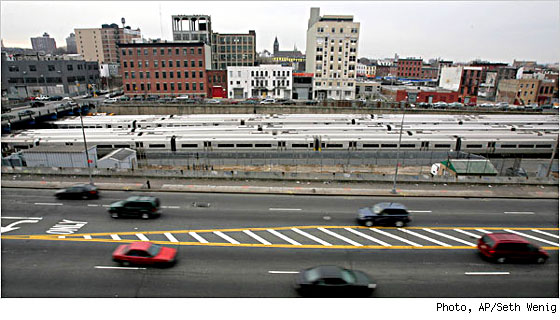
Three hours before the Nets were scheduled to play the Knicks in New Jersey yesterday, Rev. Clinton Miller sat in his office at the Brown Memorial Baptist Church in the Fort Greene section of Brooklyn.
Miller wanted to talk basketball, not Knicks-Nets basketball, but the business of basketball. Specifically, he wanted to talk about the Nets' move to Brooklyn for the 2009-10 season.
The Nets are coming to Brooklyn as part of the $4.2 billion Atlantic Yards development. The project, by Forest City Ratner, was unveiled in 2003. Forest City Ratner is also the development partner in building the Midtown Manhattan headquarters for The New York Times Company.
The revitalized Atlantic Yards would include residential and office towers and a basketball arena for the Nets. A substantial portion of subsidized housing will be for families at different income levels, but only about one-seventh of the project's roughly 6,000 units will be affordable for tenants making less than half the median income for the New York City area.
NoLandGrab: The veteran columnist falls into the same trap as other NY Times reporters, by referring to the "revitalized Atlantic Yards." Atlantic Yards is Bruce Ratner's name for the entire 22-acre development. The eight-acre rail yard is called Vanderbilt Yards.
Another correction worth noting: The Empire State Development Corporation and Forest City Ratner assert that the project will now cost $4B, not $4.2B.
Link (TimesSelect subscribers only)
Posted by lumi at 9:57 AM
Brooklyn Bridge + Atlantic Yards CBA = Black History Month?
 Atlantic Yards Report
Norman Oder decodes the latest advertisement from Forest City Ratner, which offers a magnificent view of the Brooklyn Bridge, but, alas, none of the Atlantic Yards plan.
First, even though the Community Benefits Agreement (CBA) partners are significantly funded by the developer, and most have no history previous to this CBA, they get credit for honoring Black History Month as well.
And what history is being made? Seemingly the signing of the CBA in June 2005--and also the Brooklyn Bridge. However, the CBA has little to do with the bridge; while the document was signed nearby (on Old Fulton Street), it applies to a very different and oversize project.
...
What's Mayor Mike Bloomberg doing in that picture above? Yes, a mayoral press release claimed that he "signed" the CBA, but actually, he served as a "legally irrelevant witness," as noted by the Brooklyn Rail's Brian Carreira.
Forest City Ratner also tops the list of "Corporate Partners " for the NYS Association of Black and Puerto Rican Legislators' annual conference. That means that the developer paid the most money to share the spotlight with its "Community Benefits Agreement partners."
Posted by lumi at 9:24 AM
Dismissal eyed for federal suit against Atlantic Yards
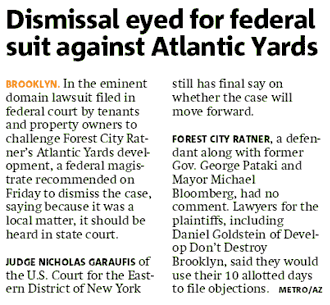 MetroNY ran this short item in today's edition about Judge Levy's recommendation to kick the federal eminent domain suit down to state court:
Posted by lumi at 9:11 AM
A grudging Times correction on "city approval" and another taking more blame than Barclays
Atlantic Yards Report
 Getting The NY Times to print a correction in reference to Atlantic Yards feels like pulling teeth, especially when they have printed the same correction in the past:
Why did it take six days for the New York Times to grudgingly correct a basic error in a 2/20/07 Metro Brief about Atlantic Yards, especially since the Times in December published essentially the same correction?
The brief stated:
The city and state approved the project despite heated opposition from residents...The correction today, under the For the Record rubric (where basic errors are corrected), states:
*A report in the Metro Briefing column on Tuesday about the construction work expected to begin at the Atlantic Yards project near downtown Brooklyn referred imprecisely to the development. Although it has been endorsed by the Bloomberg administration and the City Planning Commission, it is a state project that does not require formal city approval. (Emphasis added)That wasn't imprecise but simply incorrect.
Why did The Times take so long? What's the big deal anyway? What about the Barclays correction?
Perhaps The Times is getting sick of being fact-checked by Norman Oder.
"Correction fatigue," anyone?
Click here to get the rest of the story.
Posted by lumi at 8:51 AM
VC hints he'd like to stay
 Bergen Record
By Al Iannazzone
Nets' guard Vince Carter has to decide whether or not to re-sign with the team next year. Carter's departure would exacerbate Ratner's PR woes with the current fan base:
...owner Bruce Ratner wants to keep Carter in a Nets uniform. After the backlash he received when Kenyon Martin left in 2004, Ratner could advise Thorn to give Carter what he wants.
Posted by lumi at 8:21 AM
Putting Limits On Pay To Play
Gotham Gazette
By Mike Muller and Joshua Brustein
Whether it's "outright bribery" or "subtle persuasion," "New York's public officials have long accepted money from those with whom their agencies do business, and such donations are often perfectly legal. But quid pro quos... are getting increased attention from public officials."
Caring Bruce is very creative; he turned over the job of payouts to the Brooklyn machine pols to his older brother, Michael:
"When you do business with the city, you get solicited by everyone from U.S. senators down to members of the City Council," said Atlantic Yards developer Bruce Ratner in former Public Advocate Mark Green's 2004 book on campaign finance, Selling Out. Reflecting on his past contributions and fund-raising efforts, Ratner added, "I didn't want to be a person on the outs, nor could my business afford to be a person on the outs given how much business we do with government."
Despite his qualms, Ratner still plays the game. As the Atlantic Yards Report, a blog opposed to his plan for downtown Brooklyn, writes, Ratner no longer makes campaign contributions – directly. But his brother and sister-in-law both contribute large amounts to public officials who may have sway over development projects he hopes to pursue.
NoLandGrab: Norman Oder will tell you until he's blue in the face, or you cry uncle, that just because he's a critic of many aspects of Bruce Ratner's plan and the lack of media coverage, that doesn't mean he's opposed to it.
Posted by lumi at 8:08 AM
February 25, 2007
Ratner propaganda--playing soon at a town near you
Save Our Land
A Developing Story - New York Times -- Note the propaganda techniques as the Ratner family tries to manipulate public opinion with the "foregone conclusion" hat trick. I think we've all had about enough of this, and it's time to start speaking the truth, all of us. This op-ed piece by Jennifer Egan, a novelist--an artist--who happens to live near the scene of the Atlantic Yards sellout, is articulate and points to many basic problems we in Cleveland have in common with Brooklyn. There are three salient points that play out over and over, like some sort of sick drill to take the town apart on the way to the bottom.First of all, as is once again exemplified by these embarrassing, tacky, and inconsiderate Ratners, the money's in the wrong hands, selfish hands. Second, the people we have running our governments and our nonprofits suck up to the people with money and sell out very, very cheaply, chump-style, but they keep their little jobs and aggrandize their little positions, as much as that's possible. Third, the public interests are subverted and the public winds up paying in many, many ways, as the developer confiscates the common wealth of generations and puts future generations under obligation.
We need to take our money back, along with our cities. We in Cleveland have seen all this before, as we swirl further down the drain, and now Ratner is sucking Brooklyn into the vortex as well--the earmarks are the same--the faddish Frank Gehry buildings, the promises of jobs and tax revenue and affordable housing, the sports arenas, the doctored impact statements commissioned by the developer. Read the entire article. You'll recognize the patterns of lies, deceit, sins of omission and commission, the corruption. Dwell on the last sentence. Blog. Congregate.
Posted by amy at 3:39 PM
A Look Back at the Atlantic Yards Groundbreaking
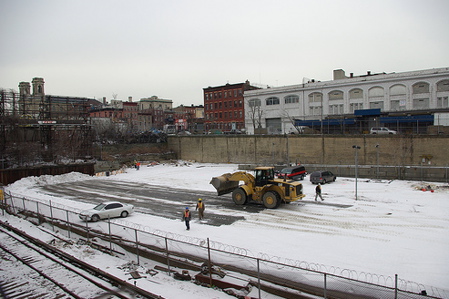
Brownstoner
Flickr photog AKinloch snapped this photo on Tuesday of the first day of demolition at the Atlantic Yards. We're going to stop by this weekend to check out the site for ourselves. Please send us pics if you do the same.
Posted by amy at 3:35 PM
Sunday Comix
 Malcolm Armstrong
Posted by amy at 11:59 AM
On objectivity, neutrality, and integrity in covering AY

Atlantic Yards Report
Yesterday NoLandGrab was well respresented at the Grassroots Media Conference by our own Lumi Rolley. Norman Oder gave a great talk about objectivity, neutrality, and integrity in the media. (See examples of non-neutrality in today's Daily News articles, below.) Norman posted his remarks online.
Here's an example of some bad reporting. A little while ago, I discovered that the city had put $205 million in the budget for Atlantic Yards—that’s double the official pledge of $100 million.That wasn’t hidden; it was right there for everyone to see, it’s just that none of the reporters either remembered the pledge or thought there was news.
I wrote a story. DDDB put out a press release. The Post and the Sun wrote stories. The Daily News and the Times ignored it.
So, am I and the others who reported this story opponents or responsible journalists? And are those who ignored the story irresponsible journalists? And does that make them, in effect, proponents?
Posted by amy at 11:49 AM
Columbia launches land-grab plan
NY Daily News
DOUGLAS FEIDEN
That clash between town and gown is part of a land battle that has erupted over Manhattanville, a 17-acre industrial parcel near the Hudson River that's bigger than the site of the World Trade Center.Columbia wants to tear down most of the low-rise buildings, and relocate the low-income inhabitants and blue-collar workers. Over a 25-year period, it would build a gleaming $7 billion super-campus, creating 6.8 million square feet of space by 2030 to ensure its competitive future.
But the elite school isn't the only party worried about its future. Faced with the threat of forced evictions, eminent domain and the wrecking ball minority residents and employees in the thinly populated neighborhood are fighting back.
...
There are just two problems: Most of the 425 West Harlem residents, who live in 132 apartment units, don't want to move out. And many of the remaining business owners, who employ some 1,200 people, don't want to sell.So Columbia has asked the Empire State Development Corp. to consider condemning the properties it wants through eminent domain, a controversial practice in which the state takes private properties, at fair market price, ostensibly for a public purpose.
Lucky for West Harlem that Errol Louis is not on the Columbia beat...
Posted by amy at 11:41 AM
Errol Louis on AY negotiation, but not the 20-year affordable housing plan
Atlantic Yards Report
Today, let us give thanks that Norman Oder has the patience to fact check Errol Louis's entire article.
Louis calls the litigation "doomed" and likens Atlantic Yards to other projects with public benefits such as Lincoln Center in Manhattan and Melrose Commons in the Bronx, neither of which have, as the Atlantic Yards plan would have, nearly 2000 luxury condos, 2250 market-rate rentals, and 900 (of 2250 "affordable" rentals) at or over market rate.(In the print edition, there's a big picture of a smiling, benevolent Bruce Ratner.)
...
Louis calls it a "fool's errand" to go to federal court to impinge on state and local exercise of eminent domain. He notes Levy's citation that federal courts generally stay out of these cases. True, but the question here is whether the Atlantic Yards litigation, based on legal theories developed after the Supreme Court's 2005 Kelo vs. New London decision, will break new legal ground.
Posted by amy at 11:35 AM
Play ball with Bruce
NY Daily News
Errol Louis
The biggest myth about the $4 billion, 22-acre Atlantic Yards project in Brooklyn is that it might not get built. So it's long past time for people concerned about the complex to quit fantasizing about how to stop it and start focusing on ways to improve it.This was made clearer than ever two days ago, when federal Judge Robert Levy hammered another nail into the legal coffin of anti-project advocates by recommending dismissal of Goldstein vs. Pataki, a lawsuit by a handful of holdouts who refuse to sell their property to the project's developer, Bruce Ratner.
No, Errol, the biggest myth would be whatever you write. "U.S. Magistrate Judge Robert M. Levy concluded today in his Report and Recommendation on the Defendants’ Motion to Dismiss in “Goldstein et al v. Pataki et al” that he believed the case should better be heard in state court." Not dismissed.
Posted by amy at 11:27 AM
Youthful mogul sticks to his vision
Salt Lake Tribune
No, the youthful mogul in question here is not Bruce Ratner, but he's certainly on his way to becoming him:
So, he has purchased a franchise in the National Basketball Association's Developmental League. He will announce the team's name next month, and the season begins in the Utah Valley State College gym in Orem this fall.
...
But it's his Lehi project that has gained Andersen the most attention - that and the hiring of a world-renowned architect to create a distinct design at what Andersen calls the "gateway between Utah and Salt Lake counties."Gehry, who designed the Guggenheim Museum in Bilbao, Spain, and the Walt Disney Concert Hall in Los Angeles, also is working with rapper Jay-Z and the New Jersey Nets on a $400 million arena in Brooklyn.
Posted by amy at 11:20 AM
Work begins on Atlantic Yards project - Construction crews get started despite pending court cases that could block towers
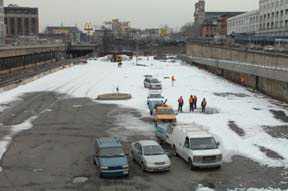
Courier Life
Stephen Witt gives a lovely run-down of all the construction and demolition firms hired so far, listing whether they are minority or woman-owned, but not whether they are Brooklyn firms. He also allows Ratner three solid paragraphs of pure PR speak, and Stuckey gets his comments in as well. Aside from the title, there is not one mention of the lawsuits, even though he asserts that specific building in the footprint of the arena are to be knocked down:
In addition to the preparatory work, FCRC said they plan on demolishing on of their buildings – a former automotive repair shop -- at 179 Flatbush Avenue to make way for the Barclay’s Center arena and 16-skyscraper project.
As you, our more informed readers, already know, Daniel Goldstein's building ("center court") is at the center of the eminent domain lawsuit, and the arena plans cannot go forward unless the court case is settled in the developer's favor.
Also keeping FCRC at its word is the Empire State Development Corporation (ESDC), who earlier this month put out an RFP (Request for Proposals) for an environmental monitor on their behalf to oversee the construction.The monitor will assure that mitigating measures addressed in the Environmental Impact Statement are kept during the construction and other phases of the development.
Among the requirement items the ESDC environmental monitor will oversee include protecting nearby historic buildings, traffic conditions, air and noise quality, the scheduling of truck deliveries, rodent control and implementation of measures to retain and detain storm water.
Will they be protecting historic buildings like the Ward Bakery, which they want to demolish???
Posted by amy at 11:05 AM
February 24, 2007
Magistrate deals legal blow to critics of Atlantic Yards project
AMNY publishes a longer version of the AP story:
Despite the recommendation, plaintiff lawyer Matt Brinckerhoff predicted U.S. District Judge Nicholas Garaufis would allow the suit to go forward because it "involves an issue of paramount constitutional importance" -- making it more suitable for federal rather than state court.But if the magistrate's recommendation is upheld, plaintiffs will refile the suit in state court, said Candace Carponter, a spokeswoman for Develop Don't Destroy Brooklyn, one of the plaintiffs.
...
A spokesman for Mayor Michael Bloomberg, John Gallagher, applauded the decision."Atlantic Yards will create tens of thousands of jobs, provide hundreds of millions of dollars in tax revenue and thousands of units of affordable housing for the city, and we welcome this recommendation by the magistrate and are looking forward to the project moving ahead," he said.
Posted by amy at 10:58 AM
Magistrate: Throw Out Atlantic Yards Lawsuit
The Real Estate
Calling it a state and a local matter the federal government should abstain from, a federal magistrate recommended on Friday throwing out the eminent-domain case brought by tenants and property owners opposed to the Atlantic Yards project. The plaintiffs, including those who live in the footprint of the 22-acre project in central Brooklyn, want to stop the state from using eminent domain to seize property.The U.S. Court for the Eastern District of New York still makes the final decision on the lawsuit, but the magistrate's recommendation can't help matters for the plaintiffs. The defendants include developer Forest City Ratner, Mayor Bloomberg and former Governor George Pataki.
Also included is the full recommendation from Magistrate Robert M. Levy - after the jump.
UNITED STATES DISTRICT COURT EASTERN DISTRICT OF NEW YORK -------------------------------------------------------X DANIEL GOLDSTEIN, et al., Plaintiffs, REPORT AND RECOMMENDATION -against- 06 CV 5827 (NGG) (RML) GEORGE E. PATAKI, et al., Defendants. -------------------------------------------------------X LEVY, United States Magistrate Judge: All defendants move to dismiss the complaint, pursuant to Rules 12(b)(1) and 12(b)(6) of the Federal Rules of Civil Procedure. On November 21, 2006, the Honorable Nicholas G. Garaufis, United States District Judge, referred the motions to me for Report and Recommendation. Briefing was completed on February 1, 2007, and this court heard oral argument on February 7, 2007. For the reasons stated below, I respectfully recommend that defendants' motions be granted. BACKGROUND AND PROCEDURAL HISTORY A. The Plaintiffs and Their Claims Plaintiffs Daniel Goldstein, Jerry Campbell (as the putative administrator of the estate of Oliver St. Clair Stewart and in his individual capacity), The Gelin Group, LLC, Chadderton's Bar and Grill Inc. d/b/a/ Freddy's Bar and Backroom, Maria Gonzalez, Jackie Gonzalez, Yesenia Gonzalez, Huda Mufleh-Odeh, Jan Akhtar, David Sheets, Joseph Pastore, Peter Williams, Peter Williams Enterprises, Inc., Henry Weinstein, 535 Carleton Ave. Realty Corp., 535 Carlton Ave. Realty Corp., and Pacific Carlton Development Corp. (collectively, Case 1:06-cv-05827-NGG-RML Document 83 Filed 02/23/2007 Page 1 of 42 1 Plaintiffs amended their complaint on January 5, 2007 to, inter alia, add some of the named plaintiffs listed above and eliminate a claim against former Governor Pataki in his official capacity. (See Amended Complaint, dated Jan. 5, 2007.) 2 The arena is slated to be home to the New Jersey Nets National Basketball Association Team. (See Declaration of Douglas M. Kraus, Esq., dated Dec. 15, 2006, Ex. E.) 3 Plaintiffs Daniel Goldstein, Jerry Campbell, the Estate of Oliver St. Clair Stewart, The Gelin Group LLC, Peter Williams, Peter Williams Enterprises, Inc., 535 Carleton Ave. Realty Corp., 535 Carlton Ave. Realty Corp., Henry Weinstein, and Pacific Carlton Development Corp. own and control real property. (Am. Compl. ¶¶ 6-8.) Plaintiff Chadderton's Bar and Grill Inc. d/b/a Freddy's Bar and Backroom has a lease for operation of a commercial enterprise. (Id. ¶ 9.) Plaintiffs Maria Gonzalez, Jackie Gonzalez, Yesenia Gonzalez, Huda Mufleh-Odeh, Jan Akhtar, David Sheets, and Joseph Pastore are residential tenants. (Id. ¶¶ 14 - 20.) 4 Section 1983 imposes liability on persons - including, by judicial construction, municipalities and other state agencies - who, acting under color of state law, deprive others of rights secured by the Constitution and federal laws. 42 U.S.C. § 1983 (2000). -2- "plaintiffs") commenced this action on October 26, 20061 seeking to enjoin the exercise of eminent domain to seize their properties in connection with a project known as the Atlantic Yards Arena and Redevelopment Project (the "Atlantic Yards Project" or the "Project"). As currently proposed, the Project is a mixed-use redevelopment project that would cover approximately twenty-two acres of land in and around the Metropolitan Transportation Authority's Vanderbilt Yards in Brooklyn, New York. (See Amended Complaint, dated Jan. 5, 2007 ("Am. Compl."), at 2 n.1.) It includes a sports arena with seating capacity for approximately 20,500,2 sixteen high-rise apartment and office towers containing approximately eight million square feet of residential, office and commercial space, and a 180-room hotel. (Id.) Plaintiffs own or rent property within the footprint of the Project. (See id. ¶¶ 6- 21.)3 They challenge the use of eminent domain under 42 U.S.C. § 1983,4 asserting claims under the Fifth Amendment's Takings Clause (as incorporated by the Fourteenth Amendment), which Case 1:06-cv-05827-NGG-RML Document 83 Filed 02/23/2007 Page 2 of 42 5 Similarly, Article 1, § 7(a) of the New York State constitution provides that "[p]rivate property shall not be taken for public use without just compensation." However, the Amended Complaint contains no claim under the state constitution. 6 For their Equal Protection claim, plaintiffs allege that "[b]y selecting plaintiffs' properties to be taken for the purpose of conferring a benefit, here the plaintiffs' property, to [the private developer], defendants have targeted plaintiffs for adverse treatment for no rational purpose." (Am. Compl. ¶ 151.) As plaintiffs' counsel conceded at oral argument, this claim "will rise or fall with the public use claim." (Transcript of Oral Argument, dated Feb. 7, 2007 ("Tr."), at 51.) 7 Plaintiffs allege that defendants have deprived them of their property interests without due process of law by, inter alia, "(1) circumventing local and community review and local zoning regulations; (2) failing to provide sufficient time to meaningfully respond between the release of the Draft Environmental Impact Statement and the hearing on August 23, 2006; (3) failing to provide a hearing that allowed plaintiffs to meaningfully state their objections; and (4) at all times providing an empty, meaningless [] process, with a pre-determined outcome. . . ." (Am. Compl. ¶ 164.) 8 This claim is only asserted against the Empire State Development Corp. The Amended Complaint also asserted a claim under EDPL § 204(A) (see Am. Compl. ¶ 178 (alleging that the Determination and Findings are null and void because they were not made within 90 days of the close of the public hearing), but plaintiffs have since withdrawn that claim. (See Plaintiffs' Opposition to Defendants' Motion to Dismiss Plaintiffs' Supplemental EDPL Claims, dated Jan. 26, 2007, at 14 n.5.) -3- prohibits the taking of private property "for public use, without just compensation,"5 and the Fourteenth Amendment's Equal Protection6 and Procedural Due Process7 Clauses. (See id. ¶¶ 131-170.) They also assert a supplemental state law claim under New York Eminent Domain Procedure Law ("EDPL") § 207. (Id. ¶¶ 171-180.)8 Plaintiffs contend that the Project, which they describe as "the single largest multi-use real estate development in the history of the City of New York," constitutes "a betrayal of public trust in service of the interests of a private developer," namely defendant Bruce C. Ratner ("Ratner") and the companies he owns or controls. (Id. ¶ 2.) They accuse City and State officials of acting in concert with Ratner for the purpose of conferring a private benefit on the developer, who allegedly conceived of and Case 1:06-cv-05827-NGG-RML Document 83 Filed 02/23/2007 Page 3 of 42 -4- initiated the Project. (Id.) They further maintain that "public input and review has been a sham" and that the defendants' findings of blight in the area are pretextual, as are their claims that the Project will result in a net economic benefit to the City and State, create significant affordable housing, and create thousands of new jobs. (Id. ¶¶ 4, 89-120.) Plaintiffs have stated that they intend to move for a preliminary injunction. B. The Defendants and Their Motions The defendants fall into four groups. They are: (1) the New York State Urban Development Corporation d/b/a the Empire State Development Corporation (the "ESDC"), a state public benefit corporation created pursuant to the New York State Urban Development Corporation Act of 1968 (the "UDC Act") and imbued by the New York legislature with eminent domain power (see N.Y. UNCONSOL. LAWS § 6263); and the ESDC's Chairman and Chief Executive Officer, Charles A. Gargano, sued in both his official and individual capacities; (2) former Governor George E. Pataki, sued in his individual capacity; (3) the City of New York; the New York City Economic Development Corporation; Mayor Michael Bloomberg; Deputy Mayor Daniel L. Doctoroff; Andrew Alper, former President of the New York City Economic Development Corporation; and Joshua Sirefman, Acting President of the New York City Economic Development Corporation, all sued in both their official and individual capacities (collectively, the "City defendants"); and (4) Bruce C. Ratner, James P. Stuckey, Forest City Enterprises, Inc., Forest City Ratner Company, Ratner Group, Inc., BR FCRC, LLC, BR Land, LLC, FCR Land, LLC, Brooklyn Arena, LLC, and Atlantic Yards Development Company, LLC (collectively, the "Forest City Ratner defendants"). All defendants move to dismiss the complaint on the grounds that it is not ripe Case 1:06-cv-05827-NGG-RML Document 83 Filed 02/23/2007 Page 4 of 42 -5- and that it fails to state a claim upon which relief can be granted. They also urge this court to abstain from exercising federal jurisdiction under Younger v. Harris, 401 U.S. 37 (1971), or Burford v. Sun Oil Co., 319 U.S. 315 (1943). In addition to arguing that the complaint fails to state a claim under the public use clause, the Forest City Ratner defendants contend that plaintiffs' assertions of favoritism and of a "sham" review process "amount to a claim that defendants have acted corruptly and perpetrated a fraud on the public," which purportedly fails to comport with the heightened pleading requirement of Fed. R. Civ. P. 9(b). (See Forest City Ratner Defendants' Memorandum of Law in Support of Their Motion to Dismiss the Complaint, dated Dec. 15, 2006, at 19 n.14, 23-24.) They also challenge plaintiffs' equal protection and due process claims as insufficient. (Id. at 24-28.) Governor Pataki moves separately to dismiss the claims against him in his individual capacity on the grounds that plaintiffs do not allege his personal involvement in the alleged constitutional deprivation and because he is entitled to qualified immunity. (See Memorandum of Law of Defendant George E. Pataki in Support of His Motion to Dismiss the Complaint, dated Dec. 15, 2006 ("Pataki Mem."), at 10-13; Reply Memorandum of Law of Governor George E. Pataki in Support of His Motion to Dismiss the Amended Complaint, dated Jan. 19, 2007 ("Pataki Reply Mem.").) The Governor also argues that the claims against him in his individual capacity are moot, as he completed his term of office on December 31, 2006, prior to the taking of plaintiffs' properties. (Pataki Mem. at 13-14; Pataki Reply Mem. at 4-6.) Last, the City defendants move separately to dismiss the claims against them in both their individual and official capacities. (See Memorandum of Law in Support of City Case 1:06-cv-05827-NGG-RML Document 83 Filed 02/23/2007 Page 5 of 42 -6- Defendants' Motion to Dismiss the Complaint, dated Dec. 15, 2006.) They argue that the Amended Complaint does not support the imposition of liability against them in their individual capacities because it does not allege specific facts showing each defendant's personal involvement in the condemnations. (Id. at 3-5.) They also contend that they are entitled to qualified immunity under section 1983 because it was objectively reasonable for them to believe that their conduct did not violate the law. (Id. at 6-7.) Finally, they maintain that the Amended Complaint does not state a cause of action against them in their official capacities because it does not allege that either the City or the EDC is the "moving force" behind the challenged condemnation proceedings. (Id. at 7-8.) Although plaintiffs allege that all of the defendants conspired with each other to deprive them of their constitutional rights, the City defendants argue that the allegations concerning their role in the purported conspiracy should be dismissed as "conclusory" and "nonspecific." (Id. at 8.) C. The Eminent Domain Procedure Law For purposes of context, a description of New York's EDPL, which provides a detailed and comprehensive statutory scheme for the taking of property, is in order. Until the state legislature enacted the EDPL in 1977, eminent domain powers were exercised through a patchwork of more than 150 disparate state and local provisions. Jackson v. N.Y. State Urban Dev. Corp., 494 N.E.2d 429, 436 (N.Y. 1986). Briefly, Article 2 of the EDPL sets forth the procedures that most condemnors must follow prior to acquiring property. Specifically, it requires condemnors to hold a non-judicial public hearing to review the public use of the proposed project and its impact on the environment. See EDPL § 201 (McKinney 2003 & Supp. 2006). Further, the EDPL requires that condemnors give notice of the hearing by publication Case 1:06-cv-05827-NGG-RML Document 83 Filed 02/23/2007 Page 6 of 42 -7- and, since January 2005, requires that affected property owners be given individualized notice, either by personal service or certified mail. See id. § 202. Within ninety days of the conclusion of public hearings, the condemnor is required to publish its Determination and Findings, see id. § 204(A), which triggers an exclusive thirty-day period in which such Determination and Findings may be appealed in the Appellate Division. See id. § 207. The Determination and Findings must specify "(1) the public use, benefit or purpose to be served by the proposed public project; (2) the approximate location for the proposed public project and the reasons for selection of that location; (3) the general effect of the proposed project on the environment and residents of the locality." Id. § 204(B). Recent amendments to the EDPL also require that individuals whose properties are being condemned be given individualized notice of both the publication of the Determination and Findings and the thirty-day time limit on judicial challenges thereto. See id. § 204(C). Section 207(B) of the EDPL states that, once a condemnee challenges the Determination and Findings in the Appellate Division, the "jurisdiction of the appellate division of the supreme court shall be exclusive and its judgment and order shall be final subject to review by the court of appeals. . . ." The scope of review in the Appellate Division is narrow. It is "limited to whether: (1) the proceeding was in conformity with the federal and state constitutions, (2) the proposed acquisition is within the condemnor's statutory jurisdiction or authority, (3) the condemnor's determination and findings were made in accordance with procedures set forth in this article and with article eight of the environmental conservation law, and (4) a public use, benefit or purpose will be served by the proposed acquisition." Id. Case 1:06-cv-05827-NGG-RML Document 83 Filed 02/23/2007 Page 7 of 42 9 In certain circumstances, not relevant here, a condemnor may be exempt from compliance with the requirements of Article 2. See EDPL § 206. -8- § 207(C).9 "'The principal purpose of EDPL article 2 is to insure that [a condemnor] does not acquire property without having made a reasoned determination that the condemnation will serve a valid public purpose.'" Waldo's Inc. v. Vill. of Johnson City, 534 N.Y.S.2d 723, 725 (3d Dep't 1988) (quoting Jackson, 494 N.E.2d 429), aff'd, 543 N.E.2d 74 (N.Y. 1989); accord Woodfield Equities, LLC v. Inc. Vill. of Patchogue, 813 N.Y.S.2d 184 (2d Dep't 2006). Upon filing a petition pursuant to EDPL § 207, the petitioner must serve a demand on the condemnor to file with the court a written transcript of the public hearing and a copy of its Determination and Findings. See EDPL § 207(A). The proceeding is then heard "on the record," with no discovery or evidentiary hearing. Id. See also Kaufmann's Carousel, Inc. v. City of Syracuse Indus. Dev. Agency, 750 N.Y.S.2d 212, 222 (4th Dep't 2002) (newspaper article appended to the EDPL petition challenging the condemnor's Determination and Findings was outside the record and therefore could not be considered by the Appellate Division), leave to appeal denied, 787 N.E.2d 1165 (N.Y. 2003); Waldo's, Inc., 534 N.Y.S.2d at 725 (stating that EDPL § 207 "does not provide for . . . adversarial proceedings."); Vill. Auto Body Works, Inc. v. Inc. Vill. of Westbury, 454 N.Y.S.2d 741, 743 (2d Dep't 1982) (EDPL § 207 "contemplates a summary review procedure. This court is to review the record and either reject or confirm the findings of the condemning authority."). Article 3 of the EDPL then controls the making of compensation offers for property that is subject to condemnation. The preamble to Article 3 states that the public policy of New York favors negotiated settlements. EDPL § 301. However, "the condemnor fulfills[ ] Case 1:06-cv-05827-NGG-RML Document 83 Filed 02/23/2007 Page 8 of 42 -9- the requirements of EDPL § 303 by making an offer to respondent property owners that 'it believes to represent just compensation for the real property to be acquired.' There is no requirement that petitioner 'plead or prove, as a prerequisite to the acquisition of property by eminent domain, that it negotiated in good faith with the [property] owner[s].'" Nat'l Fuel Gas Supply Corp. v. Town of Concord, 752 N.Y.S.2d 187, 189 (4th Dep't 2002) (quoting Oswego Hydro Partners L.P. v. Phoenix Hydro Corp., 559 N.Y.S.2d 841, 841 (4th Dep't 1990)); see also Matter of County of Tompkins, 654 N.Y.S.2d 849, 851 (3d Dep't 1997). Under Article 4 of the EDPL, the condemnor may commence a proceeding to acquire title to the property up to three years after the later of: (1) publication of the Determination and Findings, or (2) entry of the final order or judgment on judicial review under § 207. (See EDPL § 401.) This is known as a "vesting proceeding," and the condemnor's petition must set forth (a) a statement of compliance with EDPL Article 2 (or with an exemption pursuant to EDPL 206); (b) a copy of the acquisition map; (c) a description of the property; (d) the public use; and (e) "a request that the court direct entry of an order authorizing the filing of the acquisition map . . . and that upon such filing, title shall vest in the condemnor." Id. § 402(B)(3). A condemnee opposing the taking may not wait until the condemnor initiates a vesting proceeding to raise its claims, but rather must seek review directly in the Appellate Division pursuant to EDPL § 207. See City of New Rochelle v. O. Mueller, Inc., 594 N.Y.S.2d 301, 302 (2d Dep't 1993); Matter of Farmington Access Rd., 549 N.Y.S.2d 236, 237 (4th Dep't 1989). In other words, if no prospective condemnee brings a claim in the Appellate Division pursuant to EDPL § 207, then the Article 4 proceeding is the first point of judicial review. Once the Article 4 proceeding is complete, just compensation may be adjudicated in the Court of Case 1:06-cv-05827-NGG-RML Document 83 Filed 02/23/2007 Page 9 of 42 10 Both Memoranda of Understanding were dated February 18, 2005 and were signed by FCRC, the ESDC, the City of New York, and the New York City Economic Development Corporation. (See Krauss Decl., Exs. A, B.) -10- Claims pursuant to Article 5. In Brody v. Vill. of Port Chester, 434 F.3d 121, 133 (2d Cir. 2005), the Second Circuit held that the EDPL's post-determination review procedure for challenging public use satisfies due process. Although EDPL § 207 provides for a post-determination hearing that is "summary in nature, restricting both the issues that can be raised and the evidence the court will consider," the Second Circuit concluded that "[d]ue process does not require New York to furnish a procedure to challenge public use beyond that which it already provides." Id. Plaintiffs have not brought a facial challenge to the EDPL. Nor do they allege that the ESDC has failed to comply with the EDPL's requirements. D. The Current Posture The Project was first announced in December 2003 (Am. Compl. ¶ 68), and Memoranda of Understanding concerning the Project were signed in early 2005. (Id. ¶¶ 670-72; Declaration of Douglas M. Kraus, Esq., dated Dec. 15, 2006 ("Kraus Decl."), Exs. A, B.)10 In May 2005, the Metropolitan Transit Authority (the "MTA") issued a request for proposals for the purchase of the development rights attributable to the Vanderbilt Yards site, an 8.5-acre rail yard and bus depot within the Project's footprint. (Am. Compl. ¶ 75.) Two companies, including the Forest City Ratner Companies ("FCRC"), submitted formal bids (id. ¶¶ 77-78), and on July 27, 2005, the MTA's Board of Directors selected FCRC as the winning bidder. (Id. ¶ Case 1:06-cv-05827-NGG-RML Document 83 Filed 02/23/2007 Page 10 of 42 11 The other bidder was Extell Development Company. (Am. Compl. ¶ 78.) 12 According to plaintiffs, FCRC paid for the blight study. (Am. Compl. ¶ 100.) The blight study concluded, inter alia, that the proposed Project site "has suffered from physical deterioration and relative economic inactivity for at least four decades." It described the site as "[d]ominated by an approximately 9-acre open rail yard and otherwise generally characterized by dilapidated, vacant, and underutilized properties[.]" (Krauss Aff., Ex. D at B-1.) Plaintiffs contest this finding, arguing that it is a "classic post-hoc justification" and that the increase in vacant lots in the area between December 2003 and October 2006 is "squarely attributable to defendants['] own conduct." (Am. Compl. ¶¶ 98, 106.) 13 Under the UDC Act, the ESDC may only condemn property for a land use development project if it determines "[t]hat the area in which the project is to be located is a substandard or insanitary area, or is in danger of becoming a substandard or insanitary area and tends to impair or arrest the sound growth and development of the municipality." N.Y. UNCONSOL. LAWS § 6260(c)(1). -11- 79.)11 On September 14, 2005, the MTA and FCRC formally announced the terms of an agreement. (Id. ¶ 80.) A "Blight Study" was performed by AKRF, Inc. and completed in July 2006. (See Declaration of Jeffrey L. Braun, Esq., dated Dec. 15, 2006 ("Braun Decl."), Ex. C.)12 On July 18, 2006, ESDC issued a formal declaration that the Project qualified as a land use development and civic project under the UDC Act. (Am. Compl. ¶ 47; Kraus Decl., Ex. E.)13 A Draft Environmental Impact Statement, prepared by AKRF, Inc. and Philip Habib & Associates pursuant to the State Environmental Quality Review Act, was also released on July 18, 2006. (Braun Decl., Ex. B.) On August 23, 2006, ESDC held a duly-noticed public hearing concerning the Project, in accordance with EDPL §§ 202 and 203. (Am. Compl. ¶ 84.) In addition, ESDC conducted community forums on September 12 and 18, 2006 and accepted written comments until September 29, 2006. (Id. ¶¶ 85-86; Memorandum of Law of ESDC Defendants in Support of Their Motion to Dismiss the Complaint, dated Dec. 15, 2006 ("ESDC Mem."), at 8; Forest City Ratner Defendants' Memorandum of Law in Support of Their Motion to Dismiss the Case 1:06-cv-05827-NGG-RML Document 83 Filed 02/23/2007 Page 11 of 42 14 The plaintiffs in that action, entitled Anderson v. New York State Urban Development Corporation, are all rent-stabilized tenants in two buildings owned by FCRC. Their petition seeks, inter alia, a judgment rejecting the ESDC's Determination and Findings, pursuant to EDPL § 207 "with respect to the acquisition of 624 Pacific Street and 473 Dean Street, Brooklyn, New York, in furtherance of the Atlantic Yards Arena and Redevelopment Project." (See Declaration of Douglas M. Kraus, Esq., dated Jan. 19, 2007, Ex. A.) 15 The parties disagree as to whether the 30-day period for appeal under EDPL § 207(B) is subject to tolling under 28 U.S.C. § 1367(d). That issue is not presently before the court. -12- Complaint, dated Dec. 15, 2006 ("FCRC Mem.") at 4 n.3.) A Final Environmental Impact Statement was certified as complete on November 27, 2006. See www.empire.state.ny.us/AtlanticYards/FEIS (last checked Feb. 6, 2007). Pursuant to EDPL § 204(A), ESDC published its Determination and Findings on December 8, 2006. In its Determination and Findings, ESDC confirmed that it intends to exercise its eminent domain power to acquire private properties within the Project site. (Kraus Decl., Ex. E; ESDC Mem. at 7-8.) On December 20, 2006, the Public Authorities Control Board, which has the power and duty to "receive applications for approval of the financing and construction of any project proposed by [certain specified] state public benefit corporations" (N.Y. PUB. AUTH. L., Art. 1-A, §§ 50,51), approved the Project. On January 11, 2007, a separate group of plaintiffs filed a petition in the New York Appellate Division, Second Department, pursuant to EDPL § 207(B).14 The exclusive 30- day period in which the ESDC's Determination and Findings may be appealed in the Appellate Division has now passed.15 ESDC has yet to file an Article 4 proceeding seeking transfer of title to plaintiffs' properties. DISCUSSION A. Standard for Motion to Dismiss under Rule 12(b)(1) Case 1:06-cv-05827-NGG-RML Document 83 Filed 02/23/2007 Page 12 of 42 -13- Defendants move to dismiss plaintiffs' complaint for lack of subject matter jurisdiction, pursuant to Fed. R. Civ. P. 12(b)(1). Federal courts are courts of limited jurisdiction and the law presumes that "a cause lies outside this limited jurisdiction." Kokkonen v. Guardian Life Ins. Co. of Am., 511 U.S. 375, 377 (1994); see also Exxon Mobil Corp. v. Allapattah Servs., Inc., 545 U.S. 546, 552 (2005) (federal courts are "courts of limited jurisdiction" whose powers are confined to statutorily and constitutionally granted authority); Gen. Motors Corp. v. EPA, 363 F.3d 442, 448 (D.C. Cir. 2004) (noting that "[a]s a court of limited jurisdiction, we begin, and end, with an examination of our jurisdiction."). Because subject matter jurisdiction is an Article III requirement, "no action of the parties can confer subject-matter jurisdiction upon a federal court.'" Hoeft v. MVL Grp., Inc., 343 F.3d 57, 66 (2d Cir. 2003) (quoting Ins. Corp. of Ir., Ltd. v. Compagnie des Bauxites de Guinee, 456 U.S. 694, 702 (1982)). On a motion to dismiss under Rule 12(b)(1), the plaintiff bears the burden of establishing that the court has subject matter jurisdiction. Lujan v. Defenders of Wildlife, 504 U.S. 555, 561 (1992); Gilman v. BHC Sec., 104 F.3d 1418, 1421 (2d Cir. 1997). However, the court may dismiss a complaint for lack of subject matter jurisdiction only if "'it appears beyond doubt that the plaintiff can prove no set of facts in support of his claim which would entitle him to relief.'" Commodity Futures Trading Comm'n v. Int'l Foreign Currency, Inc., 334 F. Supp. 2d 305, 309 (E.D.N.Y. 2004) (quoting Fortress Bible Church v. Feiner, No. 03-4235, 2004 WL 1179307, at *1 (S.D.N.Y. Mar. 29, 2004)). Because subject matter jurisdiction focuses on the court's power to hear the claim, the court must give the plaintiff's factual allegations closer scrutiny when resolving a Rule 12(b)(1) motion than would be required for a Rule 12(b)(6) motion for failure to state a claim. Macharia v. United States, 334 F.3d 61, 64, 69 (D.C. Cir. Case 1:06-cv-05827-NGG-RML Document 83 Filed 02/23/2007 Page 13 of 42 -14- 2003), cert. denied, 540 U.S. 1149 (2004); Grand Lodge of Fraternal Order of Police v. Ashcroft, 185 F. Supp. 2d 9, 13 (D.D.C. 2001). Moreover, the court is not limited to the allegations in the complaint; instead, to determine whether it has jurisdiction over the claim, the court may consider materials outside the pleadings. Makarova v. United States, 201 F.3d 110, 113 (2d Cir. 2000); Kamen v. American Tel. & Tel. Co., 791 F.2d 1006, 1011 (2d Cir. 1986). B. Ripeness Defendants urge this court to dismiss the complaint for lack of subject matter jurisdiction on the ground that it is not ripe for judicial review. They argue that plaintiffs' claims will not be ripe for review until condemnation proceedings are commenced pursuant to EDPL Article 4. It is axiomatic that federal courts may adjudicate only those "real and substantial controvers[ies] admitting of specific relief . . . as distinguished from an opinion advising what the law would be upon a hypothetical state of facts." Lewis v. Continental Bank Corp., 494 U.S. 472, 477 (1990). Thus, ripeness is a constitutional prerequisite to the exercise of federal jurisdiction. See Nutritional Health Alliance v. Shalala, 144 F.3d 220, 225 (2d Cir. 1998). "The ripeness doctrine's basic rationale is to prevent the courts through avoidance of premature adjudication from entangling themselves in abstract disagreements." Woodfield Equities, LLC v. Inc. Vill. of Patchogue, 357 F. Supp. 2d 622, 632 (E.D.N.Y.) (internal quotation marks and citation omitted), aff'd, 156 Fed. Appx. 389 (2d Cir. 2005). The ripeness doctrine asks "whether the case has been brought at a point so early that it is not yet clear whether a real dispute to be resolved exists between the parties." 15 JAMES WM. MOORE ET AL., MOORE'S FED. PRAC. § 101.70[2] (3d ed. 1997). Because ripeness is jurisdictional and stems from the Article III requirement that federal courts hear only cases or controversies, the court is obliged to Case 1:06-cv-05827-NGG-RML Document 83 Filed 02/23/2007 Page 14 of 42 16 As defendants correctly note, the Second Circuit has held that a federal court may decide to abstain without addressing Article III limitations on jurisdiction. See Spargo v. N.Y. State Comm'n on Judicial Conduct, 351 F.3d 65, 74 (2d Cir. 2003) (explaining that, although federal courts may not exercise hypothetical jurisdiction to dismiss claims on the merits, they have flexibility "'to choose among threshold grounds' for disposing of a case without reaching the merits.") (quoting Ruhrgas AG v. Marathon Oil Co., 526 U.S. 574, 585 (1999)). In the interest of making a thorough Report and Recommendation on defendants' motions, I will address the issue of ripeness. -15- consider the ripeness question before reaching the merits of plaintiffs' claims. See Reno v. Catholic Soc. Servs., Inc., 509 U.S. 43, 57 n. 18 (1993) (explaining that "[the] ripeness doctrine is drawn both from Article III limitations on judicial power and from prudential reasons for refusing to exercise jurisdiction."); Vandor v. Militello, 301 F.3d 37, 38 (2d Cir. 2002) ("We are obliged to consider the ripeness question before reaching the merits of [the plaintiff's] claims because ripeness is jurisdictional."); see also Steel Co. v. Citizens for a Better Env't, 523 U.S. 83, 84 (1998) (instructing federal courts to resolve questions of Article III jurisdiction before reaching the merits of a plaintiff's claim).16 Moreover, because ripeness is a jurisdictional inquiry, the court "must presume that [it] cannot entertain [plaintiffs'] claims 'unless the contrary appears affirmatively from the record.'" Murphy v. New Milford Zoning Comm'n, 402 F.3d 342, 347 (2d Cir. 2005) (quoting Renne v. Geary, 501 U.S. 312, 316 (1991)). To measure ripeness, the court must look to: (1) whether the controversy is fit for judicial adjudication; and (2) the hardship to the parties of withholding court consideration. Abbott Labs. v. Gardner, 387 U.S. 136, 149 (1967). In essence, this approach balances the need for decision against the risks of decision: "[t]he need to decide is a function of the probability and importance of the anticipated injury," whereas "[t]he risks of decision are measured by the difficulty and sensitivity of the issues presented, and by the need for further factual development Case 1:06-cv-05827-NGG-RML Document 83 Filed 02/23/2007 Page 15 of 42 -16- to aid decision." Charles Alan Wright, Arthur R. Miller and Edward H. Cooper, 13A FEDERAL PRACTICE AND PROCEDURE § 3532.1 (2006). With respect to the first prong, the central inquiry is whether the court would benefit from deferring initial review until the claims it is called on to consider "have arisen in a more concrete and final form." Murphy, 402 F.3d at 347. If a claim rests upon contingent future events that may not occur as anticipated, or may not occur at all, it is not ripe for adjudication. Auerbach v. Bd. of Educ., 136 F.3d 104, 108-09 (2d Cir. 1998); see also In re Drexel Burnham Lambert Grp., Inc., 995 F.2d 1138, 1146 (2d Cir. 1993) (stating that adjudication is inappropriate where there is "no certainty" that the complained-of action will occur). On the other hand, the "hardship to the parties" prong "injects prudential considerations into the mix," requiring the court to "gauge the risk and severity of injury to a party that will result if the exercise of jurisdiction is declined." Murphy, 402 F.3d at 347. In Williamson County Regional Planning Commission v. Hamilton Bank of Johnson City, 473 U.S. 172, 194-95 (1985), the Supreme Court established a two-pronged test for analyzing ripeness of claims under the Fifth Amendment's Takings Clause. Williamson County involved a landowner's claim in federal district court for money damages suffered when the planning commission allegedly took the landowner's property in the course of applying local land use regulations. Id. at 175. The Sixth Circuit upheld a jury award of money damages to the landowner (Williamson County Reg'l Planning Comm'n v. Hamilton Bank, 729 F.2d 402, 409 (6th Cir. 1984)), but the Supreme Court found the landowner's claim unripe on two grounds. First, the Court held that a takings claim "is not ripe until the government entity charged with implementing the regulations has reached a final decision regarding the application of the regulations to the property at issue." Williamson County, 473 U.S. at 186. A "final decision" is Case 1:06-cv-05827-NGG-RML Document 83 Filed 02/23/2007 Page 16 of 42 17 For example, if the federal government committed the alleged taking, the plaintiff would not have to proceed in state court. See, e.g., Hodel v. Irving, 481 U.S. 704, 711 (1987). In addition, a facial attack on an ordinance need not comply with the finality rule. See Suitum v. Tahoe Reg'l Planning Agency, 520 U.S. 725, 736, 736 n.10 (1997) ("[F]acial challenges to (continued...) -17- a "definitive position on the issue that inflicts an actual, concrete injury." Id. at 193. In Williamson County, the Court found that the plaintiff developer had not yet obtained a final decision because it had failed to seek "variances that would have allowed it to develop the property according to its proposed plan." Id. at 188. Second, the Court held that a takings claim is not ripe until the landowner has availed itself of the state's procedures for obtaining just compensation. Id. at 195. The Court noted that the state of Tennessee authorized landowners to bring "inverse condemnation" actions to obtain just compensation for alleged takings effected by restrictive zoning laws or development restrictions. Id. at 196. It held that the landowner "cannot claim a violation of the Just Compensation Clause until it has used the procedure and been denied just compensation." Id. at 195. "The second prong of the Williamson test applies to physical as well as regulatory takings," where the plaintiff alleges a violation of the just compensation clause. RKO Delaware, Inc. v. City of N.Y., No. CV002592, 2001 WL 1329060, at *4 (E.D.N.Y. Aug. 30, 2001). See also Pascoag Reservoir & Dam, LLC v. Rhode Island, 337 F.3d 87, 92 (1st Cir. 2003) (applying the exhaustion exceptions of Williamson County to physical takings); Villager Pond, Inc. v. Town of Darien, 56 F.3d 375, 380 (2d Cir. 1995) ("'Even in physical taking cases, compensation must first be sought from the state if adequate procedures are available.'") (quoting Sinaloa Lake Owners Ass'n v. City of Simi Valley, 882 F.2d 1398, 1402 (9th Cir.1 989)). Thus, Williamson County stands for the general proposition that, subject to limited exceptions,17 a landowner Case 1:06-cv-05827-NGG-RML Document 83 Filed 02/23/2007 Page 17 of 42 17(...continued) regulation are generally ripe the moment the challenged regulation or ordinance is passed, but face an uphill battle, since it is difficult to demonstrate that mere enactment of a piece of legislation deprived [the owner] of economically viable use of [his] property.") (internal citations and quotations omitted)). 18 The Second Circuit has noted that "[t]he ripeness requirement of Williamson, although announced in a takings context, has been extended to equal protection and due process claims asserted in the context of land use challenges." Dougherty v. Town of N. Hempstead Bd. of Zoning Appeals, 282 F.3d 83, 88 (2d Cir. 2002). See also Murphy, 402 F.3d at 349 (observing that Williamson County's ripeness requirement has been extended to equal protection and due process challenges to zoning decisions); Southview Assocs., Ltd. v. Bongartz, 980 F.2d 84, 96-97 (2d Cir. 1992) (applying ripeness requirement to substantive due process claims); Kittay v. Giuliani,112 F. Supp. 2d 342, 349 & n.5 (S.D.N.Y. 2000) ("the ripeness inquiry is the same for each of plaintiff's as-applied takings, due process, equal protection and First Amendment claims."), aff'd, 252 F.3d 645 (2d Cir. 2001). Inasmuch as plaintiff's takings, due process and equal protection claims arise out of the same factual events, the court will apply the same ripeness inquiry to all of plaintiffs' claims. See Dougherty, 282 F.3d at 88-89, 92 n. 7; Goldfine v. Kelly, 80 F. Supp. 2d 153, 158-59 (S.D.N.Y. 2000); Kittay, 112 F. Supp. 2d at 349 & n. 5. 19 Of course, once a litigant's federal claims related to the merits of the taking are determined in state court, res judicata and collateral estoppel may operate to bar that litigant from bringing his or her claims in federal court. The Supreme Court recently explained in San Remo that permitting federal review of state court awards of just compensation for takings would deny full faith and credit to state court rulings in federal courts. See San Remo, 545 U.S. at 338 (stating that "Congress has not expressed any intent to exempt from the full faith and credit statute federal takings claims" and applying the "normal assumption that the weighty (continued...) -18- cannot prevail on a just compensation claim in federal court until it has failed in its effort to obtain relief through the state courts.18 The Supreme Court recently reaffirmed this holding in San Remo Hotel, L.P. v. City & County of San Francisco, 125 S. Ct. 2491 (2005). In that case, the Court explained that a regulatory takings claim "is not ripe until the government entity charged with implementing the regulations has reached a final decision regarding the application of the regulations to the property at issue," and it confirmed the requirement that a landowner challenging a regulatory taking proceed - at least initially - in state court. Id. at 2507.19 Case 1:06-cv-05827-NGG-RML Document 83 Filed 02/23/2007 Page 18 of 42 19(...continued) interests in finality and comity trump the interest in giving losing litigants access to an additional appellate tribunal"). Indeed, San Remo has been described as "in many ways the most significant" Supreme Court takings case from 2005, "because its combination of ripeness and preclusion doctrines appears to bar the door to federal court for virtually all federal takings claims" and because the Court in that case "emphatically rejected the notion that takings plaintiffs have a right to federal adjudication" Stewart E. Sterk, The Demise of Federal Takings Litigation, 48 WM. & MARY L. REV. 251, 253 (Oct. 2006). See also J. David Breemer, You Can Check Out But You Can Never Leave: The Story of San Remo Hotel - The Supreme Court Relegates Federal Takings Claims to State Courts Under a Rule Intended to Ripen the Claims for Federal Review, 33 B.C. ENVTL. AFF. L. REV. 247, 250 (2006) (criticizing the Supreme Court's decision in San Remo as banishing takings claims to state courts). -19- Both Williamson County and San Remo arose in the regulatory takings context, where the plaintiffs were seeking just compensation for an alleged taking, and neither involved a challenge to a condemnation under the Fifth Amendment's public use clause. Because just compensation is not an issue in this case, the parties agree that Williamson County's framework is inapplicable here. (See ESDC Mem. at 13; Plaintiffs' Memorandum of Law in Opposition to Defendants' Motion to Dismiss, dated Jan. 5, 2007, at 16.) It is true, as plaintiffs argue, that no Supreme Court precedent directly forecloses the possibility of securing federal jurisdiction by seeking declaratory or injunctive relief under the public use clause, and courts in other circuits have declined to require public use plaintiffs to seek just compensation in state court. See Theodorou v. Measel, 53 Fed. Appx. 640, 643 (3d Cir. 2002) (holding that because "[s]tate takings of private property for private use are not permitted . . . with or without just compensation," a property owner "need not seek compensation for an alleged physical taking for private use through a state procedure in order to ripen [his or her] claim."); Montgomery v. Carter County, 226 F.3d 758, 770-71 (6th Cir. 2000) (takings case held ripe where property owner's driveway had been classified as a public road; state eminent Case 1:06-cv-05827-NGG-RML Document 83 Filed 02/23/2007 Page 19 of 42 20 It bears noting that the courts are not unanimous on this point. The Seventh Circuit, for example, "has consistently maintained a strict requirement that Takings Clause litigants must first take their claim to state court even when plaintiffs . . . are alleging a taking for private purpose." Daniels v. Area Plan Comm'n, 306 F.3d 445, 453 (7th Cir. 2002) (citing Forseth v. Vill. of Sussex, 199 F.3d 363, 370 (7th Cir. 2000); Covington Court Ltd. v. Vill. of Oak Brook, 77 F.3d 177, 179 (7th Cir. 1996); and Gamble v. Eau Claire County, 5 F.3d 285, 288 (7th Cir.1993)) (finding that the plaintiffs' claim satisfied the futility exception to Williamson County's ripeness requirement, and therefore declining to resolve the tension between the Seventh Circuit's and other circuits' readings of Williamson County). -20- domain proceedings "would not supply the appropriate remedy" because plaintiff was not seeking just compensation); Armendariz v. Penman, 75 F.3d 1311, 1320-21 and n.5 (9th Cir. 1996) (en banc) ("Because a 'private taking' cannot be constitutional even if compensated, a plaintiff alleging such a taking would not need to seek compensation in state proceedings before filing a federal takings claim under the rule of Williamson County"); Samaad v. City of Dallas, 940 F.2d 925, 936-37 (5th Cir. 1991) (holding that "a taking for a private purpose is unconstitutional even if the government provides just compensation," but concluding that noise from automobile racing at nearby fairground did not constitute a taking). However, the instant case is factually distinguishable in that, at this moment in time, there has been no taking of plaintiffs' property. In each of these cases, in which a public use claim was deemed ripe, the alleged taking had already occurred. Thus, even assuming plaintiffs are not required to seek just compensation in state court in order to ripen their claims,20 the question remains as to when a public use claim relating to a planned condemnation is ripe for adjudication. The parties have cited no case in this circuit, and the court's independent research uncovered none, explaining precisely when a public use claim is ripe for adjudication. However, Port Chester Yacht Club, Inc. v. Iasillo, 614 F. Supp. 318 (S.D.N.Y. 1985), is instructive. In that Case 1:06-cv-05827-NGG-RML Document 83 Filed 02/23/2007 Page 20 of 42 -21- case the court explained that, in order to support a claim of an unconstitutional taking in violation of the Fourteenth Amendment and § 1983, a plaintiff must establish three elements: "(1) a property interest, (2) that has been taken under the color of state law, (3) without due process or just compensation." Id. at 321 (citing Parratt v. Taylor, 451 U.S. 572, 535-37 (1981); Kohlasch v. N.Y. State Thruway Auth., 460 F. Supp. 956, 960 (S.D.N.Y. 1978)). The plaintiffs in Port Chester challenged an urban redevelopment plan, which was slated to involve the use of eminent domain, on the ground that the planned taking was for private use. The court noted that the plaintiffs were not required to "wait until they are physically evicted before they can claim that they have been deprived of their property without due process of law," but stated that to establish a constitutional violation, a condemnee challenging a taking must show evidence of "'physical entry by the condemnor [or], a physical ouster of the owner [or], a legal interference with the physical use, possession or enjoyment of the property or a legal interference with the owner's power of disposition of the property.'" Id. at 321 n.5 (quoting City of Buffalo v. J.W. Clement Co., 269 N.E.2d 895, 903 (N.Y. 1971)). Plainly stated, "[t]he simple approval of a redevelopment plan can not be considered a deprivation of [a prospective condemnee's] constitutional rights" because "[o]nly when an individual has been deprived of property without due process of law has he been injured in a constitutional sense." Id. at 321. The court therefore dismissed the plaintiff's § 1983 claim, directing it to "take advantage of the adequate state procedures" available to it. Id. at 322. Although, as plaintiffs emphasize, the language of Port Chester Yacht Club focuses almost entirely on the plaintiff's due process claim, it is clear from the opinion that the plaintiff in that case was also seeking injunctive relief under the Fifth Amendment's Public Use Clause, and that the court dismissed that claim on ripeness grounds for Case 1:06-cv-05827-NGG-RML Document 83 Filed 02/23/2007 Page 21 of 42 -22- failure to pursue available state remedies. Id. at 319, 321. Other decisions demonstrate that federal courts are reticent to adjudicate public use claims until the taking is final. See, e.g., Wendy's Int'l, Inc. v. City of Birmingham, 868 F.2d 433, 436 (11th Cir. 1989) (public use claims held unripe because the likelihood that the plaintiffs' property would be confiscated had "not yet matured into a credible certainty;" since the redevelopment plan at issue obligated the developer to attempt to reach negotiated settlements with property owners, the threat of condemnation "simply [wa]s too attenuated to stir up an actual controversy."); Frempong-Atuahene v. Redevelopment Auth. of City of Philadelphia, No. 98-0285, 1999 WL 167726, at *3 (E.D. Pa. Mar. 25, 1999) (because plaintiff's public use claims could be vindicated by a favorable outcome in a pending state court action, plaintiff's federal claims were not ripe for federal review), aff'd mem., 211 F.3d 1261 (3d Cir. 2000); Hemperly v. Crumpton, 708 F. Supp. 1247, 1250 (M.D. Ala. 1988) (public use claim held not ripe for disposition where state condemnation proceedings had not yet been initiated); Eddystone Equipment and Rental Corp. v. Redevelopment Authority of Delaware County, Civ. A. No. 87-8246, 1988 WL 52082, *2 (E.D. Pa. May 17, 1988) (citing Williamson County for the proposition that § 1983 claim challenging taking on public use grounds "would not be 'ripe' before the state court rendered final approval of the condemnation."), aff'd mem., 862 F.2d 307 (3d Cir. 1988). See also Hancich v. Gopoian, 815 F.2d 883, 884 (2d Cir. 1987) (issue of whether decrease in mobile home's resale value due to eviction from lot would constitute a taking of plaintiff's property without due process held premature where no eviction order had yet been entered in state court); Woodfield Equities, L.L.C., 357 F. Supp. 2d at 632 (holding that Village's decision to condemn the property at issue was not "a final action" because the Case 1:06-cv-05827-NGG-RML Document 83 Filed 02/23/2007 Page 22 of 42 21 The court in Rosenthal & Rosenthal gave short shrift to the defendants' abstention argument, stating simply that it saw "no need to abstain in deference to possible state proceedings filed after the commencement of this action." 605 F. Supp. at 615. -23- condemnation still be had to be approved by the Appellate Division under EDPL § 207). These holdings are consistent with general ripeness jurisprudence. As explained above, when the events alleged in a plaintiff's cause of action have not yet occurred or are not certain to occur, a federal court is precluded from exercising subject matter jurisdiction because a real case or controversy does not exist for purposes of Article III. See Auerbach, 136 F.3d at 108. In opposition, plaintiffs cite Rosenthal & Rosenthal Inc. v. N.Y. State Urban Dev. Corp., 605 F. Supp. 612 (S.D.N.Y. 1985), aff'd, 771 F.2d 44 (2d Cir. 1985) (per curiam), and Hawaii Housing Auth. v. Midkiff, 467 U.S. 229 (1984), in which the courts dismissed public use claims on the merits, with little or no discussion of the ripeness issue. In Rosenthal & Rosenthal, the court found - with scant analysis - that the plaintiffs' suit to enjoin condemnation of their properties was ripe for review because the redevelopment project at issue had been approved by the Board of Estimate, the ESDC had published its Determination and Findings, and the condemnation was "imminent," notwithstanding potential delays due to the pendency of state proceedings challenging the project, which had been filed after commencement of the federal action. Id. at 614-15. Explaining that "[t]he federal courts remain available for challenges to truly private or truly irrational takings,"21 the court proceeded to dismiss the case for failure to state a cause of action, holding that the plaintiffs could not demonstrate that no public purpose existed for the project. Id. at 619. In Midkiff, the plaintiffs challenged the constitutionality of the Hawaii Land Case 1:06-cv-05827-NGG-RML Document 83 Filed 02/23/2007 Page 23 of 42 22 The Ninth Circuit reversed, holding that the Hawaii Land Reform Act violated the public use clause (see 702 F.2d at 798), and the Supreme Court reversed that decision, concluding that the statute did not violate the Fifth Amendment's public use requirement. See Hawaii Housing Auth. v. Midkiff, 467 U.S. 229 (1984). Again, neither court addressed the issue of ripeness. -24- Reform Act, which allowed the State to use the power of eminent domain to condemn certain residential land and then sell it to the residential lessees. See Midkiff v. Tom, 483 F. Supp. 62 (D. Haw. 1979). The plaintiffs brought suit under the Fifth Amendment's public use clause, and the district court framed the issue as "limited in scope to the question of whether the plaintiffs were denied substantive due process." Id. at 65. Explaining that the court's only inquiry was to determine whether the statute furthered "the health, safety, morals, or general welfare of the people of Hawaii," and whether "the means chosen to accomplish that object are rational and not in bad faith," the court found the law constitutional on its face as "within reach of the police power." Id. at 67. At the time Midkiff was filed in federal district court, no condemnation actions had yet been filed in the state courts. See Midkiff v. Tom, 702 F.2d 788, 789 n.1 (9th Cir. 1983). Nonetheless, no party raised the issue of ripeness and the court did not consider that issue.22 These cases, as well as the others cited in plaintiffs' brief, confirm the principle that the pertinent question for ripeness purposes is whether the challenged condemnation is final, imminent, or inevitable. In Midkiff, although condemnation proceedings had not been commenced, the state had made the statutorily required finding that the acquisition of the lands in question would further the statute's public purposes and had ordered the landowners to submit to compulsory arbitration with their lessees for the purpose of determining the prices at which the properties would be sold. Id. at 234. Thus, under Hawaii's law, it was inevitable that the Case 1:06-cv-05827-NGG-RML Document 83 Filed 02/23/2007 Page 24 of 42 23 In 99 Cents Only Stores, the municipality later denied any intention to reinitiate condemnation proceedings and in fact took significant affirmative and irreversible steps toward (continued...) -25- landowners eventually would be forced to surrender their property. Likewise, the court in Rosenthal & Rosenthal characterized the condemnations at issue in that case as "imminent." 605 F. Supp. at 615. See also Berman v. Parker, 348 U.S. 26, 28-30 (1954) (upholding constitutionality of the District of Columbia Redevelopment Act of 1945, which was authorized by Congress to eliminate blight, prior to the commencement of condemnation proceedings without addressing ripeness issue); Aaron v. Target Corp., 269 F. Supp. 2d 1162, 1176 (E.D. Mo. 2003) (granting temporary restraining order enjoining state condemnation proceedings and holding that public use claim was ripe for review because the pending state court action represented "a manifest and palpable threat that the Properties will be taken in violation of the Public Use Clause of the Fifth and Fourteenth Amendments."), rev'd on Younger abstention grounds, 357 F.3d 768 (8th Cir. 2004); Cottonwood Christian Ctr. v. Cypress Redevelopment Agency, 218 F. Supp. 2d 1203, 1215-16 (C.D. Ca. 2002) (granting church's motion for preliminary injunction against city's condemnation proceedings, where injunction was authorized under the Religious Land Use and Institutionalized Persons Act and plaintiff had already been denied a conditional use permit for church facility construction); 99 Cents Only Stores v. Lancaster Dev. Agency, 237 F. Supp. 2d 1123, 1127 (C.D. Ca. 2001) (granting preliminary injunction to enjoin a threatened taking under a city ordinance authorizing condemnation, even though no condemnation proceeding had begun, where there was a "reasonable likelihood" that the municipality would initiate condemnation proceedings in the future), appeal dismissed on mootness grounds, 60 Fed. Appx. 123 (9th Cir. 2003).23 Case 1:06-cv-05827-NGG-RML Document 83 Filed 02/23/2007 Page 25 of 42 23(...continued) the implementation of an alternate plan. 60 Fed. Appx. at 125. The Ninth Circuit therefore dismissed the appeal as moot. Id. It is impossible to know whether the district court's injunction was the motivating factor behind the municipality's decision to abandon its initial plan, or whether the condemnation would never have taken place in any event. -26- As all of the above cases reveal, however, the notion of "finality" or "imminence" in this context is amorphous, open to interpretation, and at any rate highly fact-specific. Indeed, two cases decided the same year by different judges on the same court - Rosenthal & Rosenthal and Port Chester Yacht Club - reached seemingly contradictory conclusions in similar factual scenarios. This court's research uncovered no opinion from any jurisdiction citing to both of these cases. Moreover, as the court stressed in Didden v. Village of Port Chester, 304 F. Supp. 2d 548, 569 (S.D.N.Y. 2004), local eminent domain procedures differ materially among jurisdictions; as a result, cases from other jurisdictions have limited precedential value. It is against this backdrop of conflicting and frequently opaque authority that this court must determine whether the condemnations at issue in this case are sufficiently final or imminent to satisfy Article III's ripeness requirement. However, a separate line of cases, briefly mentioned by plaintiffs and discussed at oral argument, enters into the equation. In Didden, 304 F. Supp. 2d 548, the plaintiff landowners sought injunctive relief staying a condemnation proceeding that the Village of Port Chester had commenced in 2003 in connection with a largescale redevelopment project. The court found the plaintiffs' § 1983 claims barred by the applicable three-year statute of limitations. It explained that federal law dictates when a federal cause of action accrues and that "a cause of action under 42 U.S.C. § 1983 accrues when the plaintiff knows or has reason to know of the injury which is the basis of the action." Id. at 558. The court determined that the plaintiffs "had reason to know of the basis of their injury as soon Case 1:06-cv-05827-NGG-RML Document 83 Filed 02/23/2007 Page 26 of 42 -27- as the [Port Chester Board of Trustees] announced its public purpose finding [in July 1999]" and the Village authorized a land disposition agreement with the developer covering the use of eminent domain and finding a legitimate public purpose for condemnation as a means of acquiring property for the project. Id. The court rejected the plaintiffs' argument that they did not suffer an injury until four years later, when the developer allegedly attempted to exact a cash payment from them on threat of condemnation. Id. at 559. Instead, it found the plaintiffs' claims time-barred on the ground that they "were able to, and did in fact, contemplate Port Chester's actions in 1999." Didden v. Vill. of Port Chester, 322 F. Supp. 2d 385, 389 (S.D.N.Y. 2004) (dismissing amended complaint on same grounds), aff'd, 173 Fed. Appx. 931, 2006 WL 898093 (2d Cir. 2006), cert. denied, _ S. Ct. __, 2007 WL 91474 (Jan. 16, 2007). It stands to reason that if the plaintiffs' claims accrued, for statute of limitations purposes, at the time of the government entity's public purpose finding, then their claims must have been ripe at that point. Indeed, although ripeness was not an issue in Didden, courts often use the terms "ripeness" and "accrual" interchangeably. See, e.g., W.J.F. Realty Corp. v. Town of Southampton, 351 F. Supp. 2d 18, 23 (E.D.N.Y. 2004) (explaining, in a regulatory takings case, that "[a] claim under section 1983 is not ripe - and a cause of action under section 1983 does not accrue - until" the state denies just compensation.); Williams v. Dow Chem. Co., No. 01 Civ. 4307, 2004 WL 1348932, at *7 (S.D.N.Y. June 16, 2004) ("Fully ripened claims having accrued more than three years prior to the institution of this suit, the section 349 and 350 claims [under the New York General Business Law] are barred by the statute of limitations."); Argonaut P'ship, L.P. v. Bankers Trustee Co., No. 96 CIV. 1970, 96 CIV. 2222, 1997 WL 45521, at *5 (S.D.N.Y. Feb. 4, 1997) ("This action meets the first prong of the ripeness inquiry [under Abbott Case 1:06-cv-05827-NGG-RML Document 83 Filed 02/23/2007 Page 27 of 42 24 The ESDC defendants offer a few examples of development projects that stalled or were abandoned after the condemning authority issued its Determination and Findings. (See Memorandum of Law of ESDC Defendants in Support of Their Motion to Dismiss the Amended Complaint, dated Jan. 19, 2007, at 14-15.) However, they do not suggest that there is any danger of the Atlantic Yards Project meeting a similar fate. -28- Labs. and its progeny]: it is now fit for review because plaintiffs' claim has accrued and its viability does not depend upon the occurrence of any contingent event."). This makes sense, as both inquiries center around the timing and significance of the plaintiff's injury. See Pearl v. City of Long Beach, 296 F.3d 76, 80 (2d Cir. 2002) (explaining that a claim accrues for statute of limitations purposes "when the plaintiff knows or has reason to know of the injury which is the basis of [her] action.") (internal quotation marks omitted); Dougherty v. Town of N. Hempstead Bd. of Zoning Appeals, 282 F.3d 83, 90 (2d Cir. 2002) ("The purpose of the ripeness requirement is to ensure that a dispute has generated injury significant enough to satisfy the case or controversy requirement of Article III of the U.S. Constitution."). Assessing this case on its unique facts, as the court must, I find plaintiffs' injuries sufficiently concrete to be considered ripe for judicial review. To be sure, the ESDC cannot acquire ownership of plaintiffs' properties until it has commenced an Article 4 proceeding in state court, and any number of things - foreseeable or not - could happen to derail the Project in the meantime.24 However, under Didden, plaintiffs' claims accrued when the ESDC issued its final Determination and Findings of public use, benefit or purpose pursuant to EDPL § 204(B)(1). Although the Determination and Findings effects no immediate change in plaintiffs' ability to use their properties, defendants do not point to any further legal or administrative impediments to the condemnations at issue in this case. The EDPL § 207 proceeding currently pending in state court cannot eliminate or Case 1:06-cv-05827-NGG-RML Document 83 Filed 02/23/2007 Page 28 of 42 25 Only one of the named plaintiffs in the instant case, Joseph Pastore - a rent-controlled tenant who lives at 473 Dean Street - resides in one of the buildings at issue in the state case. (See Am. Compl. ¶ 20.) 26 The petition does allege that the ESDC's exercise of eminent domain to facilitate the construction of "private roads" is unconstitutional (see Declaration of Douglas M. Kraus, Esq., dated Jan. 19, 2007, Ex. A ¶ 11), but it does not invoke the Fifth Amendment's public use clause explicitly. Since the preceding paragraph refers to the New York Constitution (specifically, Art. 1 § 7(c), regarding private roads and the right to a "jury of freeholders"), the petition does not appear to assert any claims under the federal constitution. -29- lessen all of plaintiffs' injuries in this case, as the petitioners in the state case are noncondemnees and have narrowly tailored their petition to seek only rejection of the Determination and Findings "with respect to the acquisition of 624 Pacific Street and 473 Dean Street Brooklyn"25 and relocation into equivalent housing. On its face, the state petition does not challenge the condemnations on public use grounds. (See Declaration of Douglas M. Kraus, Esq., dated Jan. 19, 2007, Ex. A ¶ 3 (stating, "Petitioners believe that as non-condemnees, they lack standing in this proceeding to challenge the condemnation itself.")26 Little need be said about the second prong of the Abbott Labs test, i.e., the potential hardship to plaintiffs. Clearly, the proposed condemnations, and the consequent dispossession of plaintiffs from their homes and businesses, pose a significant threat of harm. In short, there is a real dispute between the parties. I therefore respectfully recommend that defendants' motions to dismiss this case for lack of ripeness be denied. C. Abstention In the alternative, defendants urge this court to abstain from exercising jurisdiction in this case, either under Younger v. Harris, 401 U.S. 37, 45 (1971), or Burford v. Sun Oil Co., 319 U.S. 315 (1943). Younger established the principle that federal courts should Case 1:06-cv-05827-NGG-RML Document 83 Filed 02/23/2007 Page 29 of 42 -30- not enjoin or interfere with ongoing state proceedings. Burford, on the other hand, requires a federal court to dismiss a case involving an area of traditional state power when the exercise of federal jurisdiction would have a disruptive effect on "state efforts to establish a coherent policy with respect to a matter of substantial public concern." Colorado River Water Conservation Dist. v. United States, 424 U.S. 800, 814 (1976). Underlying both abstention doctrines is a concern for comity and federalism expressed in "the belief that the National Government will fare best if the States and their institutions are left free to perform their separate functions in their separate ways." Younger, 401 U.S. at 44. See also Quackenbush v. Allstate Ins. Co., 517 U.S. 706, 728 (1996) (explaining that a court's decision to abstain "must reflect 'principles of federalism and comity.'") (quoting Growe v. Emison, 507 U.S. 25, 32 (1993)); Spargo v. N.Y. State Comm'n on Judicial Conduct, 351 F.3d 65, 74-75 (2d Cir. 2003) (noting that Younger abstention is a prudential limitation on the court's exercise of jurisdiction "grounded in equitable considerations of comity" and "serves the vital purpose of 'reaffirm[ing] the competence of the state courts,' and acknowledging the dignity of states as co-equal sovereigns in our federal system.") (citing Diamond "D" Constr. Corp. v. McGowan, 282 F.3d 191, 197 (2d Cir. 2002)), cert. denied, 541 U.S. 1085; Youell v. Exxon Corp., 48 F.3d 105, 108 (2d Cir.) (Burford and Younger "extricate the federal courts from situations where the assertion of jurisdiction would intrude into the state courts' proper domain."), vacated on other grounds, 516 U.S. 801 (1995). However, because "federal courts have a 'virtually unflagging' obligation to exercise the jurisdiction given them" (Colorado River, 424 U.S. at 817), abstention "is the narrow exception, not the rule." Cecos Int'l, Inc. v. Jorling, 895 F.2d 66, 70 (2d Cir. 1990) (citing Moses H. Cone Mem'l Hosp. v. Mercury Constr. Corp., Case 1:06-cv-05827-NGG-RML Document 83 Filed 02/23/2007 Page 30 of 42 -31- 460 U.S. 1, 14 (1983)). See also County of Allegheny v. Frank Mashuda Co., 360 U.S. 185, 188 (1959) ("the doctrine of abstention . . . is an extraordinary and narrow exception to the duty of a District Court to adjudicate a controversy properly before it. Abdication of the obligation to decide cases can be justified under this doctrine only in the exceptional circumstances where the order to the parties to repair to the state court would clearly serve an important countervailing interest."). I am not persuaded that the Younger doctrine applies here. In Middlesex County Ethics Commission v. Garden State Bar Association, 457 U.S. 423, 432 (1982), the Supreme Court estab
Posted by amy at 10:53 AM
Magistrate says eminent domain case belongs in state court
Atlantic Yards Report provides a must-read for anyone wanting the details of Levy's recommendation:
In a setback for plaintiffs in the Atlantic Yards eminent domain case, U.S. Magistrate Judge Robert M. Levy yesterday recommended that the federal case be dismissed without prejudice, leaving those challenging condemnations to do so in state court, where they would have less leverage to argue that the project results from a sweetheart deal.
...
Though Levy’s recommendation to federal Judge Nicholas Garaufis is not binding, judges generally follow such recommendations. Still, the parties in the case have ten business days to file objections, and Develop Don’t Destroy Brooklyn, the coalition organizing the 13 plaintiffs—homeowners, business owners, and renters—promised to do so.
...
Irresponsibly, the New York Times today offers a brief Associated Press article on page B2, headlined Judge Urges Dismissal of Atlantic Yards Suit, that indicated that a judge "has the final say on whether the suit survives." It fails to acknowledge that the case could be refiled in state court, though longer versions of the AP story make that point. There's no disclosure of the Times Company's business relationship with Forest City Ratner. The Times, which in January promoted the one reporter who gained expertise regarding Atlantic Yards, never covered the hearing in the case. The Times today also offers an op-ed critical of Atlantic Yards, but the effect of that piece is diminished by the report on the lawsuit.
Posted by amy at 10:43 AM
A Times op-ed critical of AY, 38 months later
Atlantic Yards Report
Some 38 months after the Atlantic Yards project was announced, the first-ever national edition op-ed on the topic appears today in the New York Times. (One was published in the City section in November 2005.) Headlined A Developing Story, it makes some valuable points, especially in a venue unwelcoming to the topic, though--and who knows what the imposed boundaries were--it also falls short in some ways.The author, novelist and journalist Jennifer Egan, is a regular contributor to the Times Magazine and an advisory board member of Develop Don't Destroy Brooklyn (DDDB). It's understandable that the Times would solicit a piece from a writer it knows rather than others even closer to Atlantic Yards debate, but the latter strategy might have produced an even tougher piece--or maybe one that the Times would've rejected.
...
In a coincidence that can only be described as "brutally weird," the Times today contains a story irresponsibly headlined Judge Urges Dismissal of Atlantic Yards Suit, thus suggesting that the eminent domain suit Egan highlighted is likely dead--but failing to point out that the case would be re-filed in state court.
Posted by amy at 10:37 AM
N.Y. home court in arena suit - judge
NY Daily News
Jotham Sederstrom
"This action represents important public policy concerns and is essentially local in nature," Levy wrote. "The state's interest in adjudicating this case in its own forum outweighs the federal interest in retaining jurisdiction."The plaintiffs' lawyers now have two weeks to file objections to keep the case in federal court. The case was brought by 13 property owners facing eviction.
"We're disappointed [Levy] found a basis to recommend dismissal," said Candace Carponter, a member of the opposition group Develop Don't Destroy Brooklyn.
Posted by amy at 10:29 AM
Developer Strikes Deal for Brooklyn Mixed-Use Project Site
Commercial Property News joins the club of media outlets mislabeling Prospect Heights as Downtown Brooklyn:
Taking a step toward a major Brooklyn mixed-use project, a development team of Acadia Realty Trust, P/A Associates, and Paul Travis of Washington Square Partners confirmed today that it has reached a $120 million agreement with New York City to acquire the leasehold interest in two properties slated for the future site of a 1.6 million-square-foot development.The proposed project, dubbed The Center at Albee Square, would be the first major commercial development to move forward since Downtown Brooklyn’s rezoning in 2004, the developers have said. Located at the western end of the Fulton Street Mall area, a major Downtown Brooklyn shopping district, the project would rise on the current site of The Gallery at Fulton Street and an adjacent parking structure.
The Albee Square project would also be a key investment in Downtown Brooklyn, whose largest and most controversial project is Forest City Ratner Cos.’ planned 22-acre, 16-building mixed-use development highlighted by a new sports and entertainment arena.
Posted by amy at 10:24 AM
A Developing Story
New York Times OpEd
Jennifer Egan
THE developer Bruce Ratner broke ground this week on his Atlantic Yards project in Brooklyn, despite an eminent domain suit over property he must raze to build a basketball arena for the Nets. This “preparatory work” is Mr. Ratner’s latest maneuver in a maddeningly effective campaign to make his instant city — a 22-acre swarm of 16 residential skyscrapers (and a 20,500-seat arena) that would create the densest population swath in the United States — look and feel like a foregone conclusion.
...
By allying himself with groups run largely by African-Americans, [Ratner] was able to cast himself — a wealthy man who stands to make $1 billion on the Atlantic Yards development — as the champion of working-class Brooklynites who favor jobs and housing in a battle against affluent, spoil-sport newcomers who have the luxury of fretting over their quality of life. This was a powerful strategy: the question of whether the Atlantic Yards project was good for Brooklyn dissolved into the uneasy question of whose Brooklyn you were talking about.What was mostly lost in this caustic debate was the biggest question of all: what do we Brooklynites — a diverse and even divided collective — want our borough to be? Do we want it transformed from a sunny, low-lying place into knots of vertical superblocks? Are we content to let our borough’s future be imposed on us by developers and politicians?
Posted by amy at 10:14 AM
'57 Dodgers Vs. '07 Nets
QueensLedger
By Delia Hunley-Adossa
Chairperson of the Atlantic Yards
Community Benefits Agreement
Executive Committee
Where to even begin? Delia touts the health, wealth and racial harmony soon coming to Brooklyn courtesy of Ratner:
In 2007, with the historic Atlantic Yards Community Benefit Agreement (CBA), the first-ever legally binding one in the state, all of these themes are being addressed in so many ways, that I believe it will be instrumental in creating an even bigger resurgence in Brooklyn.
Minimizing the racial divide is a key component of the Atlantic Yards CBA agreement because for the first time people of color are at the table.
Minimizing the racial divide??
Socially, Atlantic Yards is about creating a healthier community. From the proposed Children Zones and other youth programs, my Community Partners and I strongly believe that these social programs - and others that provide business opportunities, jobs, affordable housing and community amenities for residents of Brooklyn - will create a happier, healthier, safer Brooklyn for all of us to enjoy for years to come.
Posted by amy at 9:17 AM
February 23, 2007
Press Release: DDDB
U.S. Magistrate Judge’s Report and Recommendation
Re: “Goldstein v. Pataki” Reveals Strength
of Plaintiffs’ Eminent Domain Challenge
Attorneys Optimistic of Convincing Presiding Judge Garaufis To Hear Case
in Federal Court; Challenge Will Proceed Regardless of Venue
BROOKLYN, NY—Though U.S. Magistrate Judge Robert M. Levy concluded today in his Report and Recommendation on the Defendants’ Motion to Dismiss in “Goldstein et al v. Pataki et al” that he believed the case should better be heard in state court, the narrowness of his recommendation, based on highly technical case law, gave hope to plaintiffs that they would ultimately prevail upon presiding Judge Nicholas Garaufis to hear the case in federal court.
In his report, Judge Levy found that the plaintiffs’ case was certainly appropriate for the federal courts, and that contrary to defendants’ arguments, was ripe to be heard. “Clearly, the proposed condemnations, and the consequent disposition of plaintiffs from their homes and businesses, pose a significant threat of harm,” wrote Levy in dismissing the defendants’ claims that the case was not yet ripe for federal court. He added that the “Plaintiffs’ Amended Complaint raises serious and difficult questions regarding the exercise of eminent domain under emerging Supreme Court jurisprudence.”
Judge Levy’s inclination to defer to the state court hinges narrowly on an “abstention” argument based on the 1943 case “Burford vs. Sun Oil Co.” Levy cited the greater expertise of state courts in deciding matters of state law, and wrote that “eminent domain is traditionally a matter of local concern.”
“We are pleased that Judge Levy rejected all of the defendants' strained procedural arguments except one” said Matthew Brinckerhoff, lead attorney for the plaintiffs and a partner in the constitutional law firm Emery, Celli, Brinckerhoff & Abady. “The ‘Burford’ abstention is a very rare and narrow exception to the general rule that federal courts are obligated to hear claims seeking to vindicate federal rights. We plan to fully address this discrete issue before Judge Garaufis, and we are confident that he will decide to hear our Public Use Clause claim on its merits.”
Jennifer Levy of South Brooklyn Legal Services, counsel for tenant-plaintiffs in the case, added that “The ‘Burford’ abstention is meant to apply in cases in which there is a complex state statute dealing with the substantive area of law at issue. In this case, the state statute simply describes the procedure by which eminent domain proceedings are heard; the area of law under which the case is brought is purely federal, so federal court is the appropriate forum.”
Ultimately, the decision on the defendant’s Motion to Dismiss rests in the hands of Judge Garaufis. Attorneys for both sides will have 10 days in which to weigh in with the judge. “Whether or not the plaintiffs’ case is heard here or in state court, they intend to win on the merits,” said Candace Carponter, lead legal volunteer for Develop Don’t Destroy Brooklyn, which has organized the legal team representing the diverse group of plaintiffs.
Regardless of the federal court’s decision on whether or not to hear this case, a challenge to New York State’s abusive and unconstitutional use of eminent domain for the benefit of developer Bruce Ratner’s “Atlantic Yards” development proposal will go to court. If Judge Garaufis grants the Motion to Dismiss, the plaintiffs have the right to appeal to the federal 2nd Circuit. If necessary, they will re-file their challenge to the abuse of eminent domain in New York Supreme Court, a remedy expressly permitted under Judge Levy’s recommendation.
Posted by lumi at 11:32 PM
Magistrate Suggests Tossing Ratner Suit
AP via Newsday
A federal magistrate has recommended tossing out a lawsuit brought by a group of Brooklyn property owners and tenants facing eviction for developer Bruce Ratner's Atlantic Yards project.The suit, filed in federal court last year, charges that seizure of the plaintiff's property under eminent domain would be unconstitutional. U.S. Magistrate Robert M. Levy concluded in court papers filed Friday that the federal court should abstain from entering the fray because it's a local matter.
A U.S. district judge still has final say on whether the suit survives.
Posted by amy at 8:07 PM
Goodbye Dolly
The Brooklyn Paper
By Ariella Cohen
Brooklyn’s only appointee to the City Planning Commission will be barred from voting on an expected rezoning around the Gowanus Canal because she stands to benefit from it, the city said this week.
Dolly Williams, who was appointed by Borough President Markowitz in 2003, owns land within the boundaries of the neighborhood redesign — a rezoning that will deliver huge windfalls to property owners like Williams.
Questions about a possible conflict of interest emerged after the planning commissioner told acquaintances that she “absolutely” supports the residential redevelopment of the Canal zone. Insiders were quick to point out that Williams’s company, A. Williams Construction, is based on Third Avenue near Sackett Street — an area that will be prime real-estate someday.
“She was working the room,” said one person who attended the Community Board 6 meeting where Williams “was telling everyone that the area would have to be rezoned. She let everyone believe that was speaking as a commissioner, not a property owner who would make millions of dollars if she could build condos on her land.”
After The Brooklyn Paper started asking about Williams’s apparent conflict of interest, the Department of City Planning told Williams that she must recuse herself.
 NoLandGrab readers may recall that Dolly Williams is also a minority owner in the NJ Nets and was forced to recuse herself from any official role in Atlantic Yards.
From the Brooklyn Papers article (03/19/05):
A City Planning Commission spokeswoman told The Papers this week that while the commission would have a minor role in review of the Ratner plan, primarily ratifying the state’s right to supercede local zoning and other development regulations, Williams will not be allowed to take part in those discussions because of her Nets holdings.
What's the point of Dolly Williams serving as Marty Markowitz's representative to the City Planning Commission, if she has to recuse herself every other time a major Brooklyn land-use issue is on the table?
Posted by lumi at 9:56 AM
A visit to the Atlantic Yards Community Liaison Office
Atlantic Yards Report
 When Norman Oder visits the Atlantic Yards Community Liaison Office, it's not clear at first that they are going to roll out the welcome mat:
You open the door. A security guard asks if you work for the developer. No.
You tell him you're here to visit the new office. He asks you if you're a member of the community. Yes, you say, and ask if he is a member of the community; apparently he's not. You sign in. (They also have security cameras outside, just in case.)
The guard works for CopStat security, which, you remember, contributed $3100 to Tracy Boyland's Senate campaign, which was notable for her pro-Atlantic Yards stance, use of a consulting firm linked to Forest City Ratner, and failure to answer press questions.
He makes a phone call. Before the designated representative, a pleasant young fellow named Marcin, descends the stairs, you encounter Tom Tuffey, a member of Forest City Ratner's governmental affairs staff. You have a cordial though not completely pacific history with Tuffey, given that he last month cross-checked you when you tried to question CEO Bruce Ratner.
Read on to find out if our intrepid reporter gets to rest his weary feet and finally gets answers to questions like "What if someone's concerned that construction has begun too early in the day or that the noise is excessive?"
NoLandGrab: Geez Norman, don't you know that if you have construction complaints, you're supposed to dial 3-1-1?
Posted by lumi at 9:31 AM
“I think space on streets is actually useless space”
 Brooklyn Views reviews Atlantic Yards landscape designer Laurie Olin's interview in The NY Observer and declares that "the cat's out of the bag:"
So the designers have finally come clean and admitted that the plan is not about making a great space, and not about what’s best for the city. As the project team looked for opportunities to increase the ratio of open space to built space in order to make the project seem smaller that it really is, it found a tricky strategy: rather than decrease the built space, the site can be “expanded” by taking the area of the streets. By demapping the streets and counting them as open space, the project’s ratio of open to built space looks better - as a number. According to the designer whose name is on the plans, the taking of streets really is about making the numbers look good. Never mind that the space will no longer be public space, and - according to the EIS – the space will now not even be accessible to the public for good parts of the day. (Presumably the details of how to keep people out of this so-called “publicly accessible space” / gated community - a high fence? a private security detail? - will be released at some point.)
Posted by lumi at 9:31 AM
Ratner doesn’t get it
The Brooklyn Paper, Editorial
A funny, and altogether depressing, thing happened the other day: A member of Bruce Ratner’s Atlantic Yards development team told the truth.
And it doesn’t look pretty.
Click here for The Paper's reaction to the truth about the Atlantic Yards open-space ratio, Sixties clichés, and one of the biggest urban-planning experiments in human history.
Posted by lumi at 9:19 AM
Cut and Footprints
Library Creates Controversy By Trying To Avoid It
 Brooklyn Downtown Star
By Norman Oder
What's in a name? How did the controversy evolve over "Footprints" artwork on exhibit at the Brooklyn Public Library? Could the Library Bill of Rights have provided the curators with some guidance?
Oder tries to answer, in depth, these questions and more.
The library didn’t help its cause by first issuing a brief, somewhat muddled statement about its intentions. It stated, "As a non-partisan institution, Brooklyn Public Library (BPL) features exhibitions that record our borough's history. As with any exhibition we host, we worked closely with the curators of the Footprints exhibit to select the pieces of high artistic merit that best document Brooklyn…. Our interest in this exhibition is in documentation, not advocacy.”
The difficulty, of course, is separating documentation from advocacy. Besides that Goldstein photo highlighting DDDB, there’s another small photo in the exhibit of activist Patti Hagan wearing a sticker challenging eminent domain.
Kaplan later amplified the library’s goals, noting that the exhibition space is dedicated in part to work that documents Brooklyn–and acknowledging that the library should have renamed the show: “The individual works included in the library's ‘Footprints’ show were selected from among the art works included in the show of the same name at Grand Space as well as from among additional works by some of the same artists that showed at Grand Space. They were selected because they documented a neighborhood and its residents at a time when the Atlantic Yards community is on the cusp of change.”
Posted by lumi at 8:54 AM
More on the "Footprints" saga: library says exhibit should've been renamed
Atlantic Yards Report
I have a long article in this week's Brooklyn Downtown Star about the controversy over the "Brooklyn Footprints" exhibition. And the library offers a fuller explanation for its actions, including an acknowledgement that the exhibition should've been renamed.
...
My article also explores the American Library Association's interpretation of the Library Bill of Rights regarding exhibitions, the difficulty of drawing the line between documentation and advocacy, and the interesting question of what pro-Atlantic Yards art might be.
Posted by lumi at 8:52 AM
It has begun: Ratner starts work on Atlantic Yards
The Brooklyn Paper By Gersh Kuntzman
Demolition work at Bruce Ratner’s $4-billion Atlantic Yards mega-project began this week — the first baby steps in what is expected to be a 10-year construction project.
Note to The Brooklyn Paper: The developer is the only one who expects that construction will be completed in 10 years.
A handful of workers spent much of the week removing debris from a former MTA bus depot on the eastern edge of the 22-acre project site.
...
Ann Russo, owner of Russo Wrecking, said she expected Ratner to press ahead at full steam.“We’ve bid on other demolition work within the project and we’ve been told to expect an answer very soon, like in the next few days,” she said.
“They’re moving quickly.”
Posted by lumi at 8:46 AM
Lights, cameras, Ratner!
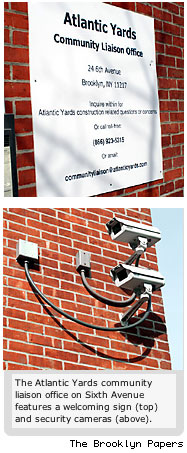 The Brooklyn Paper
By Gersh Kuntzman
Bruce Ratner wants to hear your complaints — and watch you make them.
The developer, who famously skirted the city’s rigorous public-review process in favor of expedited state oversight, just opened a “community liaison office” within the 22-acre Atlantic Yards footprint so that area residents can express their “questions or concerns” during the 10-year construction.
The office, in the old Spalding ball factory at the corner of Sixth Avenue and Pacific Street, has a welcoming sign and two not-so-welcoming surveillance cameras trained on the door.
The Brooklyn Paper received an auto-reply message when a reporter emailed the office, but a veteran Prospect Heights activist just walked right in.
Longtime Atlantic Yards opponent Patti Hagan visited the office this week said the worker there was “very friendly, though he didn’t have any answers.”
“I asked him about how the company plans to deal with all the traffic from all the construction workers’ cars,” said Hagan. “He wrote down my questions — and my name — and told me he’d get back to me in a day or so.”
Forest City Ratner’s spokesperson did not return calls.
Posted by lumi at 8:34 AM
Clarke meets with Barclays bigs
The Brooklyn Paper
By Dana Rubinstein
Rep. Yvette Clarke met with Barclays last week, the culmination of two weeks during which she slammed Atlantic Yards developer Bruce Ratner for naming his proposed basketball arena after a bank that profited from the slave trade, did business with apartheid South Africa, and froze Jewish bank accounts during the Holocaust.
Neither Clarke nor Barclays would comment on the meeting, which took place on Feb. 15. But, insiders speculated that Clarke was seeking more money from Barclays, which has pledged $2.5 million to fix up neighborhood basketball courts.
...
Forest City Ratner would not comment on the latest meeting.
NoLandGrab: Much is being made about the Ratner-Barclays deal, but there hasn't been any public discourse as to whether or not the deal would be more palatable if Barclays coughed up a bunch more money at the community. How much money would be appropriate for bygones to be bygones?
And has anyone asked how Clarke would manage to hold "Congressional hearings" on the subject?
Posted by lumi at 8:24 AM
Will Atlantic Yards Preclude the One Seat Ride to JFK?
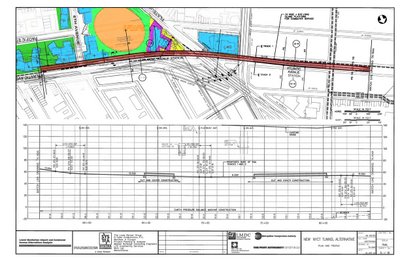 Upon consideration that Bruce Ratner's Atlantic Yards plan might render the possibility of a direct rail link from Lower Manhattan to JFK impossible because of reconfiguration of the railyard, Develop Don't Destroy Brooklyn ponders the comparison of the economic benefits between the two:
What about a cost-benefit analysis? Former Governor Pataki issued a statement in May 2004 claiming that "the rail link will result in an increased economic output of $6 to 8 billion annually, generated in Lower Manhattan and Brooklyn, and as much as $9 to $12 billion in the region as a whole.”
Even a fraction of that return (oh, we of little faith in touted public bonanzas) would render the steadily shrinking promised benefit from the "Atlantic Yards," um, how do we say... chump change.
Posted by lumi at 8:05 AM
Yards poster caper in Fort Greene
The Brooklyn Paper reports on Atlantic Yards supporters gone wild:
Two days before the screening, the owners of a Fort Greene bodega that had put up posters for the ["Brooklyn Matters"] screening reported a bizarre run-in with two diehard Atlantic Yards supporters, according to Fort Greene Association member Lucy Koteen.
“Two guys came by the bodega, tore down the posters on the outside and started kicking at the door,” said Koteen. “Then they came in and started screaming, ‘We need jobs!’ So the storeowners called the police.”
The shop-owners didn’t want the name or location of their store printed, for fear of retaliation. Nor did they ask for new posters to replace those torn down.
“And I wasn’t going to ask them to put up any,” said Koteen. “We don’t want any trouble.”
NoLandGrab: Note to supporters, intimidating store owners is not a respectable "job" (actually, neither is blogging).
Posted by lumi at 7:55 AM
Letters: Library responds to ‘censorship’ charge
Brooklyn Public Library Dir. of Programs and Exhibitions, Jay Kaplan, barks back and takes a swipe at NoLandGrab:
Our “Footprints” documentation of a current neighborhood was never intended to be the previous advocacy exhibition that was displayed in Prospect Heights. The works in our exhibition were selected because they are compatible with BPL’s documentary mission and its artistic standards. The few works in the previous show that were not included were either too large, required video installation, failed to meet artistic standards or were political cartoons.
Rather than exclude art, we included nine pieces that were never displayed in Prospect Heights. We also expanded our gallery space, which typically features 32 pieces, to encompass 54 pieces.
NoLandGrab: Kaplan also lobs a dud at "blogs written by artists who exploit the very institution that brings their art to BPL’s diverse audience."
We're pretty sure that he is referring to NoLandGrab, since photographer Amy Greer is our weekend contributor. However, Amy has tried to stay out of the fray and any commentary on the Footprints exhibit was penned by Lumi Rolley, who, though she likes to scribble on a note pad during endless community meetings, is clearly not an artist.
[For authorship info of any particular entry, please click the "Permalink" and scroll to the bottom.]
Truly, the Library should be commended for putting on the exhibit. However, the main criticism stands — by trying to enforce standards, they have compromised their own.
The Brooklyn Paper published another Atlantic Yards letter from Chris Owens, who ran against Yvette Clarke for Congress last year in the 40th District:
If Clarke, Jeffries and others had put Brooklyn’s interests first when it really counted, maybe Ratner would never have had the nerve to tread on Brooklyn as he continuously does. But that takes guts, not politics as usual.
The real issue is not Barclays — it is Ratner’s enduring disregard for Brooklyn in the name of profit. Maybe this is a wake-up call for some of our elected officials. Or maybe it’s time for new Brooklyn leadership.
Posted by lumi at 7:23 AM
Kidd & Carter stay put
 Thank goodness Jason Kidd will still be around to dish out Thanksgiving dinner photo ops and serve as a role model for Brooklyn's youth.
NY Daily News, Jason popular, but Carter's name lacking Magic
NY Daily News, Sticking with a special Kidd
Posted by lumi at 7:02 AM
Lehi project shares the Gehry 'look'
Deseret Morning News
By Amy Choate-Nielsen
Here's the idea: provide an iconic skyscraper, five-star hotel, upscale-but-affordable housing, sports arena, shops, restaurants, plenty of park space — and have it all designed by a world-renowned architect.
It sounds a lot like the proposed Frank Gehry project in Lehi, right?
It also sounds like the Atlantic Yards project in Brooklyn, N.Y., and the Grand Avenue project in Los Angeles, Calif., and the King Alfred project in Hove, England.
Those projects are also being designed by Gehry and, except for some specific details, they are surprisingly similar.
Aside from being met with some opposition from each of their surrounding communities, the projects outside Utah all feature hotel and residential towers, a mixture of retail, restaurants and entertainment, variations of a glass structure, upscale apartments and an emphasis on promoting an active, urban lifestyle.
And while coincidences among the projects could seem like some kind of architectural conspiracy, local entrepreneur Brandt Andersen, who commissioned Gehry to build his Point of the Mountain project, insists the similarities are purely happenstance.
"There are a lot of elements (of the projects) that are strictly coincidental, but there's no silver bullet there," Andersen said in an interview with the Deseret Morning News. "There's no smoking gun connecting them all."
A spokesman from Gehry's firm reinforced Andersen's statement, saying that glass is a common material that is used in contemporary architecture and the projects' likenesses are merely conceptual, not marketed copies of one design.
NoLandGrab: We don't know about the conceptual/design coincidences, but the marketing of the Brooklyn and Hove projects as being inspired by irrelevant female icons starts to smell like serial bad taste.
Keep reading the article because it gets funnier as the clients insist that their visions are "individually unique." Forest City Ratner recasts Atlantic Yards as "the result of years of discussion on how to address New York's housing crisis, according to a spokesman for Forest City Ratner Companies," and an architechture critic defends Gehry by noting "Mozart's music is pretty much the same, but it doesn't mean it's bad."
Posted by lumi at 6:28 AM
February 22, 2007
Landscape Architect Olin: streets are "useless"
From BrooklynSpeaks.net:
In a startlingly candid interview with the New York Observer (click here to read it), AY landscape architect Laurie Olin defends his superblock design for the project by declaring that space on streets is "actually useless space".
Olin was explaining why his design demaps Pacific Street: to maximize the amount of open space, and to keep cars out of the project area. Olin dismissed criticism that his design would create a superblock as "1960's language" and a "cliche".
BrooklynSpeaks explains how decades of evidence contradict the pronouncement of the esteemed landscape designer (no matter how badly he wants to believe that he's right), and outlines the differences between public streets and private parks.
NoLandGrab: Lost in the revision of the debate of Robert Moses vs. Jane Jacobs is one of Jacobs' primary, and perhaps most important, points.
During the early decades of the 20th Century, urban planners developed new planning principles that sounded good on paper, principles they believed would work because they said so. Jane Jacobs contended that this view was arrogant. Her groundbreaking premise was that the effects of organizing cities could and ought to be measured, and not merely surrendered to the latest trends proposed by urban planners. The planners at the time were schooled in principles that had a track record of being built, but not of accomplishing the goal of creating a more livable city.
In Laurie Olin's interview, he not only casually casts aside the more familiar Jacobsian notion that vibrant street life is essential for the urban environment to succeed, but ignores the more important message, that the effects of poor planning can be scientifically measured and that when data can demonstrate that an experiment is a failure, the mistake ought not be repeated.
This is not dogma; it's only proposition that we apply our best tool for understanding the universe, the scientific method, to the art and science of urban planning.
Posted by lumi at 8:04 AM
CE SOIR: Vous êtes vivement attendu au Salon des Refusés de las Bibliothèque de Brooklyn
 Come and see the SHOCKING and HORRIBLE work rejected from the ever respected BROOKLYN PUBLIC LIBRARY!
See the HORRORS of a PROHIBITION ERA PUB being threatened by EMINENT DOMAIN!
OPENING THURSDAY FEBRUARY 22, 2007 AT 5:30PM
Freddy's Bar & Backroom
485 Dean Street (corner 6 Ave and Dean)
http://www.freddysbackroom.com/art.html
If you have no idea what we're talking about, click here.
Also, one of Brooklyn's multi-talented bloggers will be performing on stage with the band, The Atomic Grind Show (downbeat, 9PM). Click here for The Atomic Grind Show
Posted by lumi at 8:00 AM
Not lost in gentrification
Artists make sure Brooklyn’s landmarks — and diversity — aren’t forgotten
MetroNY
By Nana Ekua Brew-Hammond
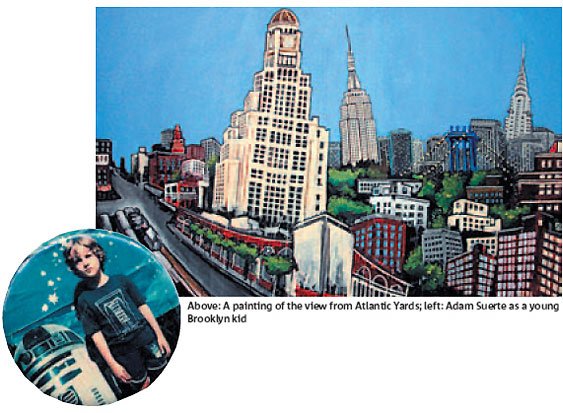 An artist who grew up in Brooklyn contemplates the changes in the borough that used to be his canvas and now is his subject:
“When I was growing up, there certainly weren’t places to show work,” [Adam] Suerte says. Now, instead of trooping his canvases to Manhattan galleries and art dealers, he can show his pieces at neighborhood spots such as two-level nightclub Sputnik, where he, photographer Keith Thomson, satirical cartoonist Willy Paredes and comic artist Omar Sanchez will be displaying their work in conjunction with BAM’s “Brooklyn Next” music festival. Paredes’ band Pagoda will perform before ceding the sound system to DJ Premier.
But on the other hand, with Brooklyn Borough President Marty Markowitz petitioning Mayor Bloomberg to tear down the Brooklyn House of Detention and developer Bruce Ratner’s plans to build 16 high-rises and an 18,000-seat basketball stadium for the New Jersey Nets, the Brooklyn that Suerte grew up tagging as a young graffiti artist and then documenting in paintings is slowly disappearing.
“You can see the clock tower … Chrysler Building and the Empire State Building all in one shot,” Suerte says of a view from Atlantic Yards where Ratner intends to erect the stadium. “It’s amazing, and it’s going to be gone.”
Posted by lumi at 7:30 AM
Beyond "Brooklyn Matters": compounding and complicating the indictment
Atlantic Yards Report
The documentary film Brooklyn Matters (click for future showings) doesn't claim to be comprehensive; rather, it's a powerful indictment . Still, upon another viewing of the film at Bishop Loughlin High School last night, I was reminded of two missing strands; one would have compounded the indictment, while the other would have complicated it.
Had Isabel Hill's camera captured the affordable housing information session held by Forest City Ratner and ACORN on 7/11/06, viewers might have seen a large crowd of working-class New Yorkers, mainly minorities, eager to gain access to subsidized housing, but dismayed that most would be either unaffordable to them and/or not available until the second phase, officially scheduled from 2010 through 2016.
Also, had a camera captured ACORN New York Executive Director Bertha Lewis at the housing debate held nearly a year ago, or in an interview longer than that in the film, Lewis might have made the point that Atlantic Yards promises more affordable housing than other developments in and around Downtown Brooklyn.
Posted by lumi at 7:28 AM
Challenging development, when you can afford a full-page ad in the Times
Atlantic Yards Report
"Why, now, is the government planning to pay for the construction of an overly expensive design to be occupied by government agencies at overly expensive rents, all at the expense of taxpayers' money which could be put to better uses?"
So asks the Continuing Committee for a Reasonable World Trade Center, in a full-page ad on p. B10 of yesterday's New York Times. That committee, run by "the developer Douglas Durst and the real estate investor Anthony E. Malkin" (in the words of the 2/13/07 New York Times), clearly reflects some self-interest.
It makes you wonder: what if some other developers felt threatened by the Atlantic Yards project? Might they be reflecting both self-interest and the public interest?
Posted by lumi at 7:18 AM
Atlantic Yards Anxiety
A posting from the Brownstoner Message Forum:
I'm about to bid on an apartment on Pacific Street in Boerum Hill...landmark block...and just realized that Atlantic Yards is only a half-mile away (2000 ft +/- according to googlemaps). I love the character of the neighorbood, but am anxious about the Nets arena crowds, and even before that, the constant flood of trucks there to do construction. Am I making a mistake?
Posted by anon at February 21, 2007 1:59 PM
No "anon," Bruce Ratner is making the mistake.
Posted by lumi at 7:08 AM
Kidd & Carter may be goners
It's deal or no deal today as Nets fall at home
NY Daily News
By the time today's 3 p.m. trade deadline passes, the Nets' 111-107 loss to the Hornets could be rendered meaningless, even though it cost them a chance to move closer to their goal of making the playoffs.
Without Jason Kidd or Vince Carter, the Nets will have no chance of making it anyway.
...
Another potential pothole on the way to any trade between the teams could be Bruce Ratner's fondness for Kidd.
From the Office of David Stern
NBA Teamowners, Tip-off of the Day:
Refrain from public display of fondness for players whose divorce papers are deemed salacious and explosive enough to appear on SmokingGun.com. Especially when your last former has-been all-star PR hack beat his wife too.
On another note, did anyone else notice that there were, like, dozens of fans in the seats behind the boards at last night's game?
Posted by lumi at 6:50 AM
Grassroots Media Conference
 Saturday February 24th
3:45-5:15 PM
The New School University Graduate Faculty Building,
65 5th Avenue (btwn 13th & 14th St.)
Panel discussion with Norman Oder of Atlantic Yards Report, Lumi Rolley of NoLandGrab and a spokesperson from Develop Don’t Destroy Brooklyn.
Moderator, Stuart Schrader, author of the blog "Picketing Henry Ford."
This panel will address the grassroots-media response to the Atlantic Yards project in Brooklyn. Though the response was not coordinated and arose organically, it can serve as a model for other communities and struggles facing a well-funded, sophisticated media machine. The project’s developer had access to many mainstream media, the opposition’s responses to it coalesced around websites, blogs, and message boards. This panel reveals the paradox of corporate message hypermanagement: although corporations and governments attempt to control every aspect of their public presentation in all media forms, the proliferation of media allow concerned citizens access to unavailable information, shedding light on the inconsistencies, distortions, and failures, as well as the strategy, of the message control. In the case of the Atlantic Yards project, an overarching message encouraged by the developer was race- and class-based divisiveness, and this panel will show how grassroots media can overcome divisiveness through rigorous analysis of such tactics.
More information at the Grassroots Media Coalition website.
Posted by lumi at 6:39 AM
Community Liason
The NoLandGrab Community Liason took this photo of the outside of the "Atlantic Yards Community Liason" office, which has a curious political statement above the buzzer.

Posted by lumi at 6:34 AM
February 21, 2007
ESDC being audited, but not over Atlantic Yards
Atlantic Yards Report
Charles Gargano, the former head of the Empire State Development Corporation, could be in some hot water for running the pubic authority like a "family business."
Norman Oder offers this analysis of the State Comptroller's ongoing audit of Gargano's reign and what might have been:
An inquiry in this case certainly seems legitimate. Then again, an inquiry into the ESDC's questionable Atlantic Yards fiscal impact analysis issued last December also would have been legitimate.
However, that's when Comptroller Alan Hevesi was negotiating his exit under a cloud of allegations and essentially crippled in his job. This audit was already ongoing.
Posted by lumi at 10:41 PM
Laurie Olin Report?
Atlantic Yards Report
Norman Oder checks Laurie Olin's math and reviews some of the designer's assumptions from the interview in The Observer.
Landscape architect Olin: project would take 20 years, Gehry would get help
No wonder why developer Forest City Ratner doesn't let architect Frank Gehry and nor (apparently) let landscape architect Laurie Olin meet with members of the public concerned about Atlantic Yards. The artists are just too candid.
Gehry admitted, in January 2006, that "we're out of whack" with the scale of the project. (He was back on message by May, decrying protesters as people who "should've been picketing Henry Ford.")
Now, in a New York Observer story this week by Matthew Schuerman, Olin projects that the development would take twice as long as projected and that Gehry, would not design the whole thing.
Laurie Olin's bad math: AY would be way more dense than Europe
One of the weirder pronouncements by Laurie Olin was, "Americans are frightened of density. Europe is not.”
Oh yeah? According to Norman Oder, "he's ignoring the fact that Atlantic Yards would be way more dense than Europe."
And he's ignoring the fact that Atlantic Yards would be way more dense than Europe. The Observer's Matthew Schuerman last year calculated that the density at Atlantic Yards would be "between 436,363 and 523,636 people per square mile." (Actually, the lower figure is probably a little high by now, given slight cuts in the residential density.)
And what does Paris, the densest city in Europe, look like? A 1999 statistic says 63,298 residents per square mile. Another stat from Britannica (also apparently 1999) says similarly. The core of Paris is low-rise; the "extreme density" of Paris occurs in the high-rise suburban towers for the poor, the locus of social dysfunction.
Posted by lumi at 10:07 PM
This Guy Wants You to Love Atlantic Yards
Laurie Olin, the landscape architect behind Battery Park City and Bryant Park, faces a tough challenge in central Brooklyn. Not that he’s worried.
NY Observer
By Matthew Schuerman
 Laurie Olin sez, "Americans are frightened of density. Europe is not.” Has anyone told Olin that Atlantic Yards would eclipse the density of European cities, except for maybe the project outside of Paris?
The Observer sits down with Ratner's landscape architect (also known as the guy brought on board to harmonize Gehry's work to the neighborhood). Here are some really choice quotes:
“Holy smokes! That many thousands of people in such a tight space, and to try to give them something wonderful that they’ll love. That’s fun. It’s hard, too.”
“It’s a great project, if it all happens,” he said. “The time calendar we are talking about is probably 20 years. People say 10 to 15, but take a look. How long does it take the market to absorb that much stuff?”
“Various architects who have specialized in doing residential towers will probably be brought in to be the architect of record anyway, even if design architects like Frank Gehry or other personalities give image and shape to them,” Mr. Olin told The Observer.
Of course, these could just be the musings of a dotty old designer, because Forest City Ratner's Jim Stuckey says otherwise, and you know Stuckey never lies:
“Laurie has his views,” countered Jim Stuckey, executive vice president of Forest City Ratner. “We don’t believe it is going to take 20 years. We expect that it will take 10.” He added, “Frank Gehry will be the architect on every one of them.”
NoLandGrab: At this point, only Ratner spokespersons seem willing to insist that Atlantic Yards might only take 10 years to build.
Posted by lumi at 9:29 PM
Forest City Ratner establishes "Community Liason" office
Brooklyn Speaks expresses some serious concerns about the "Community Liason" office:
With some environmental remediation now beginning on the AY site, FCR has established a "Community Liaison Office" for the project. A sign posted outside the office - located in the former Spalding building at 24 6th Avenue - invites members of the public to "Inquire within for Atlantic Yards construction related questions or concerns" or call 866 923-5315.
Interestingly, the sign doesn't clearly indicate that the office has been established by Forest City Ratner. And there's the crux: the government seems to be entrusting a private developer that's ultimately answerable to investors with the responsibility to manage the concerns of the community, rather than a public entity that's responsible to the public.
Posted by lumi at 9:25 PM
Blight Me? Blight You!
Curbed.com
 Columbia University students say, "Blight me!" at yesterday's on-campus protest:
Columbia student Rowan Moore Gerety explains "The lawn over there has been seized and declared blighted. It was not being fully utilized." Columbia admins were well aware of the protest and found the comparison between a manicured campus meeting area to West Harlem mildly befuddling, with spokeswoman La-Verna Fountain saying "I don't know how you can compare that." Crusty old deans.
Posted by lumi at 8:45 PM
Kidd, Carter, and the flexibility of the AY permanent campaign
Atlantic Yards Report
New Jersey Nets stars Jason Kidd and Vince Carter have been front and center in promotional efforts to support the Atlantic Yards project. At the press event held before the 8/23/06 public hearing on the project, both stars appeared, and Carter offered this bromide: “I feel it’s all about unity in the community.”
Both also appeared on the dais for the Barclays Center naming rights extravaganza held a month ago, on 1/18/07.
Now, however, the value of Kidd and Carter as props may be outweighed by the cost of losing Carter without a trade and the cost of bad publicity surrounding Kidd. (On Saturday, news that, in her divorce filing, Kidd's wife Joumana had accused him of serial adultery and further physical attacks made the front page of both the Daily News and the Post.)
Posted by lumi at 8:41 PM
Atlantic Yards: Breaking Old Ground
Brit in Brooklyn (not to be confused with Englishman in New York) posted his own photos workers at the Vanderbilt railyards:

Work began this morning on the 'demolition' of the old bus depot in preparation for the Atlantic Yards development. Not that there was much to demolish but there was a hole to be dug through the stubborn surface.
NoLandGrab: Hopefully, this isn't the part where they are supposed to "remove contamination," as reported by WNYC.
Posted by lumi at 10:37 AM
Business: Atlantic Yards Project Starts
Special To The Black Star News
Here's a funny one, this "Special to The Black Star News" ["New York's Leading Investigative Newspaper"] is in reality a reprint of Forest City Ratner's press release touting the contracts with women- and minority-owned firms to clear buildings from the footprint, prep the railyard and build Atlantic Yards.
It is "special" because, as far as we can tell, they're the only "newspaper" to carry the press release verbatim, including email address for the "Atlantic Yards community liason."
Prep work and construction of a temporary rail yard on the east side of the Vanderbilt Rail Yard started this week, Forest City Ratner Companies (FCRC) announced.
The Atlantic Yards development in Brooklyn is a residential and commercial development, including over 2,200 units of affordable housing and the future home of the Nets basketball team, all designed by world-class architect Frank Gehry.
In keeping with the Community Benefits Agreement (CBA), a voluntary and legally binding agreement signed by eight local community groups and ratified by over 200 community groups and leaders, the first contracts of this initial work, worth more than $600,000, have been awarded to minority- and women-owned (M/WBE) firms.
Click here to read the rest of the Forest City Ratner press release brought to you by The Black Star News.
NoLandGrab: They might think of changing their motto from "Speaking Truth To Empower" to "Speaking BRUCE to Empower."
Posted by lumi at 10:04 AM
Will “Atlantic Yards” Kill the JFK-Lower Manhattan Rail Link?
From StreetsBlog:
Jonathan Cohn at BrooklynViews is reporting that the current plan for Forest City Enterprises' Atlantic Yards development in Brooklyn appears to preclude the possibility of someday building one of the Pataki Administration's favorite regional transit projects, the fabled "one seat ride" rail link from Lower Manhattan to JFK Airport (and Long Island). Perhaps some of the transportation pros and policy wonks here on Streetsblog can shed some light on this.
Posted by lumi at 9:45 AM
Ratner's reign
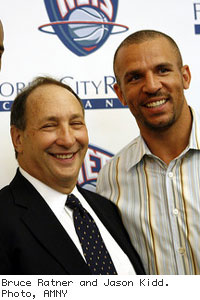 With rumors flying that, though Jason Kidd is Bruce Ratner's favorite son, Kidd might be traded to a team like the Lakers, we'd like to make one point:
NJ Nets Pre-Bruce Ratner:
2001-02 Eastern Conference Champions
2002-03 Eastern Conference Champions
Post-Bruce Ratner:
2003-04 Lost Eastern Conference Finals
2004-05 Swept in First Round of Playoffs
2005-06 Lost in 2nd Round of Playoffs
2006-07 25-29
If Bruce Ratner does for Brooklyn what he's done for the New Jersey Nets, look out.
Here's some coverage about the trade and rumors that revelations of Kidd's serial philandering and spousal abuse might force Ratner to trade him:
The Newark Star-Ledger, Don't leave the fans nothing to watch
If Ratner trades Kidd, columnist Steve Politi request that the Nets "leave":
Pack up the Mayflower vans. Take Sly the creepy fox mascot, take the Nets Dancers and Team Hype, take Jay-Z and Marv Albert and anything else not bolted to the ground and get this Dead Team Walking to Brooklyn immediately, because the fans here should not have to suffer through happens next.
The NY Times, Nets Working to Find a Way to Trade Kidd
According to one Eastern Conference official, the Nets’ owner, Bruce C. Ratner, was concerned about the negative publicity surrounding Kidd’s contentious divorce from his wife, Joumana. But Ratner is said to be close to Kidd. He also has an affinity for Carter, who helped rescue the Nets two seasons ago in the wake of the franchise’s letting go of Kenyon Martin.
NoLandGrab's unsolicited fashion tip for Bruce Ratner:
Yo Bruce! The point of removing your glasses during a photo op is that you think you look better without them. But if you're going to squint like the sun just hit one of Frank Gehry's titanium panels, then just forget it.
Posted by lumi at 9:30 AM
Atlantic Yards Construction Begins
 Yesterday's news blurb from WNYC made the same mistake as The NY Times and NY1 by repeating that the City approved the Atlantic Yards plan:
Workers are expected to begin construction on the Atlantic Yards project in Brooklyn today. Crews are planning to remove contamination from a bus depot before they demolish it.
The city and state approved the massive project, in spite of opposition from residents.
More proof that the mainstream media needs a long vacation:
The Atlantic Yards project was shepherded and "approved" by NY State's Empire State Development Corporation and received final approval by the Public Authorities Control Board. Neither the NYC Council nor the Mayor has any representation in either body.
Just because the Mayor and Borough President really, really like this project, doesn't mean that the "City" "approved" it.
It would be a miracle, after three years, if the dumbass press corps got sick of being spun by Ratner. Yeah, we're cranky, but you would be too, if you spent the last three years wiping their butts.
Posted by lumi at 9:00 AM
Eye on New York Photos: Atlantic Yards protest
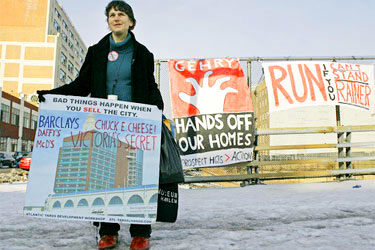 AM NY
AM NY
Photos, Kathy Willens, AP
Prospect Heights' activist-extraodinaire Patti Hagan made the homepage of the online edition of AMNY.com.
Protester Patti Hagan, a neighbor, stands on a bridge above as construction begins at Forest City Ratner's Atlantic Yards project beneath her in Brooklyn.
Click here for the slideshow of AM NY's collection of photographs covering Atlantic Yards, including photos of workers and a surveyor.
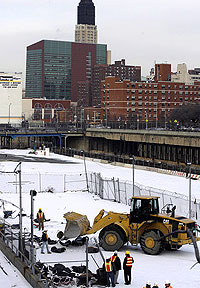
Workers begin construction on the eastern edge of Forest City Ratner's Atlantic Yards project in New York.
Posted by lumi at 8:32 AM
B'KLYN ARENA IS UNDER WAY
NY Post
By Rich Calder
Bulldozers and jackhammers broke ground on Bruce Ratner's $4 billion Brooklyn Atlantic Yards project yesterday - preliminary work to make way for a new NBA arena.
Posted by lumi at 8:26 AM
Forest City Works, But Does Not Own
The Real Estate Observer
Reporter Matthew Schuerman confirms that Ratner is starting work on the Vanderbilt Railyards before actually closing the deal with the MTA:
Forest City Ratner still does not own the 8-acre rail yard that will form the backbone of its Atlantic Yards project, but that did not keep the company from starting "preparatory work" on Tuesday.
The developer agreed to buy the property from the M.T.A. back in September 2005 for $100 million, but there are some "technical issues" that have yet to be resolved before closing the deal, M.T.A. spokesman Sam Zambuto told The Real Estate.
"At this point, there is no time-frame set for closing the deal," he said.
...
Though the deal hasn't closed, and the MTA claims that there is no timeframe, the MTA spokesman called back to add that there is nothing in the deal that would preclude both parties from closing before lawsuits were resolved.
Posted by lumi at 8:21 AM
It came from the Blogosphere...
 Daily Intelligencer, Bruce Ratner Swings His Ball
Depending on your point of view, this is either an uplifting bit of symbolism or the rough equivalent of Bambi's mother getting shot by hunters.
...
The first of today's several (by 9:05 a.m.) Daniel Goldstein press releases condemns "premature … demolition of one building for the developer's 'Atlantic Yards' project in Prospect Heights and Park Slope, Brooklyn." Goldstein, of course, is indulging in a bit of rezoning himself: It takes a certain stretch of imagination to place Atlantic Yards in Park Slope.
NoLandGrab: Sorry "Intelligencer," check your intel — the western portion of the project has its own military-ops-like code name, "Site V," and it IS in Park Slope.
Curbed.com, First Wrecking Ball to be Swung at Atlantic Yards
The one website who would rather be snarky than relevant quipped:
In what is surely the most dramatic Tuesday in Brooklyn since, like, Junior's ran out of strawberry cheesecake or something, preliminary work on the Atlantic Yards megadevelopment is scheduled to kick off today.
Brownstoner, Wrecking Ball Gets Rolling on Atlantic Yards
Brooklyn Record, One Restaurant To Survive AY Demolition
Gothamist, Atlantic Yards Construction to Start...But Should It?
The Gowanus Lounge, Ratner Starts Prep Work for Atlantic Yards
Daily Intelligencer, Atlantic Yards Begins Not With a Bang But With a Bulldozer in a Snowy Lot
Fischler.org, Forward march at the Atlantic Yards
Really, I’m trying to look on the bright side here….
Posted by lumi at 7:32 AM
Democracy Now!? For Whom!?
Don't Worry It's Just Reality
 The hypocrisy of Michael Ratner really gets under "Dreadnaught's" skin. His latest case in point concerns the Lefty lawyer, Democracy Now and surveillance cameras.
Democracy Now - an organization with close ties to Michael Ratner, - main index page had a spot showing security cameras.
It bears a striking resemblence to some of Bruce Ratner's handiwork around the 'footprint'
Posted by lumi at 7:20 AM
February 20, 2007
Construction Begins On Atlantic Yards Project
NY1 reports one additional detail about the "construction" that is starting today attributed to Ratner's development company:
Forest City Ratner says the first project will be the decontamination of a bus depot, which will then be demolished.
A temporary Long Island Rail Road yard will go in its place, so that a giant platform can be built above the permanent rail yard which will support much of the $4 billion development.
The report also makes the same mistake The Times does, claiming that the City and State approved the project. This indicates that either NY1 took its cue from the one-paragraph item in today's Times, or Forest City Ratner is feeding that information to an unwitting press corps.
Posted by lumi at 11:44 AM
Press Release, DDDB: Wishful Digging
Ratner Prep Work for Atlantic Yards Project Premature
Developer’s Project Not Viable With Federal Eminent Domain Suit Pending
BROOKLYN, NY—Forest City Ratner announced the beginning of preliminary work on the Vanderbilt rail yards and demolition of one building for the developer’s “Atlantic Yards” project in Prospect Heights and Park Slope, Brooklyn.
The prep work is clearly premature, as Forest City Ratner does not own the rail yards necessary to construct the 8 million square foot project and they do not own the properties necessary to build the arena or to demap streets to build high-rise superblocks. That is because 13 of the property owners and tenants who live and work in the project site are in federal court to protect their rights and their properties from government seizure by an abusive use of eminent domain that they allege violates the United States Constitution. The developer’s ownership of the rail yards is contingent upon the outcome of that lawsuit.
“The ’Atlantic Yards’ project as we know it is not viable. The properties Ratner needs to construct the mammoth project's arena and superblock towers, including the rail yards, are in the hands of other private owners and the MTA,” said Develop Don’t Destroy Brooklyn spokesman Daniel Goldstein. “The prep work Ratner announced today is premature, and a scare tactic used against the eminent domain plaintiff residents and the community fiercely opposed to the project, and as a public relations gimmick intended to convince his investors that work is moving forward. Don't be fooled: while preliminary work on his project can start, Ratner’s ability to move forward and finish the project is under judicial review in federal court.”
Posted by lumi at 7:53 AM
Brooklyn: Atlantic Yards Construction to Begin
The NY Times
By RICHARD PÉREZ-PEÑA
 From Metro Briefs:
Construction crews were expected to take the first steps today toward building the huge Atlantic Yards project near downtown Brooklyn, according to an aide to Bruce C. Ratner, the developer. The first stages of the work will involve subcontractors removing contamination from a bus depot, then demolishing that structure. Forest City Ratner Companies will build a temporary Long Island Rail Road yard in its place, so that a giant platform can be built above the permanent rail yard to support much of the $4 billion development. The city and state approved the project despite heated opposition from residents who said it would overwhelmingly congest the local streets and transit system. The development will include thousands of apartments, commercial buildings, a hotel and an arena for the Nets, the basketball team Mr. Ratner owns.
NoLandGrab: No mention of the eminent domain lawsuit, which is understandable, since The Times never bothered to cover the eminent domain hearing two weeks ago.
The Times coverage is a BIG pr coup for Forest City Ratner, since readers now know "Atlantic Yards Construction to Begin," but have no clue about a lawsuit that might stop the project in its tracks.
Geez, it really, REALLY is beginning to look like the business relationship between The NY Times and Ratner is affecting the coverage in the news room.
CORRECTION: The City never approved Bruce Ratner's Atlantic Yards plan, which went through the New York State land review process. [Let's see how long it takes The Times to run the correction.]
UPDATE, 02/26/07: Six days — it takes six days for The Times to research the fact that Atlantic Yards never went through a city approval process.
Posted by lumi at 7:39 AM
Developer gets the ball rolling on Nets arena construction
NY Daily News
By Rachel Monahan
The News brings you the developer's spin on today's news from an unnamed "source," jobs for women- and minority-owned firms:
The Brooklyn Nets arena has finally got game.
Construction begins today on the MTA's Atlantic Yards, over which the arena is to be built, said a source familiar with development plans.
"It is the first work that's being done on the yards and ... the first step toward the project," he said.
A. Russo Wrecking is to begin demolishing a bus depot to create a temporary railyard on the eastern edge of the project, developer Forest City Ratner is expected to announce today.
The wrecking company won one of the largest of the more than $600,000 in initial construction contracts awarded to female- and minority-owned businesses.
"We signed a community-benefits agreement, and this is obviously part of that, and something we're very proud of," the source said.
MESSAGE OF THE DAY:
This women/minority-owned demolition is brought to you by the letters F, C, and R and the number, "600,000."
Posted by lumi at 7:34 AM
B'KLYN ARENA TIP-OFF
BREAKS GROUND TODAY
NY Post
By Rich Calder
Brooklyn developer Bruce Ratner is expected to finally break ground today on his controversial $4 billion Atlantic Yards project, The Post has learned.
Preliminary work on the 22-acre Frank Gehry-designed development - which is to include an NBA arena for Ratner's Nets and 16 skyscrapers filled with residential and commercial space - will quietly kick off without fanfare along the Vanderbilt Rail Yard off Atlantic Avenue, sources said.
...
The first job calls for building a temporary parking area for trains on the east side of the yard so that existing LIRR trains could be moved from the west end, which must be cleared so that construction on the $637 million Barclays Center basketball arena could begin in September.
...
The first work on Brooklyn's biggest development in decades includes more than $600,000 in contracts awarded to minority- and women-owned companies as part of a Community Benefits Agreement reached by Ratner and government bosses.
NoLandGrab: "Will quietly kick off without fanfare?" That must be what "sources" said, because there's nothing quiet about this very calcuated pr barrage.
Some reporters really resent being used as an advertising medium, but Barclays Bank is starting to get its money's worth when the Post reporter uses the bank's name for a building that doesn't even exist.
Also, the Post reporter really gets it wrong when he gives credit to "government bosses" for the Community Benefits Agreement. The government has nothing to do with the CBA other than Mayor Bloomberg signing as a "witness." But the Post is just a newspaper, so we don't expect them to know facts.
Posted by lumi at 7:17 AM
Ratner starts to build
Despite court battle, Atlantic Yards project expected to start today
MetroNY
By Amy Zimmer
Though lawsuits against Forest City Ratner’s Atlantic Yards project are pending in the courts, construction crews are expected to kick off the prep work today needed for the first phase of the $4 billion development that includes an 18,000-seat arena for the Nets and the residential tower architect Frank Gehry calls “Miss Brooklyn.”
A temporary rail yard will be set up on the eastern side of the Metropolitan Transportation Authority’s tracks — where buses are currently stored — to allow Forest City Ratner to build the arena on the western portion of the yards, according to a source familiar with the project. The developer expects “to begin working on the arena in the fall of this year,” said the source.
Despite the MTA’s agreement to sell the yards to Forest City Ratner, no lease has yet been signed.
The source said the developer had a license agreement with the authority to allow for the construction. MTA officials were checking yesterday to confirm this agreement, but did not before press time.
Develop Don't Destroy Brooklyn noted the confusion at the MTA over their agreement with Ratner (link):
It also sounds like the Kalikow MTA didn't brief the Sander MTA on the terms of ths deal.
Posted by lumi at 7:09 AM
Will Atlantic Yards Preclude the One Seat Ride to JFK?
 A MUST-READ FOR YOU PLANNING AND TRANSPO GEEKS OUT THERE (AND CITY EMPLOYEES TOO!)
Brooklyn Views wonders if the current plans for Atlantic Yards might preclude an AirTrain link from Lower Manhattan to JFK (one of the region's top priorities for transportation infrastructure):
While no one seems to know exactly how to find the holy grail of Lower Manhattan development - the one seat ride to JFK airport (or, as some say, the commuter rail link from Long Island to Lower Manhattan) – there is no shortage of ideas.
...
We have no reason to believe that the current plan for Atlantic Yards is making any provision for the rail link. The MTA’s belated Request for Proposals for the disposition of Vanderbilt Yard indicated that the only operational issues that need to be considered are to provide additional storage; it made no mention of accommodating a possible future rail link. And in the Memorandum of Understanding between Forest City Ratner and the MTA, the required ongoing operational functions of Vanderbilt Yard are listed, but there is no mention of intent to provide for a future rail link. The only mention of the rail link in the EIS came in responses to questions, which basically state that the link was not studied since it will have its own EIS (Responses 29, 13-42).
While the Mayor is hotly pursuing his NYC2030 campaign and the resurrection of Robert Moses is on everyone's lips, Bruce Ratner's Atlantic Yards plan gets the right of way. Learning from Brooklyn Views and Robert Moses:
And here’s the thing: If the purpose and need of the Atlantic Yards project is that it will be so great for the region, so great that we should ignore the local neighborhood whining about density and such, why is there no transportation plan associated with it? While we’re rediscovering Robert Moses, let’s recognize what it was about big plans that helped the development of the region: Robert Moses realized that transportation was key. He opposed creating a venue event that would stop-up the flow of traffic in this area.
Posted by lumi at 6:48 AM
Marty said “get real” on traffic/parking, but ESDC didn’t agree much
Atlantic Yards Report
 Borough President and Cheerleader-in-Chief Marty Markowitz declared at last August's hearing that it was time to "get real" about traffic. Did the Empire State Development Corporation listen? Norman Oder finds out:
Out of 16 comments about traffic, transit, and parking his office submitted on the Atlantic Yards Draft Environmental Impact Statement (EIS), the Empire State Development Corporation (ESDC), by my count, said no to 12 and yes to two. The ESDC offered a partial yes to one comment and declared another not their issue. (Arguably, some of the "no" answers were outside the ESDC's bailiwick, as well.)
And Markowitz is the borough's cheerleader for Atlantic Yards. Tougher critics like Community Consulting Services fail the ESDC's review for ignoring or downplaying numerous issues--such as congestion pricing--that Markowitz didn’t even bring up.
Here's the list: * Downtown traffic calming? Not incorporated * Additional intersections? Nope * Closed-circuit TV monitoring? No * Expanded study area for parking? No * Permit parking? Not necessary * Free parking for residents who lose spaces? No * Studies to monitor traffic conditions? Sort of * DOT simulation? It’s up to them * Market testing? Yes * Subway guidelines change? No * Trolley loop? Nope * Bus rapid transit? Not yet * Transfer connection? No * LIRR train frequency? Nope * ADA compliant? Yes * Through ticketing? No * Pedestrian safety study? No
Posted by lumi at 6:30 AM
Group looks to ‘blight’ Columbia plan
Students, tenants say West Harlem project being developed in secret
MetroNY
By Amy Zimmer
COLUMBIA UNIVERSITY. A group of students unfurled a large banner on a snowy patch of the main campus with the word “blight” written in red. It was a gesture of solidarity by the Student Coalition on Expansion and Gentrification with community members who they then shared the microphone with at a press conference denouncing the university’s plans to develop 17 acres in West Harlem.
Several residents and business owners in that zone are worried the state may designate the area as blighted to seize their property, making way for the $7 billion 30-year plan. Though Columbia has agreed to negotiate a “Community Benefits Agreement” with the West Harlem Local Development Corporation — a group of public housing residents, businesses and elected officials — SCEG members such as Rowan Moore Gerety remain skeptical.
“There’s been a lot of concern about the lack of transparency,” Moore Gerety, a Columbia senior, said. “Being that this is the only legally binding agreement [for the community], we’re concerned they’re going to negotiate in private sessions without public comment.”
Snarky student "press release" after the jump.
FOR IMMEDIATE RELEASE: the Universal Institute for the Public Good condemns a Columbia University Lawn as blighted due to unsanitary, ill-maintained conditions, and chronic under-use.
Just a few moments ago, representatives of the Universal Institute for the Public Good arrived at the old South Lawn recreational zone bearing “BLIGHT” notices and cease-and-desist orders against Frisbee throwers, midday revelers, and scholarly picnickers, informing them of the Institute’s plans to take over the area in order to promote the public good, as defined, of course, in the Institute’s own mission statement.
Through the proxy exercise of the power of Eminent Domain, the Institute has begun to carry out its plans to revamp this old recreational zone, saving it from the dilapidation and disease that its primary under-users appear not to have noticed.
Indeed, despite daily excursions onto the Lawn by soccer players of all stripes and ambling toddlers chasing balloons, the Institute believes that their plan for the construction of a gazillion dollar Center for Research on the Alleviation of the Negative and the Promotion of the Positive, Broadly Construed, will revitalize this defunct area.
This latest move comes after years of gradual acquisition of the area by the Institute, which has taped off an increasingly large swath of the field and forbidden any activity on it in order to ensure that its utility is maximized.
In the future, people who had hitherto used this space for the advancement of nothing but their private athletic, spiritual, and recreational pursuits, will be able to participate in the massive efforts of research and production of the Positive that are to take place there. The Institute, does not, as of yet, have plans for alternative facilities for kickball, afternoon snacking, siestas, or T’ai Chi, but it has assured all participants in the aforementioned activities that the old recreational zone of South Lawn will remain a wonderful place for them when it houses their silver bullet Center. The new Center for Research on the Alleviation of the Negative and the Promotion of the Positive, Broadly Construed, will create new means of recreation that will eradicate existing blight and uplift those who have been consistently under-using the small portion of the old South Lawn recreational zone to which they had been confined.
The Institute welcomes any input or concerns that current under-users and contaminators may have, and recommends that they contact Nobody Jones of the Institute’s Office of Goodness between 28 and 29 o’clock every Moosday and Lunday.
Posted by lumi at 6:20 AM
February 19, 2007
Suits won't stop Atlantic Yards [But maybe slacker activists might?]
From Crain's Insider (link, subscription required):
Pending lawsuits against Atlantic Yards will not stop Forest City Ratner from proceeding with the Brooklyn project, a company source says. Architect Frank Gehry is revising his design to reflect the compromise that won state approval for the $4 billion mixed-use development. When he's finished, site work will begin.
Two businesses and 26 residents in the project's footprint have asked a federal court to declare that the eminent domain condemnations are unconstitutional.
NoLandGrab: Suits won't stop Ratner from TRYING to build Atlantic Yards by demolishing buildings and starting some preliminary work, but they could keep Ratner from finishing.
Develop Don't Destroy Brooklyn explains:
Here's the real deal. Forest City Ratner certainly can start prep work on the properties they own but they do not own the properties necessary to build the arena or to demap streets to build superblocks; this means that the project as we know it is not viable. That is because 13 of the property owners and tenants are in federal court to protect their rights against a use of eminent domain that they allege violates the United States Constitution.
Additionally Forest City Ratner does not own the rail yards (known as the Vanderbilt rail yards.) The signing of the contract selling the yards to Forest City Ratner (FCR) from the MTA is contingent on outstanding lawsuits like the eminent domain suit.
Posted by lumi at 10:09 AM
Michael Ratner endorses DDDB over BrooklynSpeaks (not quite)
 Atlantic Yards Report channels Bruce's bro, Nets investor and constitutional rights champion Michael Ratner, to settle the question once and for all: DDDB or Brooklyn Speaks?"
One lingering question in the Atlantic Yards saga is whether the generally hard-line opposition and legally focused battle by Develop Don't Destroy Brooklyn (DDDB) is a wiser tactic than the lobbying effort by BrooklynSpeaks to change the project.
...
An interesting perspective, and an implicit encouragement for a hard-line approach to contested issues, comes from human rights lawyer Michael Ratner of the Center for Constitutional Rights (CCR).
Sez Michael Ratner, to the Columbia U alumni mag:
"What I believe is simple: Social change comes through principled opposition to the worst excesses."
NoLandGrab: Any chance that the hefty "Lefty" has written a fat check to DDDB recently from "his" "office" at Metrotech?
Posted by lumi at 9:08 AM
The Art the Brooklyn Public Library Does Want You To See
Englishman In New York
Paul Berger, the freelance journalist who wrote the article in yesterday's NY Times City section about the Footprints exhibit controversy at the Brooklyn Public Library, posted outtakes on his blog:
Since the development is controversial and since the library’s decision to exclude some works has proved controversial, I expect that my story will come in for criticism too. So be it. However, there are a couple of things I would like to add, since the 450 word count for the Times story was a constraint.
...
However hard the library might have tried to exclude works that it deemed too political the sum total of the exhibition is to leave the visitor—or this one at least—with the depressing impression that if the development goes ahead all of the people and places featured will be gone.Another aspect missing from today’s story is the image of the picture above. In my story I mention that the painting Console Yourself, by Aisha Cousins, is included in the exhibition, but the impact of the work is only clear if you can see it for yourself.
...if the library was willing to show the picture above, why not show Donald O’Finn’s collage of the arena as a gigantic, glowing toilet?
NoLandGrab: The point about "controversial" works slipping through, while others were excluded has been made by us and Norman Oder as well, which makes one wonder why the library even tried to make a distinction.
Posted by lumi at 8:48 AM
Copacabana up-in-arms over forced move
AM NY
By Farnoosh Torabi
"The hottest spot north of Havana" is likely moving farther uptown.
Through eminent domain, the city is evicting The Copacabana from its current leased location on 550 W. 34th St. to make way for the No. 7 subway line extension. The 75-year-old hip-hop and salsa club must vacate by July 1. It's been at the 34th Street location since the early 1990s.
"I'm furious, to say the least," said Copacabana owner John Juliano, who's managed the club for more than 30 years.
...
The owner is also upset about moving because he suspects The Copacabana -- a historical, social and cultural destination in New York, with distinguished visitors from Frank Sinatra to the Clintons -- will get replaced by upscale residential units."The Latin community is very upset," Juliano said. "The city just throws you out on the street, and they call it progress ... so some rich real estate mogul can put up a high-rise."
Some property-law attorneys argue that eminent domain law -- the right for the government to seize private property for public projects -- has been watered down. They also say individuals and business owners face a higher risk of eviction by the city.
"[Eminent domain] used to just happen for true public purpose reasons," said Michael Rikon, an attorney with Goldstein, Goldstein, Rikon & Gottlieb. "Now, [New York] has some huge condemnation proceedings, which are economically driven. Like in Brooklyn, there's a huge project for the Nets stadium and luxury housing."
There's also a sidebar Q&A with prominent eminent domain attorney Michael Rikon.
Posted by lumi at 8:31 AM
Barclays of America? shooting hoops in Brooklyn
LANzen Blog
By Neil Robinson
A British business blogger shares his insight into the Barclays naming rights deal.
No sooner had the dust settled on the recent rumours of a Bank of America takeover, Barclays has put Wall Street queuing up for tickets to its next game. In Atlantic Yards.
Barclays, one of the UK’s biggest banks, is looking Stateside for its next step up the global banking banking ladder.
...
Unlike a once-a-year benefit like a marathon, a constant brand reminder like a stadium deal places the Bank’s profile in the league of CitiGroup, who sponsor the New York Mets. CitiGroup are the world’s biggest bank.
...
However, Barclays will be keen to distance themselves from any association with the controversial “Land-Grab” inflaming New Yorkers over the planned re-development of Brooklyn. Brooklyn is traditionally a lower income area and not everyone’s happy. There is an active “Develop, Don’t Destroy” campaign gaining popularity.If Barclays get caught up in this and the brand is damaged rather than enhanced, could it make them a target for Bank of America’s attentions once again?
Posted by lumi at 8:25 AM
NBA moves to Bklyn beat - Local drumline is tapped to play all-star showdown
The Courier-Life Publications
By Lesley Grimm
For their yearly All-Star blowout, the NBA handpicked an A-list line-up of entertainment: Christina Aguilera, Toni Braxton, Mary J. Blige – oh, and a group of Brooklyn teenagers!
Yes, these youngsters are packing their drumsticks and heading to Las Vegas where they’ll rub shoulders with celebrities and basketball elite.
The group – known as the Nets Drumline – was specially selected to hammer out its trademark show at a host of flashy NBA events, including Sunday’s All-Star match-up.
...
To celebrate the drumline’s national recognition, Nets’ owner and mega-developer Bruce Rater has donated $10,000 to BMAP.
...
The Nets Drumline will perform at a host of competitions and promotions beginning on Friday, and culminating with Sunday’s 56th NBA All-Star Game.All events will be televised nationally on TNT.
Posted by lumi at 7:55 AM
Las Vegas: the final frontier
NBCSports.com
By Frank Isola
The league keeps waiting for the New Jersey Nets to make a big move. GM Rod Thorn is contemplating a move that would send Jason Kidd to the L.A. Lakers. But owner Bruce Ratner and Thorn are having second thoughts about trading the face of their franchise.
NoLandGrab: A sign of how freakin' tone deaf the NBA is about the conduct of its players — Caring Bruce and Rod Thorn should be more concerned about SAVING "the face of their franchise."
Kidd probably won't be rolled out again as a role model for kids in Brooklyn any time soon, that is, unless folks are adding philandering and domestic abuse to their kids' list of future accomplishments (see The Smoking Gun, "Wife: Jason Kidd A Serial Abuser, Adulterer").
Posted by lumi at 7:38 AM
Celebrity Vegas Overload: Diddy, Jay-Z, Kobe, Shaq and More, More, More Stars Plus Illegal Parties Fallout
VegasPop
By Robin Leach (yes, "The Robin Leach")
Jay-Z, "king of entertainment," and LeBron James, "king of sports," will take over the 42,000 square-foot TAO restaurant and nightclub tonight to co-host a private "power dinner" that will consist of a who's who in the entertainment and sports industries...
Topping the A-list is Jay-Z's partner, our favorite mogul, affectionately known as "king of Kings," and "the biggest guy around," Cleveland's favorite son, Caring Bruce Ratner.
NoLandGrab: Could Ratner be in Vegas during the all-star break to check out the propects of moving the Nets to the city that really never sleeps, just in case Atlantic Yards doesn't work, due to the lawsuit?
Posted by lumi at 7:30 AM
Atlantic Yards correction
Courier-Life Publications published an article last week by Stephen Witt, which stated in the headline, "Congresswoman pulls support of Atlantic Yds. citing Barclay’s shadowy past."
Since the Congresswoman would probably never pull her support for the project (God forbid!), the Courier-Life ran a carefully worded and slightly redundant correction in this week's edition:
Last week’s story regarding U.S. Rep. Yvette Clark pulling her support of the Atlantic Yards project was incorrect.
In fact, the Congresswoman never stated nor implied in any way that she was withdrawing her support for the project.
She merely voiced concerns about the naming rights deal between Barclays Bank and Forest City Ratner Companies, the developer of the Atlantic Yards project.
She never made any comment changing her support of the project itself.
We regret the error.
NoLandGrab: This makes the local weekly's track record for running corrections much speedier than the New York Times.
Posted by lumi at 7:18 AM
GL on the BPL in the NYT
Last week, Gowanus Lounge went off on the Brooklyn Public Library for the decision to omit controversial artwork from the Footprints exhibit and landed a quote in yesterday's Times article.
From the Times:
After the decision to remove the works was reported on Feb. 8 in The New York Observer real estate Web log, there were complaints. One Web log, the Gowanus Lounge, called the omissions “self-interest and stupidity of the highest order.”
Gowanus Lounge didn't gloat, only stating that he was "happy to be mentioned in the story."
NoLandGrab: Every other blogger that covered the story is probably seething with envy, except us, of course.
Posted by lumi at 7:03 AM
From the AY Saga to Terrorists at the Tea Lounge
Gothamist gives props to The Brooklyn Paper for covering "stories here way before the dailies get to them, if ever."
Their favorite headline, "Fowl play: Fairway ducks foie gras flap."
Links to articles about censorship at the Brooklyn Public Library, Yvette Clarke's sitdown with Ratner over Barclays and terrorists at the Tea Lounge (darn, we're going to have to find another wireless cafe at which to meet sketchy neighborhood activists!).
Posted by lumi at 6:57 AM
An Exhibition Notable for What’s Not There
The NY Times
By Paul Berger
The proposed Nets arena has been depicted as many things by opponents of the Atlantic Yards project, but a gigantic, shining toilet bowl is the most eye-catching critique to date.
The artwork is one of more than 50 works that appeared last fall in an exhibition, “Footprints: Portrait of a Brooklyn Neighborhood,” at Grand Space, a community center in Prospect Heights.
But last Tuesday night, the 70 or so visitors to the Brooklyn Central Public Library on Grand Army Plaza, where the exhibition is beginning a new life, did not see that item. Nor did they see about a dozen other works that had been on display at Grand Space, including a collage called “Target” of the area near the Atlantic Yards site, and a portrait of Daniel Goldstein, the spokesman for Develop Don’t Destroy Brooklyn, a group staunchly opposed to the project.
Those works are absent because the library judged them too partisan or too abstract for its purposes. The decision has led to a debate over censorship that is as spirited as the battle over the project itself.
NoLandGrab: The library's response was that the Goldstein portrait was "hagiographic" and the toilet collage was a "political cartoon."
Yesterday, NoLandGrab spotted hagiography at the library's exhibit and Atlantic Yards Report stumbled over a political cartoon that must have gone over the heads of the censors.
Posted by lumi at 6:29 AM
February 18, 2007
Desktop Day: Creature from Atlantic Yards

Brit In Brooklyn immortalizes dirty snow in this hagiographic desktop wallpaper.
Born of carbonic acid and toxic waste, this mutated slush puppy will fit on a 1024-by-768 monitor.
Posted by amy at 9:25 AM
Shhhush. This is a Library!
Develop Don't Destroy Brooklyn
The Times Sunday City Section has an article, An Exhibition Notable for What’s Not There by Paul Berger on the Brooklyn Public Library's censorship of the art show "Footprints: Portrait of a Brooklyn Neighborhood". The article leaves out an important fact about the censored portrait of DDDB's spokesperson Daniel Goldstein–which is that he is a resident of the proposed footprint for the "Atlantic Yards" project and a plaintiff on the federal lawsuit challenging the use of eminent domain to build the project. The portrait and other works were censored, er "absent," from the Public Library's exhibition.
Posted by amy at 9:17 AM
"Footprints" portrait hagiography or not? You decide

Atlantic Yards Report points out what's missing from the Times article "An Exhibition Notable for What’s Not There":
The Times article summarizes the controversy, but doesn't (because of space?) connect the dots to explain that Atlantic Yards opponents have charged that the library's caution derives from a fear of offending Forest City Ratner, a potential donor.Nor does it delve into the inherent difficulty of separating documentation from advocacy, given the unexplained back story behind many of the works, as I pointed out. Still, it does point out that one piece, by Aisha Cousins, suggests that homes are about to be gobbled up--a bit of a political cartoon in itself.
Posted by amy at 8:54 AM
From the AY Saga to Terrorists at the Tea Lounge

Gothamist enjoys the Brooklyn Paper:
Today, the big story is newly-elected Congresswoman Yvette Clarke's call for congressional hearings on the $400-million naming of the Nets arena after Barclays, the multinational bank that the paper says profited from the slave trade, froze the accounts of Holocaust victims and operated in apartheid South Africa. Last week, black leaders, including Clarke, had a sit-down with Ratner. If AY's past is any indication, the Barclays naming will proceed.Another piece covers accusations of censorship against the Brooklyn Public Library for cutting key parts of an art exhibit about the 22-acre Yards site. The show, called "Footprints: Portrait of a Brooklyn Neighborhood" looks at the area's residents and businesses. Artist Sarah Sagarin says that controversial pieces were left out, namely a portrait of DDDB's Daniel Goldstein and a Donald O'Finn painting (image at left) of the Yards as a toilet bowl. Ratner's in talks with the library to fund the proposed arts branch near BAM.
Posted by amy at 8:40 AM
Hagiography at the library!
Since when is "hagiography" on par with pornography? We're not sure, but we know it when we see it.
The controversy over the Brooklyn Public Library’s possible censorship of the Footprints art exhibit now turns to Jay Kaplan, director of the Brooklyn Public Library’s programs and exhibitions. According to The New York Times, Kaplan “called the rejected painting of Mr. Goldstein 'hagiographic.'” This makes us wonder if Kaplan has taken a casual glance at the current Footprints exhibit.
Merriam-Webster Online Dictionary defines hagiography as "biography of saints or venerated persons." Wikipedia's explanation begins by stating plainly, "Hagiography is the study of saints."
 Hanging in the main gallery of the Central Branch of the Brooklyn Public Library is the most blatantly hagiographic portrait of the entire original "Footprints" collection, the oil painting of Joseph Pastore by Claire Wieting (click image to enlarge). Pastore, a 62-year-old retiree, is a 40-year resident of Dean Street and a plaintiff in the eminent domain lawsuit against the City and State of NY and developer Forest City Ratner. Earlier this month, his photo ran on the cover of the commuter daily AM New York, where he was featured with three other property owners who have held out against Ratner's attempts to take their property for the arena-housing complex called "Atlantic Yards."
Portrait of Joe
In Wieting's 16"x20" portrait, Pastore's face is lit, even though he stands in the shadow of the stoop. However, Pastore's eyes are left shrouded within the shadow of his brow. It appears as if his face is illuminated from within.
By abandoning the laws of physics, the painter makes a point. The gemütlichkeit of the stoop, an icon of Brooklyn's neighborhoods, is juxtaposed by the man who, casting his own light, is other-wordly (possibly saintly in his stance against the project?), but whose eyes, the keyhole to his soul, remain unseen and thus unknowable to those who do not walk his path. [Note, the actual keyhole to Pastore's front door can be seen in the painting.]
At this point, we're wondering how the portrait of Pastore managed to slip past the sharp-eyed deciders at the library.
For a representative of the library to call Sarah Sagarin's portrait of Dan Goldstein "hagiographic," but to ignore the portrait that quietly venerates Pastore is short-sighted spin at best, and has probably served to exaggerate any hagiographic significance of Goldstein's portrait, which will be hanging at Le Salon des Refusés de la Bibliothèque de Brooklyn begining Thursday, February 22.
The Footprints exhibit at the Brooklyn Public Library, including hagiographic content, is running through April 21.
Posted by lumi at 7:45 AM
February 17, 2007
Rant Rhapsody: An Evening of Literary Nonfiction
TOMORROW:
The Brooklyn Rail's popular reading series comes to Freddy's for the next two months, in order to join the fight against Ratner's wrecking ball. This month's lineup features: Christian Parenti (The Nation), Jennifer Bleyer (NY Times City section), Ivor Hanson (Life on the Ledge), Andrew Boyd (Billionaires for Bush co-founder), longtime activist Leslie Kaufman, and the Rail's Matty Vaz. Hosted by Rail editor Theodore Hamm.
Freddy's Backroom
485 Dean Street, Brooklyn
Sunday, February 18
6-8p; $free
Posted by amy at 10:40 AM
Democracy deficit: Gargano stonewalls the Voice; ESDC embraces transparency
Atlantic Yards Report:
Meanwhile, the ESDC has somehow acknowledged that it is responsive to the public rather than some kind of clubhouse. As Matthew Schuerman reports in the Real Estate Observer:
The Empire State Development Corporation used to send out meeting notices to the press that read:
"Meetings are open to the public for observation, but not for direct participation."Earlier this week, the state economic development agency sent out one for Thursday morning's board meeting--the first under Gov. Sptizer's co-chairmen Patrick Foye and Dan Gundersen--that read:
"The meeting is open to the public for observation and comment."Imagine if that policy had been in place during the 12/8/06 meeting of the ESDC board, which showed itself generally uninformed about Atlantic Yards, approved the project in just 15 minutes. Surely the public would have offered considerable observation and comment.
...
This, remember, is the agency under challenge in the Atlantic Yards eminent domain case. While a lawyer for the ESDC said in court earlier this month that the authority was legislatively empowered to pursue condemnations, that doesn't necessarily prove that this eminent domain finding was reached after an open legislative process.
Posted by amy at 10:34 AM
Designing the Future of West Harlem and Red Hook

Gothamist
Those negotiating the CBA on behalf of West Harlem at first were representatives from nearby public housing projects, local business organizations and commercial property owners. Now seven pols, who had been overlooked to avoid any conflicts of interest, are on the board negotiating the CBA. Supposedly conflicts of interest related to their official roles were resolved, but, as one local stakeholder asks, isn’t Columbia one of their constituents? Two of those seven elected officials even have a vote on the land-use application.Columbia isn’t the first developer to turn to CBAs. Forest City Ratner also signed a CBA with 8 local nonprofits including ACORN, which supported the project. At least four of the CBA signatories received money from Ratner, but it hasn’t been determined which ones and how much. Indeed, the Yards CBA has been criticized for being an example of democracy-for-hire.
Posted by amy at 9:54 AM
Dear Michael Ratner.
Don't Worry It's Just Reality: Brooklyn Edition
Dear Michael,I think you are a hypocrite and charlatan. I think your self righteous blubbering about human rights is seriously undermined by the campaign contributions in your name to corrupt Brooklyn politicians and by your silence on the crooked real estate deals and eminent domain abuse by your brother. In fact, your 'activism' looks more like a smoke screen for Ratner family interests.
...
For the record, I am repulsed by George Bush, by his abuse of the Constitution and by torture. But I have little patience for someone who applies one set of standards to themselves and their family and one set of standards to others. If you're going to loudly shout and scream about civil liberties, I suggest you start with your corrupt nasty brother, who is a head of the same Hydra that sprouted Bush. You defend prisoners from Bush , I'll defend Brooklynites from you.Sincerely
Some Guy in Brooklyn
Posted by amy at 9:48 AM
February 16, 2007
The Difference a Governor Makes
The Real Estate Observer reporter Matthew Schuerman is noting that they are singing a new tune at the ESDC:
The Empire State Development Corporation used to send out meeting notices to the press that read:
Meetings are open to the public for observation, but not for direct participation.
Earlier this week, the state economic development agency sent out one for Thursday morning's board meeting--the first under Gov. Sptizer's co-chairmen Patrick Foye and Dan Gundersen--that read:
The meeting is open to the public for observation and comment.
And indeed, before every vote, Mr. Foye would ask if the public had any questions. For an agency that had gained a reputation as one of the more inscrutable deliberative bodies, well, that's worth a blog post at least.
Also, Mr. Foye said he would try to attend the public hearings on ESDC projects in person as much as possible.
NoLandGrab: Board members taking questions from the PUBLIC? A board chairman attending hearings?? Let's not get crazy.
Seriously, it's too bad that Governor Spitzer couldn't postpone the approval of Atlantic Yards so that it would fall under his administration (cough, cough).
Posted by lumi at 1:33 PM
Hot seat: Nine vie for council post - Candidates court voters at P.S. 217
Courier-Life Publications
Here's the latest on what candidates for the City Council's 40th District (Yvette Clarke's old seat) are saying about Atlantic Yards:
McNally was one of two candidates present to say she was against the Atlantic Yards development in downtown Brooklyn, as an “unconscionable abuse of eminent domain.” (The other was Gordon.) With respect to the affordable housing component, McNally asked, “What’s affordable, and to whom?” adding, “The benefits being reaped by the developer are way out of scale.”
Posted by lumi at 1:27 PM
The “Footprints” controversy: omission of work less disturbing than lack of captions
Atlantic Yards Report
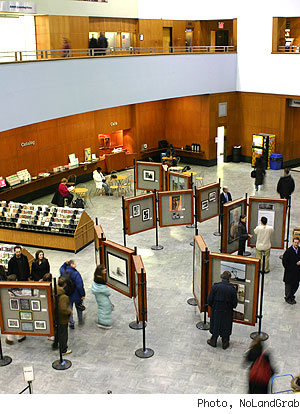 You know Norman Oder is an overkiller when he is more perturbed by the lack of comprehensive information than the possiblity of artwork being censored at the Footprints "art" (not comprehensive display of all matters Atlantic Yards) exhibit.
His overkill instincts aside, maybe Norman is right to criticize the lack of info at an exhibit that can't even get the description right:
I found the newly re-mounted “Brooklyn Footprints” exhibition at the Brooklyn Public Library dismaying, but not so much because the library rejected some politically-charged pieces and claimed, disingenously, “Our interest in this exhibition is in documentation, not advocacy.”
(The New York Observer broke the censorship story, which has been followed up by NoLandGrab, Develop Don't Destroy Brooklyn (DDDB) and the Brooklyn Paper, among others. Is it censorship? Probably in part.)
Even more disturbingly, the library exhibition lacks footnotes that link the artwork to the inevitable political context regarding the proposed Atlantic Yards footprint. There are no descriptive captions, so the “documentation” is quite sketchy. For the relatively few who can see more into the photos, drawings, and paintings, that’s not a problem; for everyone else, it is.
...
When I first saw the exhibition in October, I commented that “some of the documentation available on the web site had not made it to the gallery walls.” That was less a problem, because at least visitors received a postcard pointing them to the Footprints web site, which contains links to informational and advocacy sites about Atlantic Yards. (Update: I'm told the postcards were available on opening night Tuesday. When I visited Wednesday, they weren't there.)
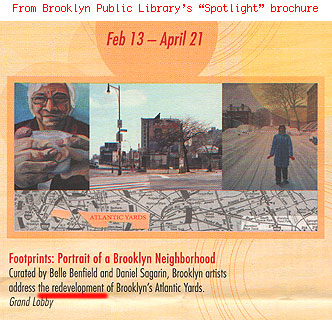
At the library, there are no links, and even the capsule description--"the redevelopment of Brooklyn's Atlantic Yards"--is inaccurate, since Atlantic Yards is a development project, not a place.
NoLandGrab: It's notable that the Brooklyn Public Library didn't want to appear partisan in the debate over Atlantic Yards, because by describing the project as "the redevelopment of Brooklyn's Atlantic Yards," the library proves that developer Bruce Ratner has already won the public relations game.
Posted by lumi at 12:27 PM
Linking Ratnerville and Miss Oklahoma win
The problem with Ratnerville is that everything starts to relate to Ratnerville, as evidenced by this letter to the editor of The Brooklyn Paper:
To the editor,
Thanks for the pictures of New York beauties Bethlene Pancoast and Bess Myerson, the only Jewish Miss America, crowned in 1945 (“Snubbed! Miss New York loses again,” Feb. 3). The local pride in your article was a welcome break from yet more news that our politicians are giving Bruce Ratner yet more money for the “favor” of turning us into Anyplace, USA.
Like the southern contestant who beat Miss New York, Brooklyn may soon have its own false smile, false facade and one-size-fits-all “glamour.”
How can we expect the rest of the country to appreciate our brand of individual and neighborhood beauty unless we are willing to fight to save it?
Jezra Kaye, Prospect Heights
The writer is a volunteer with Develop Don’t Destroy Brooklyn.
Posted by lumi at 12:12 PM
Images the Brooklyn Public Library doesn’t want you to see
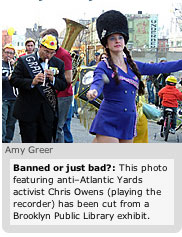 Oh snap! The Brooklyn Paper takes a spirited swipe at our own Amy Greer in this snarky caption to her photo, which is not on exhibit at the Brooklyn Public Library.
Aside from contemplating whether Amy's photo is sensational or sucks, the article catches up with the controversy surrounding the Footprints exhibit:
The Brooklyn Public Library censored a politically charged art exhibit inspired by Atlantic Yards, free-speech advocates charged this week.
The show, entitled “Footprints: Portrait of a Brooklyn Neighborhood,” portrays the condemned 22-acre area where Atlantic Yards is slated to be built, capturing those who live and work there on the eve of the land’s condemnation.
The show mostly consists of documentary-style depictions, but several hot-button pieces, ranging from a neutral portrait of a high-profile Yards opponent to a depiction of Ratner’s arena as a toilet bowl, were eliminated.
Posted by lumi at 11:33 AM
THE EDUCATION OF YVETTE CLARKE PART 20: TOP SECRET FOR YVETTE ONLY
Arthur Piccolo of HardBeatNews.com posts an interesting "top secret" for-Yvette-Clarke's-eyes-only document with the directive:
Stand at the Atlantic Yards site before a large media contingent and simply say the following: “I STAND HERE BORN AND RAISED IN BROOKLYN MY HOME AND NOW HONORED TO SERVE BROOKLYN IN CONGRESS FOR WHAT I CONSIDER THE PROUDEST MOMENT OF MY ENTIRE CAREER. I STAND HERE TODAY WITH OTHER ELECTED OFFICIALS AND OTHER PROUD BROOKLNITES TO ANNOUNCE OUR COMMITMENT OUR DETERMINATION THAT BROOKLYN’S NEW SPORTS AND ENTERTAINMENT ARENA TO BE BUILT ON THIS VERY SITE THAT THERE IS ONLY ONE NAME THAT IT SHOULD, THAT IT MUST BEAR AND THAT IS THE NAME OF OUR GREATEST SON THE ATHLETE WHO HAS FOREVER DEFINED OUR BOROUGH AS GREAT. THAT WE FINALLY DO WHAT WE HAVE NOT DONE BEFORE NOT BEFORE OR AFTER HIS DEATH IN 1976. WE ARE HERE TODAY TO PLEDGE OUR UNWAVERING DETERMINATION THAT THIS ARENAS BE FORMALLY AND OFFICIALLY NAMED AND BE FOREVER KNOWN AS ‘THE JACKIE ROBINSON ARENA’.”
NoLandGrab: Sure, Jackie Robinson would have been proud to have his name on an arena complex built on the homes and businesses of other proud and courageous Americans like Akhtar, Cambell, Goldstein, Gonzales, Muflah-Odeh, O'Finn, Pastore, Sheets, Weinstein and Williams.
Posted by lumi at 10:47 AM
Clarke to Ratner: Fear the Wrath of Congress
The Brooklyn Paper
Rep. Yvette Clarke will call for congressional hearings on the Atlantic Yards development unless developer Bruce Ratner and Barclays amend their $400-million naming-rights agreement to her satisfaction, she told The Brooklyn Paper this week.
“One way of bringing transparency to a mega-project of this magnitude, is to bring hearings that put all of the elements on the table,” threatened Clarke (D-Park Slope).
NoLandGrab: "All of the elements on the table?" Could Clarke be talking about the use of eminent domain to expand a private real estate monopoly?
Black leaders, including Clarke, took part in a historic sit-down with Ratner last week after she expressed outrage that the impending Nets arena would be named for Barclays, a bank that profited from the slave trade, froze the accounts of Holocaust victims, and operated for decades in apartheid South Africa. Rico
Assemblyman Hakeem Jeffries (D-Fort Greene) and Rev. Clinton Milller, of Fort Greene’s Brown Memorial Baptist Church, were also at the meeting.
...
Clarke stopped short of calling for the termination of the agreement.“I’m not quite there, but I did want [them] to know that we’re not the type of constituency you can take for granted,” said Clarke. “I will not stand for the community being blindsided.”
While the Barclays naming-rights deal may remain on the table — and leaders may try to wrangle more money from Barclays — at least one issue is no longer up for discussion.
Posted by lumi at 10:42 AM
Barclays burden bumps benefit: Fallout continues over Barclays arena
 Amsterdam News columnist Tanangachi Mfuni recaps the local controversy brewing over Bruce Ratner's deal with Barclays Bank to sell the naming rights to a new Nets arena for nearly $400 million and reports the latest salvos:
In a letter to The Amsterdam News responding to the January 25 front page article entitled “Barclays’ apartheid past threatens Atlantic Yards,” Barclays spokesman Peter Truell wrote: “Slavery was a heinous period in the history of both the United States and the United Kingdom. We condemn it and are firm in our belief that the partnership bank on which we were founded did not profit from the slave trade or slavery.”
Congresswoman Clarke was not entirely convinced when the AmNews reiterated the bank’s statement to her.
“I can only deal with the reality of my beliefs…and that of the community who feel that Barclays has benefited from the slave trade,” said Clarke speaking to the AmNews by phone Tuesday afternoon.
The congresswoman, who met with representatives of Forest City Ratner last Friday, said she wanted to meet with Barclays next to find out what exactly their intentions are in the community.
“It’s important that nobody in this process be able to take anybody for granted,” said Clarke, who took particular issue with the clandestine nature of the Nets naming deal that many in the downtown Brooklyn community were unaware of until it was announced to the media last month.
Reached for comment this Wednesday, Barclays refused to comment further, referring to their letter, which appears on page 13 in this week’s Amsterdam News.
Related Links:
Barclays responds (letter from Barclays to Amsterdam News)
Barclays’ apartheid past further taints Atlantic Yards project (original article, published 01/25/07)
Posted by lumi at 10:05 AM
Drink ’til you drop at Yards-area bar
The Brooklyn Paper
By Dana Rubinstein
The JRG Restaurant and Fashion Cafe — which is on Flatbush Avenue between Atlantic and Fifth avenues — is having a hedonistic last hurrah before it is torn down to make way for Ratner’s Atlantic Yards mega-development.
The bar, which is in the way of the Frank Gehry–designed arena, is liquidating its stock in a $30, all-you-can drink bacchanal.
... The liquoricious deal will last only as long as the bar-cum-restaurant-cum-fashion house does — through the end of the month.That’s because the premises are owned by Forest City Ratner, which has said it intends to start demolition for its 16-tower development as early as next month.
...
Rodriguez insists the bar will relocate rather than just close down.“We’ll come back even stronger,” he said.
He also claimed that JRG Restaurant would move into the Nets arena when it is completed in 2009 — though Forest City Ratner would not comment.
After all the binge-drinking is done, Rodriguez will throw one last two-day bash on March 3 and 4.
NoLandGrab: Though Forest City Ratner pretty much has "no comment" these days, the press keeps reporting that the company intends to start demolition soon.
Demolition seems premature, since Ratner won't be building anything like a basketball arena unless he can knock down Dan Goldstein's condo and Freddy's Bar and Backroom, amongst other properties. However, we expect Ratner to go ahead, just because he can.
Posted by lumi at 9:21 AM
Congratulations to Grammy Winner Dan Zanes, Musician and Local Activist
While we were sorting through the latest AY controversies, we missed a great story, which was reported in this week's The Brooklyn Paper.
 Dan Zanes, the pop icon of the stroller set and Develop Don't Destroy Brooklyn Advisory Board Member, just won the Grammy Award for Best Musical Album for Children.
Zanes's award winning album, Catch That Train, though targeting young listeners, is essentially a Brooklyn album. A couple songs have lyrics depicting scenes from the neighborhood, but, just as important, Zanes overlays different folk traditions on a blues foundation to create an album that reflects the diversity of Brooklyn and its streets.
The Brooklyn Paper describes the album as "loved by parents sick of Raffi." This alone can't account for ZANEMANIA. "Catch That Train" not only speaks to children, but also parents who were brought up on the multi-ethnic Sesame Street (another really good neighborhood) sensibility.
Zanes's role as an activist is simply an organic outgrowth of his music. Thanks Dan, for bringing Atlantic Yards to the notice of neighborhood-friendly families in Brooklyn!
Congratulations Dan and Friends for a great ride!
[Photo, Dan Zanes and the Goose, REUTERS/Mike Blake]
Links:
Catch that Train
Zanes's statement on Grammy win
The Brooklyn Paper, Dixie Chicks who? Dan Zanes wins the big Grammy
Posted by lumi at 8:16 AM
Yards Ball Now In Judge's Court
Brooklyn Downtown Star editor and reporter Nik Kovac attended last week's eminent domain hearing and filed this report:
"The right of the people to be secure in their persons, houses, papers and effects, against unreasonable searches and seizures, shall not be violated. Nor shall private property be taken for public use without just compensation."
Those words are from amendments four and five of the Bill of Rights, adopted by the United States in 1789, and last week in Brooklyn federal court they were still being debated, well over two centuries into the country's legal history.
"Eminent domain," argued Douglas Kraus, one of the many lawyers representing various versions of state and local government in the Atlantic Yards eminent domain case, now known as Goldstein v. Pataki, "is quintessentially of local concern." The magistrate judge, Robert Levy, then interrupted the ESDC-hired attorney for this question: "The public use clause [amendment 5] is written into the federal constitution. Does that in some way give credence one way or the other?"
Posted by lumi at 8:09 AM
Looney Mooney is back
The Brooklyn Paper
By Christie Rizk
In one of the more bizarre twists of the Barclays saga:
A man who set out to row himself across the Atlantic Ocean last year, but sank three hours into the journey, vows to complete his mission — and he hopes he’ll have Barclays behind him.
Victor Mooney, whom some bloggers have dubbed “Looney Mooney” after he attempted to row from the old slave-trading post, Goree Island, Senegal, to the United States last May, announced his second try last Wednesday, unveiling a new (but still-unbuilt) boat.
“It [will be] virtually unsinkable and professionally built,” he said, a reference to his less-than-seaworthy, self-made first boat, which sank three hours into his trip, forcing the Senegalese navy to rescue him.
This time, Mooney will need $75,000 to make this dream a reality — $50,000 for the boat and another $25,000 for supplies and to support his family for the three months he estimates the journey will take.
He hasn’t gotten any corporate sponsors, but that didn’t stop him from splashing the Barclays logo on renderings of the boat (it’s not likely that the financial behemoth will touch anything that links it, again, to slavery).
But Mooney, who once got free workspace from Atlantic Yards developer Bruce Ratner, is always optimistic.
“Barclays is good for Brooklyn,” he said. “I commend Barclays."
NoLandGrab: For the record, we weren't amongst the bloggers who called Mooney "looney."
The Brooklyn Paper makes a good point: one would think that Barclays Bank wouldn't want to have anything to do with any project that might ignite a conversation about ties between the bank and the slave trade.
It makes us wonder if Mooney received a cease-and-desist letter.
Posted by lumi at 8:06 AM
MSU program to teach land-use strategies
From Michigan State University News:
Some MSU researchers say effective land use can be the difference between life or death for a small community.
To help address this problem, organizers at the fourth annual MSU Land Use Summit will try to help Michigan communities plan for the future. The program will be held from 7:30 a.m. to 4:45 p.m. Monday at the Kellogg Center.
...
This year's keynote speaker is Albert Ratner, co-chairman of Forest City Enterprises Inc., a real-estate company that provides land-use management strategies to cities across the country.[Director of the MSU Land Policy Institute Soji] Adelaja said the speakers, combined with MSU research presentations, will give small communities the knowledge they need to improve their land-use decisions.
NoLandGrab: Some enterprising student might want to ask Chairman Al if land use decisions are best handled at the local level, or if they should be rammed through by the state whenever possible?
Posted by lumi at 7:58 AM
February 15, 2007
PRESS RELEASE
New Study Details Devastating Effects of Eminent Domain Abuse on African Americans
From the Castle Coalition:
Arlington, Va. - “Eminent domain has become what the founding fathers sought to prevent: a tool that takes from the poor and the politically weak to give to the rich and politically powerful,” concludes Dr. Mindy Fullilove in her new report released today titled, “Eminent Domain & African Americans: What is the Price of the Commons?” The report is available at http://www.castlecoalition.org/publications.
Eminent Domain & African Americans is the first in a new series of independently authored reports published by the Institute for Justice, Perspectives on Eminent Domain Abuse, which will examine the different aspects of eminent domain abuse from the vantage point of noted national experts. The release of this inaugural report is particularly timely this month, as millions around the nation learn about African American history.
In this study, Dr. Fullilove, a research psychiatrist at the New York State Psychiatric Institute and a professor of clinical psychiatry and public health at Columbia University, examines the effects of eminent domain abuse on the African American community. Focusing specifically on the Federal Housing Act (FHA) of 1949, Dr. Fullilove finds that “[b]etween 1949 and 1973 … 2,532 projects were carried out in 992 cities that displaced one million people, two-thirds of them African American,” making blacks “five times more likely to be displaced than they should have been given their numbers in the population.”
Although urban renewal under the FHA was discontinued in 1973, Dr. Fullilove reported “the tools of urban renewal had been honed through 20 years of projects. Politicians and developers found that they could repackage eminent domain and government subsidies in many new ways, facilitating the taking of land for ‘higher uses.’”
Dr. Fullilove shares the story of David Jenkins-who lost his Philadelphia home to urban renewal in the 1950s-to illustrate the devastating impacts of forced displacement. “Within these neighborhoods there existed social, political, cultural, and economic networks that functioned for both individual and common good,” explains Dr. Fullilove. “These networks were the ‘commons’ of the residents, a system of complex relationships, shared activities, and common goals”-the loss of which cannot be replaced or remedied.
“What the government takes from people is not a home, with a small ‘h’, but Home in the largest sense of the word: a place in the world, a community, neighbors and services, a social and cultural milieu, an economic anchor that provides security during the ups and downs of life, a commons that sustains the group by offering shared goods and services,” continues Dr. Fullilove.
“Dr. Fullilove’s pioneering research reinforces the need for state and federal legislative reforms of eminent domain laws,” said Steven Anderson, director of the Castle Coalition, which helps homeowners nationwide fight eminent domain abuse. The Castle Coalition is a grassroots organization coordinated by the Institute for Justice, which litigated the Kelo eminent domain case before the U.S. Supreme Court in 2005. Anderson said, “Property owners nationwide-particularly minorities, as evidenced by this paper-will remain vulnerable to seizures by tax-hungry governments for land-hungry developers until the use of eminent domain is reined in and limited to only true public uses.”
A recent example of eminent domain targeting African American communities can be found in Riviera Beach, Fla. Despite the state’s new restrictions on eminent domain, city officials are pursuing a plan to remove thousands of mostly low-income, African American residents from their waterfront homes and businesses to make way for a luxury housing and yachting complex. The Institute for Justice is representing property owners there who want to protect their rights and save what rightfully belongs to them.
In addition to her clinical and teaching duties, Dr. Fullilove is the author of Root Shock: How Tearing Up City Neighborhoods Hurts America, and What We Can Do About It, which takes a powerful look at the effects of urban renewal on African Americans. She coined the term “root shock” to describe the devastating effects of forced displacement.
Posted by lumi at 9:28 AM
Spin City Roundup
Atlantic Yards Report
Nothing gets to Norman Oder like public officials and community leaders who are into spin:
Spin city #1: Burden calls AY “a gaping hole in the heart of Brooklyn”
City Planning Commission Chairperson Amanda Burden, speaking yesterday before a development-friendly audience at a Crain’s New York Business breakfast, declared that “Atlantic Yards was a gaping hole in the heart of Brooklyn,” a statement either deceptive or naïve.
The "hole" is a working railyard, the 8.5-acre Vanderbilt Yard, while Atlantic Yards is the name of a 22-acre project. In casual discussion and press accounts, the two are often conflated, but a public official like Burden should know better, right?
I caught up with Burden (right) after her presentation and said, “You’re calling the project, the whole thing, a gaping hole.”
“The yards are a gaping hole,” she responded, unwilling to acknowledge that she had bought into the developer’s branding.
Spin city #2: Lewis says AY would be "totally luxury" without ACORN
Norman Oder analyzes and fact checks Bertha Lewis's interview yesterday on WBAI.
 Lewis's version of events seems to contradict the record:
Lewis continued:
And when Atlantic Yards came up, we stepped in and we said, “Whoa, wait a minute, if this tide is going to wash over us, we’ve got to be able to affect it.” There was no plan to do anything affordable in that project, whatsoever.
While it's possible that when the developer began conceiving of Atlantic Yards there was no plan for affordable housing, affordable housing was a component of the project plan when first unveiled on 12/10/03.
The developer and ACORN did not sign the affordable housing Memorandum of Understanding (MOU) for 17 months, until 5/17/05.
Spin city #3: Doctoroff says AY had "enormous level of community input"
In this week's New York Observer, in a Q&A headlined Modern-Day Robert Moses, Deputy Mayor for Economic Development Dan Doctoroff first seems to acknowledge that the Atlantic Yards project received too little community input, then reverses himself, claiming--against strong evidence--"an enormous level of community input."
Posted by lumi at 8:20 AM
Mr. Bollinger's Battle
The NY Observer
By Matthew Schuerman
Columbia University is planning to expand into West Harlem, but community groups want assurances that the plan would benefit the community (you know, the community not cleared away by eminent domain).
Reporter Matthew Schuerman, who has been staying on top of the issue of Community Benefits Agreements (CBA) throughout the city, sits down with some of the players to try to get the story of how a Columbia University-West Harlem CBA might take shape:
Finally, after months of preparation, the negotiations for the community-benefits agreement began last month. Once completed, the C.B.A. may set a precedent for all other large real-estate projects in New York City, a precedent which, based on the way it has evolved so far, would be much more rigorous than those already established in the Bronx or Brooklyn.
Or it could provide more evidence that negotiations like this, outside the halls of government, come to no good.
Would Bruce Ratner's "historic" CBA in Brooklyn serve as a role model?
WHEN THE COMMUNITY BOARD STARTED TO FORM an entity that would negotiate on West Harlem’s behalf, one thing was certain: Harlem didn’t think much of the community-benefits agreement for Atlantic Yards, in which developer Forest City Ratner negotiated directly with nonprofits that would end up making money from the agreement.
“Ratner and the city got together with one big, national not-for-profit and a set of local sycophants and put something together which doesn’t seem to have satisfied too many people, except for those who are benefiting directly from it,” Mr. Reyes-Montblanc, the chairman of Community Board 9, said.
What about eminent domain?
The community board is struggling to maintain a united front against the use of eminent domain—the government’s right to take private property, with compensation for the owner, so long as it goes to some sort of public use, with “public use” being variously defined. Tom DeMott, a former post-office employee who is a tenants’ representative on the development corporation’s board, fears that the involvement of elected officials may dilute that resolve, even though they profess solidarity.
Posted by lumi at 7:31 AM
February 14, 2007
Premiere Caribbean Café Forced To Close Doors As Brooklyn Stadium Looms
HardbeatNews.com
By Allison Skeete
A premiere Caribbeean-owned Brooklyn restaurant and bar is being forced to close its doors to pave the way for the new Nets home in downtown Brooklyn, New York.
The J.R.G. Fashion Café Restaurant and Bar, located in the heart of the revived Flatbush/North Park Slope hub at 177 Flatbush Ave Brooklyn, NY, is slated to close it’s doors at the end of this month, according to owners, Guyanese Junior and Rawle Giddings.
The area is being torn up and rebuilt by developer Bruce Ratner for a basketball arena for the Nets and 17 office and apartment buildings along Atlantic Avenue.
...
The Giddings, though being in business at JRG for only a few years, have managed to earn a great following with their first floor contemporary-design bar and dining area and second floor exclusive VIP area as well as the Hampton style rooftop deck. Some of the highlights unique to this eatery included monthly summer fashion shows, boat rides and community involvement that brought patrons, politicians, press and families into JRG. And their annual food and wine tasting introduced many to an enjoyable and affordable atmosphere often.It also made the Zagat ratings for its family friendly and moderately priced for meals and drinks establishment. To mark their closing and to thank all their patrons, JRG is hosting month long specials that include 15 percent off appetizers, entrees, and desserts as well as a $30 price for and evening of premium bar drink from 4 – 11 p.m. nightly. There’s also a Valentine Special of $25 for a three-course meal tonight.
Posted by lumi at 9:54 AM
Affordable housing: low income or below market--and neither
Atlantic Yards Report
Norman Oder "mad overkills" Ratner's attorney over his improvised description of "affordable housing."
During the federal court hearing last Wednesday on the Atlantic Yards eminent domain case, Forest City Ratner attorney Jeffrey Braun, in answer to a question about the definition of "affordable housing," responded by saying "below market."
"We have a long history of public intervention in the housing market," he added, citing such programs as the Mitchell-Lama middle-income program, zoning incentives, and the city's plans to increase low-income units.
But "below market" was an imprecise description.
Affordable housing is more precisely described as subsidized housing which, for rentals at least, the rent is pegged at 30 percent of household income. (The affordable housing universe includes a much smaller fraction of subsidized for-sale units.)
Oder continues by explaining that the area median income figures used to formulate the Atlantic Yards housing plan are not relevant to the incomes of Brooklynites.
And here's one of the big myth busters about Atlantic Yards below-market subsidized housing:
Let's look at the Atlantic Yards housing chart. For the two higher-income bands, involving 900 units, two-person households would pay $1701 or $2127 per month for an apartment.
How does that compare to market rents nearby? I looked at the listings from the high-end Corcoran agency, checking off Boerum Hill, Fort Greene, Park Slope, and Prospect Heights, the neighborhoods closest to the project site (which would be mostly in Prospect Heights).
A sampling includes a Prospect Heights one-bedroom for $1395, a Fort Greene one-bedroom for $1400, a Park Slope one-bedroom for $1600, a Fort Greene studio for $1650, and a Boerum Hill one-bedroom for $1900.
Posted by lumi at 9:42 AM
Barclays feels heat in NY
NationNews.com
By Tony Best
Bruce Ratner's naming-rights deal with Barclays Bank for a new Nets arena is getting some play outside of Brooklyn:
Few corporations have dominated their global field of operations for as long as Barclays Bank has done in places which once belonged to the then far-flung corners of the British Empire.
Think about banking in places that range from Trinidad and Tobago, Nigeria, Pakistan, Singapore, India, Jamaica, Malaysia, Pakistan, Tanzania and Barbados to the Cayman Islands, Bangladesh, South Africa, Antigua and The Bahamas, and Barclays would be the first to come to mind.
After all, people say, it was Barclays that laid the foundation for banking, opened the doors to careers in finance for black Bajans and other non-white people at a time when United States banks hardly paid any attention to them.
...
But if Bajans and others in the Commonwealth of nations have a healthy respect for the British bank, some black elected officials and other public figures in Brooklyn don't share those feelings. Indeed, some of them are so hostile with what they assert is Barclays' tainted history that they are vigorously opposing a plan to name a new 18 000 seat sports stadium in Brooklyn, Barclays Centre.And the debate has placed Barbados and Jamaica, in particular, onto centre stage, principally because of slave plantations which existed in both countries centuries ago.
Posted by lumi at 9:32 AM
Development Dons
 The Village Voice, The Magician's Nephew
The goods on Gargano: A seamy tale of nepotism on the Brooklyn waterfront
By Tom Robbins
How Pataki's economic development boss kept it all in the family when he paid a visit to a Brooklyn port operator.
The NY Observer, Modern-Day Robert Moses
Reporter Matthew Schuerman has a sit-down chat with our Local Development Don for the weekly paper's "Location" column:

Location: Well, what do you think about that? Atlantic Yards, in particular?
Doctoroff: I think in that case there was an enormous level of community input. There were hundreds of meetings and enormous outreach to community leaders. The difference was that it was not submitted to a vote of the City Council. In that case, you had a local Council member who was not in favor. On the other hand, you had the majority of the Council—I can’t say this with 100 percent certainty—that wants it.
The Council shows deference to the local Council member, but it has also demonstrated an ability to see needs of citywide import and to respond accordingly. I don’t think the response would’ve been any different.
Doctoroff also stresses the City's interest in redeveloping the Brooklyn waterfront, which doesn't bode well for the port operator who told his story to the Voice.
Posted by lumi at 8:46 AM
It came from the Blogosphere...
 The Brooklynian, AY Footprint Purchase
"Haddock" falls in love with a brownstone adjacent to the 22-acre Atlantic Yards footprint. Is there a fire sale on property right next to the footprint? Should he go for it? Will living next to a construction zone wasteland for 10 years be a hardship? Or will having an arena in your backyard actually increase your property value?
New York Mag: Daily Intelligencer, Who's Afraid of Brooklyn Redevelopment?
The great thing about the Atlantic Yards imbroglio is that, while everyone's busy yelling about that, other developers can do all sorts of things right next door... And now, with very little fanfare, a deal has been reached to erect one of Brooklyn's tallest buildings mere blocks from the epicenter. Where, you ask, will it go? Let's see how to break this to you. Remember Fulton Mall? Excellent. Now forget it.
Steamboats Are Ruining Everything, Illustrating the Underbelly
A photo of the "underbelly" of an iconic Brooklyn bridge illustrates why Bruce should be banned in Brooklyn.
Don't worry, it's just "Dreadnaught" has an itchy trigger finger this week aimed at Bruce Ratner: Atlantic Yards Litmus Test
The ESDC claimed it would create a 'dramatic skyline' yet not once, in the multiple 'liar flyers' mailed out to Brooklynites, did forest city ever show the buildings. Why?
Noise and Light aren't just aesthetic issues
Dreadnaught references the Wikipedia article on noise pollution to illustrate that noise and light isn't just about "ambience."
It's Just One Guy
What's the point of having an eminent domain clause in the Fifth Amendment of the US Constitution, when politicians and developers are going to do what they want anyway?
Our laws exist exactly to protect people like Daniel Goldstein from Bruce Ratner. Our laws and values have been so distorted, so warped that even politicians and in some cases, judges have lost sight of this....but once you have justify taking land because it will benefit some abstract greater good, or that a groups benefits are more important than an individual's rights, that becomes the justification for taking. In other words, developers will set up a pre-text of public benefit, and literally no home is safe.
Posted by lumi at 7:56 AM
'Extremely remote' odds for Kidd deal
LA Times reporter Mike Bresnahan is reporting that Jason Kidd is one of Caring Bruce's favorite players and thus will not be traded unless Kidd asks the big man himself, despite all sorts of trading rumors during the past several weeks:
For days, the rumor mill has been heating up with talk of the Lakers and New Jersey Nets point guard Jason Kidd.
On Tuesday, however, a source with knowledge of the situation said it was "extremely remote" that a trade would take place between the Lakers and Nets.
Kidd is a particular favorite of Nets owner Bruce Ratner and would not be traded unless he went to Ratner and asked to be moved — an unlikely scenario, said a source familiar with Kidd's thinking.
...
More than a month ago, the Nets made a round of phone calls during a losing streak to see if teams would be interested in some of their players, a source said. The Lakers, like many teams, wanted to talk about Kidd.
...
The Nets, for their part, are still a contender in the weak Atlantic Division and haven't officially decided if they should break up their team. Previous rounds of calls have been mainly to test the water.
Posted by lumi at 7:32 AM
February 13, 2007
EMINENT DOMAINIA
Newark Star-Ledger, His domain to the end
Though he could barely walk, Albert Viviano ambled to protest meetings and rallies in and around Long Branch. Later, when he couldn't walk at all, he rolled to them in his motorized wheelchair, a little American flag in one hand, a placard in the other.
At 93, with his heart slowly giving out, Viviano was motivated by one thing: the right to die in his home.
The city of Long Branch wants that home, one of two dozen converted bungalows local officials have been trying to seize for three years to make way for new development.
The battle continues, but not for Viviano. On Sunday, he died in his bed, two blocks from the boardwalk he cherished, in the neighborhood he had known for 75 years.
"He won," said Viviano's daughter, Estelle Toscano. "My father won because he died in his own house."
The Austin Chronicle, What Price Baseball?
What do Bruce Ratner and George W. Bush have in common? This article from 1997 explains why the conservative administration is not orthodox about property rights:
George W. Bush loves baseball. And why not? After all, baseball has been very very good to the governor. When it comes to power, the governor is a true triple-threat. Consider his record: (1) His initial baseball investment of $600,000 carries the current potential of a 3,200% return. (2) Through savvy PR and political maneuvering, he and his partners have persuaded a city and the state to directly subsidize a facility for their business. (3) Not content with taxpayer subsidies, he and his fellow owners have also successfully used the power of government to take land from other private citizens so it could be used for their own private purposes.
Yes, baseball has been very good to Bush. Moreover, the biggest deal Bush has ever done, the career-shaping transaction he boasted of on the campaign trail -- the planning, funding and construction of the Texas Rangers' Ballpark at Arlington -- has been largely ignored by the national media as they rush to paint Bush's presidential portrait.
IndeNews.com, City blows eminent domain proceeding, losing lots
The City of Hudson wanted Edward Keegan, Sr.'s property to build low-income housing, though the official justification for eminent domain was "blight clearance."
By a stroke of luck, Keegan will get to keep his property, due to a technicality.
Mayor Tracy called the situation frustrating. "I hope Mr. Keegan will do what's right and pursue the necessary improvements to these properties," he said.
AllAfrica.com, Uganda: Government's New Strategy On Land
Taking of private property, flouting the law for land giveaways — there's a backlash in Uganda as the federal government has been expanding the definition of "public purpose."
Posted by lumi at 10:02 AM
Footprints: Portrait of a Brooklyn Neighborhood
 February 13, 2007 - April 21, 2007
Central Library, Grand Lobby
The proposed Atlantic Yards arena and building complex in Brooklyn is poised to be one of the largest redevelopment projects ever undertaken in New York City. Its targeted 22-acre site is known as the "Footprint."
In the midst of the debate over the future of Atlantic Yards and of Brooklyn, a group of local artists have joined together in an effort to move beyond the sound bites and take a closer look at this contested place and its community.
Footprints: Portrait of a Brooklyn Neighborhood stands both as a document of a Brooklyn neighborhood and as an exploration of issues surrounding redevelopment.
Click here for more info on the curators and artists.
Posted by lumi at 9:56 AM
PRESS RELEASE: Salon des Refusés de la Bibliothèque de Brooklyn
A Collection of Art Work Censored by the Brooklyn Public Library
Feb 22nd to March 29th
Freddy's BACKROOM
485 Dean St. @ 6th Ave. Brooklyn, NY 11217
(718) 622-7035

Opening Reception, Thursday, Feb 22nd 5:30 to 8:30
BROOKLYN—The Brooklyn Public Library is hosting and re-curating an exhibit it invited to the Library. In its re-curation the Library has censored the vision of the show’s original organizers and curators.
In the summer of 2006 a group of Brooklyn artists were asked to create work inspired by the section of Prospect Heights slated for demolition to make way for Bruce Ratner’s “Atlantic Yards” project. The curators of the show, Dan Sagarin and Belle Benefield, put out a call for portraits of the residents, images of the landscape, and conceptual interpretations of the buildings and sidewalks that many of these artists call home. The goal was not to take a stand on what has become a heated and divisive political issue, but to document the neighborhood as it is now and explore the issues surrounding the proposed development. The results were brought together in Footprints: Portrait of a Brooklyn Neighborhood. The show, comprised of paintings, drawings, photography, video, sculpture and installation, made it clear that what stood in the footprint of this massive development project was actually a dynamic, diverse, thriving neighborhood.
 After a well-attended, successful November run at Grand Space in Prospect Heights, the Brooklyn Public Library chose to pick up the show and exhibit it in the library’s central branch. But the library excluded works they deemed “too political” or “abstract,” thereby altering Sagarin’s and Benefield’s original vision and exhibition.
Mr. Sagarin said in response "I was hurt when I learned that, if we wanted to exhibit at the library, some of our artists, including my sister, would not be represented. I knew that I wanted to go ahead with it anyway, and that I would have to tell some of our strongest artists that they were out."
 The Brooklyn Paper reported last August that the library was trying to get Bruce Ratner to fund its new arts branch.
When questioned about the show and the censored works, the Library told the NY Observer “As a modern library, our mission is to provide free and open access to information for all library patrons through many resources....”
“I think the Library’s fear of addressing any real dialogue about the project, is a reflection of their own political stand in support of it, due to their own desires for financial support. Perhaps an even more important issue might simply be the immorality of the library’s censorship. I believe some of the strongest pieces in the original show were omitted. I invite anyone to come make your own decision,” said Donald O’Finn rejected artist.
Some of the censored works can be found here: http://www.freddysbackroom.com/art.html
In the spirit of the Alternative Salon* and with the goal of displaying all of the work from the original Footprints show at the same time, Donald O’Finn, artist and manager of Freddy’s bar presents:
Salon des Refusés de la Bibliothèque de Brooklyn: opening reception Thursday Feb 22nd 5:30 to 8:30
Freddy's BACKROOM 485 Dean St. @ 6th Avenue. Brooklyn, NY 11217
Come view the work and experience Freddy’s, a neighborhood institution (voted one of the best bars in America by Esquire magazine in 2006) currently thriving in the footprint of “Atlantic Yards”. Enjoy it while you still can…
* Set up by Napoleon III, in 1863, in response to protests from the artists about the restrictive nature of the jurying for the official Paris Salon which excluded some of the most experimental artists of the time: Manet, Courbet, etc.
Posted by lumi at 9:04 AM
Even More Moses
 More articles on the exhibits and panel discussions reconsidering the legacy of Robert Moses:
Toronto Globe and Mail, Moses vs. Jacobs plays again
Last Thursday night, the Museum of the City of New York held a symposium titled The Lessons of Robert Moses. Most of the panelists, including Dan Doctoroff, the city's deputy mayor of economic development and rebuilding, seem to be taking the wrong lesson from the current re-evaluation of Moses. They have learned that arrogance was Moses's real sin. So their modus operandi is to appear to care about communities and then go ahead with big development plans anyway.
Doctoroff, who failed in his bid to build a stadium on the west side of Manhattan and also failed to secure the 2012 Olympics for the city, is overseeing the largest building boom in the city since Moses's era. “We definitely do not believe you need to break eggs,” he said.
That would be news to the hundreds of families and businesses in Brooklyn who will be evicted under the government's powers of land expropriation to make way for the gargantuan Frank Gehry-designed Atlantic Yards project, which will attempt to deposit a massive high-density downtown-style development (including a basketball arena and a 50-storey apartment tower) in a low-rise area of Brooklyn.
CityLimits.org, ROBERT MOSES RECONSIDERED: MOSTLY RIGHT THE FIRST TIME
So yes, this exhibition is revisionist in that it puts a more positive face on Moses than the Caro opus. Understandably, given Ballon’s expertise, the focus is on the physical results of more than 40 years of power and it does not try to probe the source of the power that allowed him to ride roughshod over anyone standing in his way. And, indeed, the physical achievements, whether judged good or bad, are undeniably mighty in breadth, scale and obstacles overcome.
But the danger in a revisionist view of history is that it takes on a life of its own. That life often then becomes myth, like the incorrect belief about Mussolini that “at least he got the trains to run on time.” Clearly, no one is all good or all bad, and Caro’s book, despite what is often said, does have positive things to say about Moses. Of Robert Moses one must ask if the damage he wrought outweighs the good.
Posted by lumi at 8:42 AM
New school at AY would add 100,000 square feet
Atlantic Yards Report
Even the Mad Overkiller misses something once in a while. When a clue turns up in a Request for Proposal, Norman Oder tracks down the lead.
Though it's yesterday's news to Ratner, Oder just learned that a new school at Atlantic Yards would add another 100,000 square feet to the project:
There's a curious passage within a Request for Proposals (RFP) from the Empire State Development Corporation (ESDC) for an Environmental Monitor to oversee construction activities, mitigation measures, and "certain other activities associated with the Atlantic Yards Land Use Improvement and Civic Project."
It reminds us--in a passage that I and others had missed when first announced in November--that the project got a little bigger with the addition of a school.
Given "the projected significant adverse impact to the supply of elementary and intermediate school seats within ½ mile of the Project," developer Forest City Ratner, if requested by the New York City Department of Education (DOE) prior to January 1, 2010, would convey or lease "to allow for the development of an approximately 100,000 gross square foot elementary and intermediate public school." The likely location: Building 5, which would be east of Sixth Avenue between Atlantic Avenue and Pacific Street.
Here's the news:
The space provided for the School shall be in addition to the Atlantic Yards program described in Table S-1 of the FEIS and shall not replace or result in a reduction of any part thereof. (Emphasis added)
...
That's an increase of only 1.25 percent. Then again, a projected 6 to 8 percent decrease made the front page of the New York Times, so maybe the school is news. (The decrease, ultimately about 8 percent, had been mostly on the table for months.)
The same RFP also adds some details to how the State will be monitoring Ratner's compliance to the Environmental Guidelines and who gets to decide who pays for additional traffic enforcement agents.
NoLandGrab: Stated plainly, if Ratner builds a school, it won't come out of his square footage, or his pocket book.
Politicians charged with representing the public's interest really put the screws to Ratner in extracting this "concession."
Posted by lumi at 8:28 AM
February 12, 2007
Missing Link: Brooklyn Public Library Drops Anti-AY Art
From the "Record:"
The missing link
NoLandGrab and Gowanus Lounge cited The Real Estate Observer for the scoop. Develop Don't Destroy Brooklyn only posted a response AFTER the story broke.
We don't know why the editors at Brooklyn Record didn't give The Observer credit for the scoop or shed light on the full story, but we know that bloggers are pretty sensitive when the mainstream media (msm) doesn't give them credit for their stories. The msm-published blog The Real Estate Observer is sort of a hybrid that probably deserves the same respect.
In the blogosphere, oversights like this tend to propagate, — NY Magazine's blog Daily Intelligencer linked to the DDDB remarks, giving credit for the citing to Brooklyn Record.
Is the distinction important? Well, for once, it wasn't DDDB that issued a strongly worded press release on a wing and a prayer that someone in the mainstream media might give damn about the largest single-source private project in NYC history that is about to turn a strip of Prospect Heights into the densest residential community in the nation (but we digress...).
Posted by lumi at 10:48 AM
Ivy League University May Use Eminent Domain in West Harlem
AssociatedContent.com
Fox News reported today that Columbia University may try to use eminent domain to acquire the 17 acres from 125th to 133rd Streets in New York City known as Manhattan Ville. The University claims expansion is necessary as it is currently only one-half the size of Harvard and one-third the size of Princeton and Yale. According to Emerging Minds Magazine, Columbia is one of the city's largest landlords. The acquisition of Manhattan Ville would double the current size of the University's campus. Columbia plans to build a bio-chemical research center on the property, which would have five stories below ground level, potentially wreaking havoc on the environment.
Just you watch, the Empire State Development Corporation (those guys again!) will technically justify the taking of private property because the area is "blighted," naturally.
Posted by lumi at 10:12 AM
Stadium game playing us for fools
An article in MetroNY about cities who have adopted a "build it and they will come" position to arena building, references Bruce Ratner's Atlantic Yards (click image to enlarge):

"The fact is that these communities, just like Detriot, St. Louis, Newark, N.J., Brooklyn and others, have fallen prey to the same sporting facilities shell game that has played out all across this nation. Areas that can't find a nickel to reduce class sizes, help get medication to their poorest residents or even adequately fix pot holes suddenly can hike taxes a percentage point so they can tailgate. Why fix cities, when you can give citizens bread and circus?"
Posted by lumi at 10:02 AM
"The Gray Lady" eventually gets around to printing correction on AY "reconstruction"
 The lead time for extracting a correction from "The Gray Lazy" is about two weeks when the topic is Atlantic Yards.
From this weekend's NY Times:
Correction: Rehabilitating Robert Moses
An article on Jan. 28 about new exhibitions looking at Robert Moses’ impact on New York today, referred imprecisely to the Atlantic Yards real estate project in Brooklyn. It is a new development, not a reconstruction project. (Go to Article)
As important as any one correction is the recognition that Bruce Ratner's PR team has waged a very successful effort to brand "Atlantic Yards."
At this point, it seems that most Brooklynites believe that the Vanderbilt Railyard is actually called "Atlantic Yards," and that "Atlantic Yards" is an actual location, not a development plan.
Norman Oder of Atlantic Yards Report explains why two weeks practically constitutes foot-dragging as far as the NY Times is concerned:
And why couldn't the Times have corrected it on the day of publication, given that they had ample advance warning? (The Times prints the Arts & Leisure section days in advance, but typically runs a correction in the main news section if adequately warned.) Was it delayed for research?
Develop Don't Destroy Brooklyn worded it this way:
Two weeks ago Norman Oder pointed out a substantial mistake in a NY Times article, and that it could have been corrected in a timely and, thus, meaningful manner.
Posted by lumi at 9:23 AM
More Moses
AP via APP, Exhibits revisit Moses' NYC transformation
Nearly all the projects master builder Robert Moses championed between the 1930s and 1960s as head of the New York City's Parks Department and a public transit authority are still here. Moses brought Lincoln Center, Jones Beach and Riverside Park to New York, but also drew scorn for displacing thriving neighborhoods to create roads such as the Cross-Bronx Expressway.
Three connected exhibits opening this week revisit Moses' legacy, and its planners say the late urban planner should ultimately be remembered for building far more than he destroyed. ...
"Robert Moses and the Modern City: The Transformation of New York" opens in the middle of a building boom the city hasn't seen since Moses, who died in 1981. The World Trade Center site, Atlantic Yards in Brooklyn and planned stadiums and subway lines are among the projects changing the landscape in every corner of the city.
Atlantic Yards Report, Author Caro: remember Moses's effect on people
Though he ostensibly had a few weeks to prepare a rebuttal to the book and exhibition, Robert Moses and the Modern City, Robert Caro, author of the scathing and seemingly definitive biography, The Power Broker (1974), chose not to fully counterattack yesterday.
Rather, in a lecture sponsored by the Museum of the City of New York (MCNY)--an event added only after he was excluded from the panel discussion ushering in the exhibits--Caro hewed mainly to what seemed to be his standard Moses presentation: the story of how he came to write the book (his increasing recognition of the unelected Moses's grip on power), his admiration for the young Moses's idealism (the creation of Jones Beach as a destination for urbanites), and the failure of his later vision (the displacement of at least 500,000 people for the creation of highways and housing).
Posted by lumi at 9:08 AM
Panel Discussion on Atlantic Yards and Grassroots Media at NYC Grassroots Media Conference (February 24th)
Picketing Henry Ford
At the NYC Grassroots Media Conference on Saturday February 24th, I will moderate a panel discussion with bloggers Lumi Rolley of No Land Grab and Norman Oder of Atlantic Yards Report and a spokesperson from Develop Don’t Destroy Brooklyn.
The panel discussion is at 3:45pm, ’til 5:15pm, at The New School University Graduate Faculty Building, which is 65 5th Avenue between 13th and 14th Streets.
If you are interested in attending, you can save money by pre-registering for the conference on the NYC GMC website.
Posted by lumi at 9:02 AM
It came from the Blogosphere...
 Nets Fan in New York, Potty Humor
Everyone's a critic. NY's #1 Nets fan trashes Donald O'Finn's crapper:
As Oscar Wilde once said:
"Every portrait that is painted with feeling is a portrait of the artist, not of the sitter. The sitter is merely the accident, the occasion. It is not he who is revealed by the painter; it is rather the painter who, on the coloured canvas, reveals himself."
Miss Brooklyn portrayed as a toilet? How original. What does this say about the artist?
A Good 'Hood, Gehry Is So Very....
I'm not saying that the development needed a traditional "brownstone" look to link the neighborhoods on either side of the development, but a design that was both progressive, yet also respectful to the current neighborhoods would go a long way to creating a good hood, one that adds to the existing areas, while also giving it it's own identitiy. As the design stands now, this will be a 1970s superblock, completely isolated from the surrounding environments, not just because the footprint of the development isn't more welcoming, but because it will stand out...and not in a good way.
Don't Worry It's Just Reality: Brooklyn Edition, About the Barclay's Crap
"Dreadnaught" sounds off on the backlash to Bruce's Barclays deal:
This little corner of the AY opposition is pretty un-PC, and I kinda sorta agree with Errol Louis that the past is the past, and everyone's had their hand in it, including plenty of Africans- where even today the peculiar institution isn't so peculiar.
But I will say this - the fact that Ratner would ignore the sensibilities, feelings and thoughts of black leaders after he was done using them is a perfect example why Forest City and Bruce Ratner in particular should not be trusted, why the fake CBA isn't worth the paper its printed on, and Brooklynites should be taking steps to not only halt Forest City's expansion in Brooklyn, but preferably, have them leave. It's also a clear indicator that long term Forest City is very, very bad for Brooklyn, and that hoops and other mindless distractions are smokescreens for seizing more and more power and control of the borough.
The Gowanus Lounge, Art the Brooklyn Public Library Doesn't Want You to See Redux
GL reposted the entry about the Brooklyn Public Library, since the original entry might have gotten burried during the weekend coverage:
The
censorsofficials at the Brooklyn Public Library have decided that some art from the Footprints show can't be shown at the library. Is it gay-themed art or something overtly sexual? Nah. Just a depiction of Atlantic Yards as a toilet bowl, a portrait of Develop Don't Destroy's Daniel Goldstein and that sort of thing. The Library issued a bizarre statement explaining that they're publicly-funded when The Real Estate asked them aboutthe censorshipthe choice they made to exlude six works.
"Computer Art" by H. Price.
Posted by lumi at 8:25 AM
Brooklyn DAILY Eagle: Atlantic Yards Opponents Fight For Their Right to a Federal Trial
Norman Oder pointed out last week that a reader took him to task for overlooking Brooklyn's daily newpaper, the "Daily Eagle" (published M-F).
Oder noted, "The Eagle did cover the court hearing Wednesday, with a 427-word article. A more substantial Brooklyn daily, I'd imagine, would've given it more space. The New York Sun, by contrast, managed 669 words."
To Oder's point, Brooklyn Daily Eagle posted a 431-word article on their web site on Friday, covering the hearing on the use of eminent domain at Atlantic Yards. The NY Sun published a 670-word article the day after the hearing on Thursday.
From the Eagle article:
Judge Robert Levy questioned lawyers on all sides yesterday. If a development project has a public use, does that make eminent domain constitutional? What if the public use represents only 5 percent of a largely private project? What if, hypothetically, the project has a public use — for example, as a railroad or highway — but was created through an unethical or even corrupt process for the purpose of benefiting a private person?
“It’s not the purposes that count, if you’re doing something permissible,” concluded Douglas Kraus, who represented the ESDC.
“We’re not talking about [Times Square], the crossroads of the world,” said Jeffrey Braun, an attorney for Forest City Ratner. “We’re talking about eliminating this scar on Brooklyn.”
more (registration required)
Posted by lumi at 7:33 AM
February 11, 2007
City Council Candidate Questionnaire
DFNYC asked the candidates for the February 20th election in the 40th district in Central Brooklyn about their positions on Atlantic Yards. Moe Razvi, Harry Schiffman and Leithland "Rickie" Tulloch counted themselves "in favor." Here are the responses from the remaining three candidates:
Karlene Gordon: Now that the Atlantic Yard Project has been approved, my concern was affordable housing and affordable to whom. According to ACORN, 50% of the housing will be set aside for low and moderate income families. How much of that 50% will be designated for victims of domestic violence? Holding the developers accountable will be something I will pay particular attention to.Jennifer James: Traffic and environmental issues are already of great concern, not only for those who reside in the immediate area, but for those wishing to travel in and out of Manhattan, throughout Central Brooklyn and beyond. With the arrival of the stadium, these problems will only be compounded. We must hold the developers accountable to high environmental standards to ensure that this project does not cause a decrease in the quality of life for our residents. The only people who benefit from taxpayer subsidies to real estate developers are the real estate developers, themselves, unless we hold the developers accountable to the residents of the community in terms of the amount of affordable housing that they provide. It is the job of the City Council representatives to work closely with other elected officials to ensure that the Community Benefit Agreement is upheld and that people have the right to afford to live and do business in the areas in which they have for so long been stakeholders. The Atlantic Yards project has the potential to affect the area and all of its neighbors. We must be sure to address all of these issues aggressively.
Zenobia McNally: I am gravely concerned about several of the issues raised by the project, including the lack of transparency of the project.
• Eminent domain was misused to promote private development, not for the public good.
• There is an apparent lack of concern about the environmental impact on Downtown Brooklyn, specifically, and Brooklyn, generally, especially as it relates to air quality and asthma rates.
• Traffic in the area surrounding Atlantic and Flatbush Avenues ranges from heavy during the day to snarled during the morning and evening rush hours; yet, the community has been told that the project will not negatively impact driving and parking in the area.
• Given how “hot” the New York City real estate market is right now, taxpayer subsidies to real estate developers is corporate welfare.
• Job growth and commercial office space are among the “carrots” dangled before the community by the developer. Subsidy payments to the developer should be delayed until after the promised job growth/commercial office space rentals are maintained for at least ten years. I want to emphasize that I am not against development, only irresponsible development.
Posted by amy at 3:01 PM
Tamar McFarlane: Gentrification Fighter
Feministing interviews Tamar McFarlane from FUREE (Families United for Racial & Economic Equality) about her work in Downtown Brooklyn:
Can you describe the work that you’re doing now with FUREE against gentrification?I’m working on the Downtown Brooklyn project to organize and mobilize low-income communities of color for accountable development. The Bloomberg administration is forcefully pushing forward a large-scale development plan for Downtown Brooklyn that will drastically impact the social, economic, and cultural stability of low-income residents of Downtown Brooklyn. If the Downtown Brooklyn Plan goes into effect, it will completely change the cultural vibrancy of Fulton Street Mall from being a place where predominantly Black and Latino shoppers, socialites, and workers can come comfortably into a 5th Avenue big chain retail district. We are working with public housing and stabilized-rent residents, clergy, and community-based organizations and services.
We’re also mobilizing members around the Underground Railroad site that is on Duffield Street. It’s located in the center of the Downtown Brooklyn Plan where they proposed a quasi–green space and underground parking lot for proposed condos and a hotel. The city planning department is abusing eminent domain to seize Joy Chatel’s house along with three other houses for the interest of corporate profit. Joy Chatel is a FUREE friend and for the last two or three years, she has been fighting tooth and nail for her house because of its site. She’s calling for a city council hearing where prominent site researchers, experts, and witnesses can testify that it’s an Underground Railroad site. And the city is basically using all types of corrupt loops to illegitimize the need for investigation. We have set out to get 5,000 petition signatures calling to landmark Duffield Street.
Posted by amy at 2:55 PM
Wikipedia War over Michael Ratner

Don't Worry It's Just Reality: Brooklyn Edition on Michael Ratner's Wikipedia entry...
What keeps getting removed? this section:ControversyInvestigative reporter Norman Oder uncovered campaign contributions made by Micheal to politicians in Brooklyn - where he does not live - but his brother has been involved in controversial real estate deals. His brother, Bruce Ratner, has been accused of [ http://nymag.com/news/features/18862/ corruption and political ruthlessness] including eminent domain abuse. Critics have charged that Michael ignores his brother's subversion of the democratic process and unconstitutional use of eminent domain. (the project in question would force homeowners to sell their property so Forest City can build luxury condos.
Michael Ratner and his wife, Karen Ranucci, both Greenwich Village residents, have recently made campaign contributions using Forest City Ratner's Brooklyn building as a return address. Ranucci has matched many of her husband's contributions. And Bruce Ratner's girlfriend, Pamela Lipkin, as well as other Ratner family members, have made contributions engineered by an FCR lobbying firm. The Ratner campaign money trail leads to... Michael (& his wife)
apparently michael ratner's cheerleaders aren't too proud of his campaign contributions. Why not, doesn't this upstanding crusading civil libertarian support those fighting eminent domain abuse? Not when the abuser is his crooked brother.
Posted by amy at 1:45 PM
The Fight Against Atlantic Yards

WBGO News interviews Daniel Goldstein.
Find out more about Goldstein, and the price of his apartment, than we know about Ratner, and the price tag for Atlantic Yards...
Posted by amy at 1:44 PM
Atlantic Yards Lawsuit Challenges Kelo Exception

Multi-Housing News
By Daniel Goldstein
A rubberstamp approval from Albany was no surprise to opponents or supporters of the project. It has been clear that any semblance of public review would be pro forma with a predetermined conclusion, as the political fix had been in from even before the project was unveiled in December 2003.Never mind the kabuki theater of the political review of the project. In the end, rubberstampers will not decide the fate of Atlantic Yards. The fate of the massive project will be determined in federal court. And that is exactly where the project is now.
...
Those who are only slightly familiar with the Kelo case may wonder what the plaintiffs' argument is if the Supreme Court ruled as it did. Implicit in the majority decision and explicit in the concurring majority opinion written by Justice Kennedy was a description of what would be an illegal taking. The court made clear that the process matters when eminent is used to seize properties, as does the intent of those takings.Kennedy wrote that when the beneficiary of the taking--in this case, Forest City Ratner--is known before the taking, that would be a characteristic of an illegal taking. Completely contrary to the analysis by the New London City Council, which led to its decision to redevelop a section of the city by condemning properties and then putting them out for bid with an RFP, for Atlantic Yards, there never was an RFP and the project was driven entirely by the developer.
Posted by amy at 1:30 PM
Brooklyn Love and Preservation Stuff
Andrew J Lederer mourns the loss of Roll-n-Roaster, but puts it into perspective:
Roll-n-Roaster is charming and has good food but it will not be a tragedy of the highest order to see it go.I would gladly have traded it for the protection of that mid-19th century dry dock in Red Hook that's to be supplanted by an Ikea.
And let's scale back that Ratner/Gehry project in Prospect Heights.
And develop Coney Island in way that respects its glorious history.
For those things, I can give up a Roll-n-Roaster san-a-wich.
Posted by amy at 1:10 PM
A Fortunate Series of Coincidences?
Brooklyn Downtown Star finds a link between Barclays, Duffield Street, and Black History Month:
Joy Chatel has begun the process of formally converting some - and eventually perhaps all - of her home into a museum of African-American and American Abolitionist history. Abolitionists used to live there, and fugitive slaves may have hid out in her very basement.And earlier this week, some of the earliest visitors to her new museum were from - guess where? - Britain, and they are researching the very trans-Atlantic slave trade that was already in the headlines because of old British money coming to Brooklyn.
These two news events did not cause each other - their simultaneous prominence is a coincidence. But we should take this coincidence as a blessing, both to increase our historical knowledge and to use it to reflect on the present. The very first thing we should realize is that the antebellum Duffield Street rowhouses should not be torn down - and especially not for a parking lot.
Posted by amy at 1:09 PM
Moses revisionism, Jane Jacobs, the BQE, and the Promenade
Atlantic Yards Report visits three Robert Moses exhibits and lives to tell the tale:
While I'm not equipped to offer definitive analyses of the Moses revisionism, on a granular level, I found myself wondering whether elements of the exhibition give Moses the benefit of the doubt. At the Queens Museum, a brief set of panels regarding the building of the Brooklyn Queens Expressway states:
The design incorporated innovative triple-decking of the roadways and the public esplanade in Brooklyn Heights, but the BQE also cut through Red Hook and Cobble Hill, demolishing blocks of historic residences...
...
That shorthand description omits the furious battle fought to achieve the esplanade (aka Brooklyn Heights Promenade) against Moses's effort to direct the highway through the neighborhood rather than around its edge. As the Project for Public Spaces (source of the photo) explains:
In the mid 1940’s, Robert Moses and the New York City Planning Commission wanted to dissect the well-to-do neighborhood of Brooklyn Heights by putting up the Brooklyn-Queens Expressway along Hicks Street. The Brooklyn Heights Association opposed the plan and won.I don't know if other elements of the exhibition contain similar lapses. (Perhaps someone wants to "mad overkill" the exhibit?) But just as Moses deserves a revisionist look, that revisionism should not be taken as gospel.
Posted by amy at 1:01 PM
February 10, 2007
The Art the Brooklyn Public Library Doesn't Want You to See

The Gowanus Lounge
Censorship, particularly crass and brainless politically-motivated censorship, is one of our hot button issues. We could even vaguely understand if they were keeping something awful and offensive from their walls, but they're not exactly trying to spare the people of Brooklyn a depiction of the Virgin Mary surrounded by little vaginas and dung. No, this is self-interest and stupidity of the highest order. The Library, in its statement to The Real Estate, even vaguely tries to blame local gallery owners and artists for participating in the decision as part of a "selection committee."In deciding to ban these works, the Brooklyn Public Library is behaving like a little village library in 1980s Transylvania refusing to show a portrait of Nicolae Ceausescu wearing one of those funny noses with eyeglasses and mustache. Actually, we're overstating the case--the backwoods Transylvanian Communist censors would have had a better excuse, either because they were true believers or because they were afraid of being dragged out into the forest by the Secret Police and shot for mocking Ceausescu. The people at the Brooklyn Public Library, on the other hand, are said to not want to offend Bruce Ratner as they are trying to suck up to him do some fundingraising development work so that he'll bankroll their floundering BAM Cultural District project. (Perhaps as a follow-up they can block internet access to DDDB and other websites that are deeply critical of Atlantic Yards. It could be worth an extra four or five hundred G's, minimum.)
Guess this means the "Free Speech Zone" installation the library hosted in 2004 was only an abstract idea? Well, yes, actually. The BPL has had some censorship issues with actual books in the past. For instance, this case, which made waves in September.
Posted by amy at 2:07 PM
Brooklynite Wants Jackie Robinson's Name On Arena
Hardbeatnews reports that one Arthur Piccolo of Brooklyn suggests a different name for the proposed Barclay's arena, and is mounting an email campaign to public officials.
"Having been born, raised and living in Brooklyn I believe the new sports arena at Atlantic Yards offers a unique opportunity to finally honor Brooklyn's greatest son Jackie Robinson as he deserves to be. April 15, 1947, is a milestone in American history,” stated Piccolo in his letter to the officials. “The day Jackie Robinson stepped on the field and integrated Baseball but much more the beginning of the integration of all sports. Time Magazine and many others list Jackie Robinson one of the 100 Greatest Americans. He is by most standards the most important American athlete who has ever lived. Robinson played his entire career with the Brooklyn Dodgers as well as living in Brooklyn until his death.""Many elected officials and other Brooklynites are opposed to Bruce Ratner selling the name rights to the arena to Barclay's Bank and pocketing $400 Million in the process. Atlantic Yards will make a very wealthy Bruce Ratner even far richer without pawning our birthright by selling the name of what will become Brooklyn's first and the finest indoor arena for sports, entertainment events, conferences and conventions,” he added. “The best way to counter the Barclay's proposal is to counter it with a far far better name The Jackie Robinson Arena. Brooklyn honoring Jackie Robinson and his legacy in the finest way imaginable. I hope you agree."
article
Although your heart is in the right place, Arthur, your time would be better spent raising $401 million dollars. Even then you might be surprised to learn they won't take your money.
Posted by amy at 1:27 PM
Nazis, slave traders & racists are too much for Clarke - Congresswoman pulls support of Atlantic Yds. citing Barclay’s shadowy past

Courier-Life
Stephen Witt
“Forest City Ratner Companies [FCRC] has fallen short of community expectations in fulfilling certain commitments. I am concerned about this marriage and its ramifications in meeting the expectations of the residents of Central Brooklyn,” said Clarke.
...
“This process must be inclusive, transparent and structured so that community stakeholders are active participants in making key decisions,” she said.“There are a range of issues including tax breaks and eminent domain that can only be addressed by multiple levels of government,” Clarke added.
article
And we are all anxiously awaiting Yvette's participation in making this opaque process transparent.
Posted by amy at 1:19 PM
In Coney Island, developer learns from Atlantic Yards
Atlantic Yards Report looks at Thor Equities' Joe Sitt's PR blitz on proposed Coney Island redevelopment:
As Gowanus Lounge blogger Robert Guskind has ably pointed out, the developer apparently sent a mailer from a seemingly grassroots group, The Future of Coney Island. As with a Forest City Ratner brochure, the list of issues for respondents to cite could only serve the developer: "Yes, my community needs jobs."As Guskind wrote, "The promo mailer says nothing about housing or highrises, both of which are controversial parts of Thor's plan." It's reminiscent of the Atlantic Yards mailer last May that curiously contained no towers but asked residents what aspects of the project interested them.
Posted by amy at 12:01 PM
A Brooklyn daily? Yes, but...
Atlantic Yards Report explains his exclusion of the Brooklyn Daily Eagle when saying that Brooklyn has no dailies:
A reader took me to task for my musing yesterday about the failures to cover the Atlantic Yards eminent domain hearing: "Imagine Brooklyn as a separate city with its own daily newspaper. The Atlantic Yards case would've been front and center."
...
The Eagle did cover the court hearing Wednesday, with a 427-word article. A more substantial Brooklyn daily, I'd imagine, would've given it more space. The New York Sun, by contrast, managed 669 words. I thought it was worth a lot more than that.
Posted by amy at 11:56 AM
February 9, 2007
Whose Downtown is it anyway?

Brooklyn Paper
Everyone is sick of Prospect Heights being mistakenly called Downtown Brooklyn in various media, but it is definitely worth a look at what is actually going on in the actual Downtown Brooklyn:
The City Council unanimously rezoned Downtown Brooklyn in 2004 to bring in high-rise office towers and sleek new residences.It’s happening already. So congratulations to our esteemed councilmembers. But in a severe case of shortsightedness, the rezoning is killing the small businesses that already existed in the area. Now, the buildings on the side streets — Lawrence, Willoughby, Duffield — are being bought up one by one and torn down to make way for something “better.”
...
Joyce Kiehm’s wig shop has been on Lawrence Street since 1986. She emigrated here from Korea, started her own business and played by all the rules.“I don’t know what’s going to happen to me,” said Kiehm, who has two years left on a lease that most experts say will never be renewed, even if she could afford the inevitable rent hike.
The upzoning for "upscaling" doesn't stop there. Nik Kovac reports for Brooklyn Downtown Star:
House-Turned-Museum Still Faces Wrecking BallGiven the necessarily underground nature of the Underground Railroad, it was hard at the time and it's even harder now to discern exactly what was going on: to know which escaped slaves were hid where. "That just burns me," admitted Chatel, "when people say there's no evidence. It was a secret society!"
The reason it burns Chatel so is that the city wants to demolish her historic house to build a ramp into a hotel and underground parking garage - part of the redevelopment and rezoning of Downtown Brooklyn passed by the City Council in 2004. The case of Chatel's home and its three abutting rowhouse neighbors was referred to the Landmarks Commission by the Council back then, and is still officially under investigation.
As with the Atlantic Yards proposal, this plan is not a done deal. Join the band Kakande this weekend for a fun fundraiser:
African Music Returns to the SafehousesWe'll rock your socks off with lush classical West African melodies from the Mande Empire, and you will get to hear stories of how the former owners of the building resisted legal slavery in the United States.
Just to be clear: February 10 will not be a regular performance in a regular club. This is their home and gathering spot/hair salon that New York City wants to destroy to make an underground parking lot. The details are shocking, but we're standing up to the City's bulldozers with our own musical bulldozers.
Here are the details:
Kakande
High-Energy Classical West African Melodies
with Famoro Dioubate
Saturday February 10
9 pm
227 Duffield Street
(between Fulton & Willoughby in Brooklyn)
$8 suggested donation
Take the 2/3 to Hoyt or the M/R to Lawrence
Posted by amy at 9:06 PM
Thoughts on Atlantic Yards
The Brooklyn Rail
By Brian J. Carreira
 Another Atlantic Yards must-read by one of the first reporters who came on the scene to provide critical news reporting and analysis of the Atlantic Yards plan.
Though Carreira now lives in an "undisclosed location," he's been following recent events and offers this look back on how Ratner had his way with our elected representatives, who had their way with Brooklyn.
Just over three years ago, developer Bruce Ratner announced plans to build a basketball arena and skyscrapers in Prospect Heights, Brooklyn, a block and a half from where I lived at the time. I wrote about the proposal in these pages, highlighting its effects on the local community and the public relations tactics used to sell it to the people of New York.
When I wrote about the manipulations of the developer, the brokenness of the public processes, and the general drawbacks that such a massive undertaking—an arena and 16 towers spread across 22 acres—would entail, I always secretly believed that level heads would rule the day in the end. I assumed that the ugliest extravagances of the project would be scaled back or even eliminated. And that a combination of community pressure and common sense would inform our elected officials to demand less excess and more benefit from Forest City Ratner Companies.
Sad to say, this never happened.
Posted by lumi at 1:01 PM
Yvette Clarke to Ratner: Reject Barclays
The Brooklyn Paper
By Dana Rubenstein
Rep. Yvette Clarke, a powerful supporter of the Atlantic Yards project, denounced developer Bruce Ratner’s $400-million deal with Barclays that would brand the Nets arena — the centerpiece of Ratner’s 16-skyscraper project — with the name of an institution that profited from the slavery and other horrors of human history during its “troubling past.”
“Barclays is a 400-year-old, $2-trillion, multinational financial empire that has been linked to Nazi Germany, Apartheid in South Africa and the transatlantic slave trade,” said Clarke.
The naming-rights deal comes “under very questionable circumstances,” added Clarke, who largely sat on the sidelines of the Atlantic Yards debate during her tenure in the City Council, but now raised the possibility of “congressional hearings on the impact of the Atlantic Yards development on my constituents.”
By issuing her condemnation, Clarke joined a growing group of black leaders — many of them Ratner supporters — demanding that the developer reconsider the agreement.
...
A spokesman for Forest City Ratner did not return calls for comment. Barclays denies a link to slavery.
Posted by lumi at 12:09 PM
Slavery? Apartheid? Barclays deal is wrong for other reasons
This week, blogger Stuart Schrader headlines The Brooklyn Paper's Letters section with his take on the Barclay's scandal:
A sounder — though less-sensational — argument against the [Barclays Bank naming-rights] deal is this: using the arena to advertise this bank is contrary to the economic reality of most Brooklynites. Ordinary folk simply have no reason to care about Barclays’ boast that in 2006, it was named “Inflation Derivatives house of the year, Commodity Derivatives house of the year, and Currency Derivatives house of the year by Risk magazine.” Say what?
Forest City Ratner garnered support of many low-income African-Americans for its mega-development by promising jobs and housing. Yet by selling the naming rights to a foreign investment bank with nary a U.S. consumer branch, FCR has shown its true colors.
Suddenly, the project is revealed to be less about the poor kids who will grow up in its shadow (literally), and much more about unfathomably rich investors
Schrader goes into more detail about the gobal implications of the controversial deal on his blog, Picketing Henry Ford.
Posted by lumi at 12:00 PM
Bruce gets the last laugh
The Brooklyn Paper dispatched editor Gersh Kuntzman to Laugh Don't Destroy:
In the end, Bruce Ratner wasn’t that funny.
Comedians stayed away from jokes at the expense the Atlantic Yards developer at Tuesday night’s anti-Atlantic Yards fundraiser, “Laugh Don’t Destroy,” at Union Hall in Park Slope.
With Ratner off the table, the overflow crowd of 150 was treated to the usual array of jokes about urinating, flatulating, defecating, masturbating, douching, drinking one’s own urine (it’s sterile, you know) and, of course, “Star Trek.”
But mostly, it was crude, rude and hilarious. And lucrative. The event raised $2,000 for Develop Don’t Destroy’s legal battle against Atlantic Yards, said spokesman Daniel Goldstein.
...
The evening almost came to blows when Manhattan-based jokester Jon Benjamin told an uproarious story about how Brooklyn is really like his little brother, looking up to him, asking for advice, watching him “f—k a supermodel.”
The comedian was heckled, but he redeemed himself with some visual aids:
Benjamin then showed a riotous video of his encounter with “Brooklyn,” the mustached face of the borough that appeared to him one day.
Benjamin told “Brooklyn” that he wanted to help the battle against overdevelopment, but “Brooklyn” wouldn’t hear of it.
“We need the jobs,” the “Brooklyn” character told him. Eventually, Benjamin came around to “Brooklyn’s” position, even offering to sexually gratify him.
But the brief encounter ended when Benjamin noticed that “Brooklyn” was speaking with a Chicago accent.
“I grew up in Chicago before I moved to me,” “Brooklyn” said.
Posted by lumi at 11:55 AM
Nets promise local fans cheaper tickets - Say $15 seats will be available for Brooklyn games
Courier-Life Publications
By Stephen Witt
Lately, Forest City Ratner has been no-commenting a lot, but now the controversial development company is coming out of the closet to tout its plan to provide 2,000 $15 cheap seats.
Brooklyn’s hardworking basketball fans will not be forgotten once the NBA’s Nets land in Brooklyn, according to team spokesperson Barry Baum.
Baum’s comments fly in the face of a recent published report touting that tickets for Nets games, once the team comes to Brooklyn, are estimated to go for between $51 and $970 each.
“We want to make Nets games in Brooklyn as accessible for everyone and so we’re providing 2,000 $15 tickets for all regular season games in the upper bowl seats,” said Baum.
Baum also noted that the Community Benefits Agreement (CBA), signed with eight local community based organizations, calls for the team to designate one luxury suite, four seats in the lower bowl and 50 seats in the upper bowl for community seats.
Last month, Jay-Z refused to comment on the Barclays Bank naming-rights brouhaha, but he is offering this cheerful remark:
Meanwhile, Brooklyn-born rap artist Def Jam Records President and Nets part-owner Sean (Jay-Z) Carter, said that to have an NBA team in Brooklyn up the street and down the block brings the dream closer to youths in the borough.
“I was telling Bruce [Ratner] and the guys from the beginning [that] you guys think this is a good idea, but you don’t understand it’s really a great idea,” said Jay-Z.
NoLandGrab: Forest City Ratner and Jay-Z have sure got it figured out; whatever the impact or slight to the African-American community, everything will be forgiven if you toss in a few basketball tickets.
Posted by lumi at 11:31 AM
Ratner’s shadows end solar power dream
The Brooklyn Paper
By Ariella Cohen
Bruce Ratner’s Atlantic Yards project would cast such long shadows that the architect of a housing complex being built across the street has scraped a plan to heat his building with solar power.
“It’s just not an option for a building that will be in substantial shade all year round,” said Magnis Magnusson, who is designing the 80-unit “Atlantic Terrace” building that will rise next year on Atlantic Avenue at South Portland Street — across the street from Ratner’s proposed 16-tower mega-development.
Magnusson, who is working with the non-profit Fifth Avenue Committee development group, said he harbored his green dream until the state approved Ratner’s 30- to 50-story towers this winter.
“If the towers had been reduced to 20 or 25 stories, it would have been possible,” he said.
...
Forest City Ratner did not return a call for comment.
NoLandGrab: Ft. Greene residents have warned that potential solar energy is a resource that should be considered in the Atlantic Yards Environmental Impact Statement. As reported by Norman Oder in Atlantic Yards Report, the Empire State Development Corporation dismissed all related concerns and stated, in regard to the Atlantic Terrace project, that "the incremental shadows are of short duration and do not cover the entire space."
This disappointing development demonstrates how Bruce Ratner's Atlantic Yards plan is already adversely affecting the surrounding neighborhoods. These are not just complaints from cranky Brownstone Brooklynites, either — the Fifth Avenue Committee has a long track record of building and managing affordable housing in Brooklyn.
Posted by lumi at 10:53 AM
Ratner foes have first day in court
The Brooklyn Paper
By Ariella Cohen
A familiar cast of characters clashed in the first courtroom battle over the fate of Atlantic Yards — with opponents saying the project abuses state condemnation powers and a state lawyer retorting that plaintiffs are “naive” to the ways of the world.
...
The hearing, ostensibly to debate a motion to dismiss the case put forward by Ratner, the city and the state, ended inconclusively with Federal Judge Robert Levy promising to issue a decision “as soon as possible.”It is unlikely that Levy will dismiss the federal eminent domain complaint, a complicated, case filed by Goldstein, who is also spokesman for Develop Don’t Destroy Brooklyn, and 12 other Prospect Heights property owners who believe that their homes are being taken for a development that will primarily benefit Ratner, rather than the public.
Legal experts said that Levy could send the constitutional claim to state court, where most eminent domain complaints are heard.
In New York’s courts, the case could have a harder time because of its judges’ reluctance to rule against other governmental bodies on land-seizure cases, said eminent domain lawyer Robert Goldstein, who is no relation to the plaintiff.
Posted by lumi at 10:41 AM
Sizing up Ms. Brooklyn
 BrooklynSpeaks.net sizes up the redesign of the new Miss Brooklyn and makes some of their own suggestions:
A last minute deal before the PACB vote saw Forest City Ratner agree to reduce the height to below the Williamsburgh Savings Bank, a reduction of 100ft. But was the problem with Ms. Brooklyn just its height?
The original Ms. Brooklyn would have been an enormous building – not just tall, but bulky. Under the original version of the plan, the building would have contained 1.1 million square feet. That’s the equivalent of 3 Williamsburgh Savings Banks combined, or the same amount of square feet as the Chrysler Building in Manhattan – a building that is far taller than the proposed Miss Brooklyn, but much more slender.
...
Interestingly, the Department of City Planning and the Borough President agreed that Ms. Brooklyn was too big – but provided different recommendations. DCP requested that Ms. Brooklyn be slimmed down, rather than reduced in height, while the Borough President requested at a Public Hearing on August 23rd that the building be made shorter so that the Williamsburgh Savings Bank would remain Brooklyn’s tallest building. While Forest City Ratner is apparently accepting both recommendations, Ms. Brooklyn will still remain enormous unless it is scaled down further.
BrooklynSpeaks also takes the starchitect to task for the insipid name given to the main tower:
Finally, Gehry has described how he drew his inspiration for Ms. Brooklyn from a bride he once saw in Brooklyn. This is not the first time he has described his work as being inspired by images of clothed women: the inspiration for some oddly similar buildings he’s designing in Brighton was apparently Victorian maidens. This anecdote and the name of the building has irritated critics: Paul Goldberger has written that the name of the building is “foolish” while novelist Jonathan Lethem called it “metaphorically impoverished and…slickly patronizing”. Let’s hope that the new building is not only dramatically more slender but also rechristened.
The one bit of info that still hasn't been revealed is the revised square footage of the smaller Miss What's-Her-Name.
Posted by lumi at 10:17 AM
Barclays Bullies Brooklyn Paper?
Barclays to Brooklyn: No ‘Blood money’ here
 Barclays Bank sent a letter to The Brooklyn Paper claiming that allegations of connections to the slave trade were "simply not true" and "asked that the newspapers 'immediately retract'" stories which made the claim. This letter was also sent to other journalists who covered the Barclays Bank naming-rights controversy.
Editor’s note: Our Barclays coverage
So an official letter copied to Barclays Bank's Gobal General Counsel probably would have The Brooklyn Paper running for the hills, right? NOT!
But we are not retracting our stories. Indeed, further research on our part confirmed the central truth of our coverage: Barclays profited handsomely from slavery and its business dealings with the Apartheid government of South Africa.
...
This is not the debate we wanted to have, but it is the debate that Barclays has foisted upon us by sending a letter that tried to absolve itself from what historians say is a clear link to the so-called “Peculiar Institution” of slavery.We would much rather be analyzing the flaws of the Ratner project — the public subsidies that will allow the developer untold profits with very little risk, the huge environmental toll, the steamrolling of the established public review process — than debating the causes and villains of the horrific crime of human bondage.
Besides, our news stories about Barclays were not an examination of whether the bank had profited from slavery — all banks did, so to pretend otherwise is silly. Rather, our initial article — and its follow-up, “Black leaders rip Ratner’s $400M Barclays arena deal” — centered on the outrage that black leaders like Councilwoman Letitia James, Assemblyman Hakeem Jeffries, former Assemblyman Roger Green, and some church pastors — felt after hearing about the Ratner-Barclays contract.
We did not manufacture their outrage; we reported it, leaving our readers to decide for themselves if the bank’s past bothered them.
...
Truell’s letter also took exception to our reference to the bank’s long-documented link to South Africa’s apartheid government, and its role in freezing the accounts of some French Jews during the Holocaust. RicoBut the letter did not substantively dispute the accuracy of our coverage so we stand by those parts of our stories, as well.
Posted by lumi at 9:48 AM
"Mad overkilling" a response to Atlantic Yards neglect
Atlantic Yards Report
So, why didn't the New York Times or the New York Post, both of which sent reporters, publish articles about the federal court hearing Wednesday regarding the Atlantic Yards eminent domain case?
I can only speculate. Maybe space was tight. Maybe the Times was handicapped because the one Times reporter who'd actually gained expertise on Atlantic Yards, during more than a year of reporting, was promoted to Albany. Maybe the Post didn't want to distract from the day's crime-heavy local coverage.
Still, the Sun, the Daily News, Metro, and amNY, among others, managed to find news in the hearing.
Norman Oder scours "all the print that fits the news" for courtroom coverage that the papers deemed more important or relevant to their readers.
NoLandGrab: We still contend that backstage celebrity cat fights at Fashion Week are probably more important than the "little people" who ought to be "picketing Henry Ford" rather than standing in the way of progress.
Posted by lumi at 9:33 AM
Brooklyn Public Library censors exhibit of controversial plan?
Is it possible that the Brooklyn Public Library has been cowed by Bruce Ratner?
Yesterday, The Real Estate Observer broke the story that the Brooklyn Public Library will "re-mount the 'Brooklyn Footprints' exhibit that debuted in October at a multi-cultural center in Prospect Heights," only it will not include "the more overtly critical pieces."
"We could have said, you can take all of it or nothing, and we didn't say that." But, [curator Dan] Sagarin continued, "It hurt me. I would have to tell some of our artists, whom I had begged to do these works in the first place, that they would not be shown at the library."
Later in the day REO posted the Brooklyn Public Library's response to the omissions, which explained that the library was "publicly funded" (so is Ratner's Atlantic Yards for that matter), but gave no specific explanation for why certain pieces would not be included except to say that the library was "non-partisan."
The breaking controversy elicited an online statement from Develop Don't Destroy Brooklyn, which observed, "A web of political fear seems to be widening across Brooklyn."
REO also reported that one of the banned artists, Donald O'Finn, who is also a plaintiff in the eminent domain lawsuit, will be exhibiting the censored artwork at Freddy's, his bar in the footprint of Atlantic Yards, in an exhibit titled, "Salon des Refusés de la Bibliothèque de Brooklyn." Touché!
NoLandGrab weekend contributor Amy Greer found herself in the awkward position of having one photo accepted for the "Footprints Lite" exhibit at Brooklyn Public Library, but two which were not.
When asked why she thought two of her photos were rejected, the bewildered photographer posited, "Maybe the other photos were just too colorful."

|
 |
 |
Here's a no-brainer: try to guess which one of Greer's photos was accepted (click on images to enlarge).
Posted by lumi at 8:35 AM
TONIGHT: WBGO Journal
www.wbgo.org, 88.3FM
WBGO's award-winning half-hour news magazine, Fridays at 7:30PM. Hard-hitting, informative, fun.
This week on the WBGO Journal:
Friday, February 09, 2007
After highlights from Mayor Corey Booker's State of the City address in Newark, "Allan Wolper talks with Daniel Goldstein about his battle to hold onto his home. Goldstein’s condo is within the footprint of the proposed Brooklyn arena for the Nets."
Posted by lumi at 8:30 AM
Marty's State of the Borough Ratnerville Address
Marty promoted Bruce Ratner's Atlantic Yards plan and the Barclays Bank naming-rights deal as part of Brooklyn's renaissance in his State of the Borough address.
Here's the local coverage:
The Brooklyn Paper, Marty for Mayor? This cookie didn’t crumble
By Lilo H. Stainton
Like a broken record, Marty is still promising to be "responsive" to make the project palatable to everyone who is not "He-Whose-Name-Must-Not-Be-Spoken:"
Markowitz also mentioned his beloved Atlantic Yards project — but did not utter the name that often draws catcalls: Bruce Ratner.
Markowitz raved about the housing, shopping, and jobs the project will allegedly generate, claiming the 16-tower arena, hotel and office space development “will help create the new center of city life that our borough of 2.6 million residents deserves.”
But he also promised to “be responsive to the concerns of those in the area surrounding Atlantic Yards, and to make this project one that all Brooklynites are proud of for generations to come.”
But he didn’t explain how he would do that, given his overwhelming support for the project and the fact that it has already been approved by the state.
Courier-Life Publications, Markowtiz touts Bklyn ‘renaissance’
By Stephen Witt
Courier-Life continues to cheer on the controversial Atlantic Yards project (maybe they'll ask questions later):
Markowitz also continued to cheer on the controversial Atlantic Yards project which includes 16 skyscrapers and an arena to house the Nets NBA basketball team as well as other events.
“Last month, we learned that Barclays, one of the largest financial institutions in the world, will kick off its expansion in America by investing $400 million to name the Atlantic Yards arena the Barclays Center,” said Markowitz.
“The naming of the Barclays Center is a major step toward making one of my own dreams for Brooklyn a reality,” he added.
Markowitz pointed out that the project will not only include thousands of apartments for Brooklynites of all incomes, but new jobs for residents of every skill level with many being solid union jobs.
The project will also feature eight acres of open space, a new school, shopping, a boutique hotel, and world-class architect Frank Gehry designing it — all above one of the largest public-transportation hubs in the metropolitan region.
“Atlantic Yards will help create the new center of city life that our borough of 2.6 million residents deserves,” he said.
NoLandGrab: We don't understand why Marty is still touting Ratner's deal with Barclays, since it received the same cold shoulder from the African-American community as the Beep's overtures to Cracker Barrel.
Posted by lumi at 8:12 AM
February 8, 2007
It came from the Blogosphere...
 NY Magazine, Daily Intelligencer, Urban Planners Agree: New York in 2030 Will Suck
The Mayor's NYC2030 brainstorming session backfired when urban planners came to warn about problems on the horizon.
Planning to stick around town for the next 23 years? You might want to reconsider. Apparently the New York of 2030 — the major American city at the second-greatest risk of catastrophic hurricane damage after Miami, by the way — will be facing a homelessness epidemic, more Miss Brooklyn–esque way-out-of-scale enormous buildings over rail yards, a major shortage of engineers qualified to construct such things, and a war between the union and nonunion laborers who build them.
Room Eight, NY Politics, Two To See
The local politics blog excerpts the NY Sun article covering Thursday's hearing.
A little-noticed, jaw-dropping exchange about the appropriate use of eminent domain between a federal judge and a lawyer representing Brooklyn's massive Atlantic Yards projects:
"What I'm hearing is that so long as a defendant can articulate a public use," Judge Levy asked, eminent domain is "per se constitutional?"
"Your honor, I would say yes," Mr. Braun said, adding that "the role of the court really disappears" beyond conducting that initial review.
This answer did not seem to satisfy Judge Levy. Soon thereafter, he put forward a hypothetical: What if developers wanted to seize 22 acres of private property and build luxury housing on 21 acres of it and place a school on the remaining acre?
Hardbeatnews.com, THE EDUCATION OF YVETTE CLARKE PART 19: SO HOW IS SHE DOING SO FAR?
Disappointments over the Bruce Ratner-Barclays Bank naming-rights deal is getting play in the Caribbean-American community and Yvette Clarke's core constituency.
Disappointment #5. Ratner selling the name of the new Brooklyn arena.
Lots of Brooklynites and numerous elected officials have criticized Bruce Ratner for selling the name of Brooklyn’s first ever major indoor facility the state of the art sports, entertainment and convention center that will open in 2009 – selling that name to a very suspect British bank Barclay’s with Ratner pocketing $400 Million in the process. What is Yvette’s position? She could make a big difference. As a strong supporter of the project Yvette is in a position of strength on this issue if she will speak out forcefully.
Note: Just this week, Yvette Clarke issued a statement to the press expressing her concerns.
Field of Schemes, Nets arena court battle begins, Knicks arena next?
Neil DeMause sends readers to Norman Oder's "extensive report" on the hearing for the defendants' motion to dismiss the Atlantic Yards eminent domain lawsuit. Also, there are rumblings across the river over a plan for a new Madison Square Garden where, in what will come as no surprise to the NoLandGrab reader, the public will probably have to pony up some bucks.
Queen's Crap, The King's Decree
The blog tracking real estate controversies and the related political fallout in Queens takes issue with Mayor Bloomberg's recent statement about eminent domain. Bloomberg probably didn't mean to describe a property owner who isn't willing to sell to Bruce Ratner as "one little person," but he did.
This represents the general contempt that King Michael has for any of his subjects who dare stand in the way of his buddies' development proposals.
not another f*cking blog!, my next photography exhibit
A local photographer will be exhibiting photographs "of buildings in and around the 'footprint' of the proposed Atlantic Yards development" at the Oliver Wolcott Library in Litchfield, CT in April.
NoLandGrab: Wonder if the Litchfield library censors their exhibits for politically controversial material.
nyu realty llc, Are these Celebrities looking to Buy Real Estate in Brooklyn?
Why would celebrities like Gisele (Runway SuperModel Star), Tiger Woods (World's Greatest Golf Star) and Joakim Noah (Son of Tennis Great Yanik Noah and maybe The Next New York Knick) buy Real Estate in Brooklyn. Maybe because Bruce Ratner And JayZ are going to Bring the New Net's Stadium to Brooklyn. What do You Think?
Don't Worry It's Just Reality, Brooklyn Edition, The Brooklyn "Public" Library..another instution in the tentacles of Forest City
Are we to believe Forest City had nothing to do with [censorship of the Footprints Exhibit at the Brooklyn Public Library]? Given Ratner's track record, of lying, deceit, underhanded influence, its' to be expected. I would seriously consider asking BAM and other Brooklyn institutions to divest from Forest City - if they continue to accept his money, its clear the arts will not serve Brooklynites, but Bruce Ratner.
Posted by lumi at 8:54 PM
Yards sued on plan to grab land
The Daily News
By Jotham Sederstrom
It took us forever to find it, but at least the Daily Snooze ran a short article covering yesterday's hearing in its Brooklyn edition, unlike The Times and Post, who are busy covering Fashion Week.
Thirteen property owners threatened by the controversial Atlantic Yards project fired their first legal salvo yesterday, challenging the use of eminent domain to make way for the 22-acre development.
Seeking to have their case heard before a federal judge, the plaintiff's attorneys argued that developer Forest City Ratner and city and state officials - including former Gov. Pataki and Mayor Bloomberg - skirted due process for the sake of private development.
"We have the right to have our federal claims heard," attorney Matthew Brinckerhoff said before Magistrate Robert Levy in Brooklyn Federal Court. "Our federal constitution has been violated."
Posted by lumi at 9:15 AM
MAYOR BLOOMBERG PRESS CONFERENCE
7 FEBRUARY, 2007
Here's Mayor Bloomberg's complete response to a question about eminent domain posed by a reporter from a local daily newspaper at yesterday's press conference:
Q: Do you have a comment on the federal court fight on Atlantic Yards in reference to eminent domain?
A: Without eminent domain, we’d be living in a city that was built 100 years ago and nothing ever been done. You never would have redid Times Square without eminent domain. There just, you won’t, you’d never do any of these big projects. And we have to build something for our children.
Nobody likes to take away somebody else’s property, but we have in society made decisions that in the interest of continuing society we make sacrifices. In war time, we draft our young men and women and send them to risk their lives to fight and die for us.
In terms of development, you can’t let one little person, one person that owns one little piece of property stop big developments because otherwise we wouldn’t have the housing that we need, we wouldn’t have the schools that we need, we wouldn’t have the infrastructure that we need. And when it comes to eminent domain, there’s plenty of protection.
In New York State, which is really unique throughout the country, in terms of you have access to the courts if you are, to make sure that we take property only in the case of economic development where there is blight. And there’s a lot of case law that defines it. When you take property for a water tunnel shaft or for a bridge or road that, the laws are slightly different. But the public is well protected.
But we just have to have eminent domain or you wouldn’t have any building going on. And I think in this case it really has nothing to do with eminent domain. These are just people trying to stop a project, which will create housing and jobs and entertainment and revitalize our city, particularly a part of Brooklyn which was going to be a new Ebbets Field, just to show you how long that piece of property has stood vacant with just some rail tracks on it.
NoLandGrab: There's nothing in the Mayor's comments about taking land from "one little" private citizen, or from a dozen for that matter, to give to politically connected developers who approach the government with a plan to expand their massive real estate holdings (Bruce Ratner owns both malls across the street).
The mayor doesn't have a clue what he's talking about when he mentions Walter O'Malley's plans for a "new Ebbets Field" at Atlantic and Flatbush Avenues. Bruce Ratner already built a mall on that site. So either the Mayor is "ignoranting" or he's lying.
Posted by lumi at 8:33 AM
“Public purpose” enters uncharted territory in marathon eminent domain “seminar”
Atlantic Yards Report goes into some depth on yesterday's hearing:
The marathon hearing in the Atlantic Yards eminent domain case yesterday at times felt like a law school seminar, as Magistrate Judge Robert M. Levy tossed hypothetical situations at lawyers for the plaintiffs and the defendants. Given a case that tests the boundaries of the law, Levy challenged them to suggest rules for determining when the balance of public and private purposes behind a project is so wrong that a court must intervene—and seemed unwilling to swiftly dismiss the case, as the lawyers for the defense hope. About 100 people listened intently in the federal courtroom in Downtown Brooklyn.
At issue are: * the determination of blight (the ESDC says that the area was declared "blighted" in 1968, the plaintiffs say, yeah, the railyard, but not their properties); * the constitutionality of using eminent domain for developer-driven projects; * the Supreme Court's warning against "impermissible favoritism;" * whether to allow more "fact-finding" or discovery on behalf of the plaintiffs; * though the case may stink, is it "ripe;" * if another case filed in State court will have any bearing on the Federal suit; and * if the courts can intervene when a public purpose has been identified.
The Mad Overkiller also "Oderizes" the numbers cited by lawyers for both sides and a defense attorney's assertion that the project will create a "public" park.
Here's one point made by the defense that made us choke with laughter:
So what kind of case might trigger an alarm? Kraus suggested a case in which a store owner might pressure city officials to condemn a neighboring store for his use. The issue, he said, was reminiscent of Justice Potter Stewart’s famous formulation about pornography: “You know it when you see it."
Bruce Ratner developed and owns the malls just across the street from the proposed Atlantic Yards project. Now he wants to work his magic on the next 22 acres.
Posted by lumi at 7:37 AM
Judge Poses Tough Questions to Atlantic Yards Backers
The NY Sun
By Joseph Goldstein
The article in The Sun examines some of Judge Levy's questioning of attorneys, where he seemed to be examining if there were a role for the courts to protect the public interest when governments overstep their authority according to the Constitution:
The central issue during yesterday’s hearing was whether Judge Levy would be overstepping his role if he began to weigh the public benefits that the project would deliver against the private benefits that would accrue to Forest City Ratner. The defendants are asking Judge Levy to immediately dismiss the lawsuit on the grounds that the public benefits of the development are obvious.
A lawyer for Forest City Ratner, Jeffrey Braun, told Judge Levy that his role as a reviewer of the plan should be extremely limited. All the judge needed to do before recommending the dismissal of the lawsuit was to confirm that the proposed public uses were legitimate, Mr. Braun, said.
“What I’m hearing is that so long as a defendant can articulate a public use,” Judge Levy asked, eminent domain is “per se constitutional?”
“Your honor, I would say yes,” Mr. Braun said, adding that “the role of the court really disappears” beyond conducting that initial review.
This answer did not seem to satisfy Judge Levy. Soon thereafter, he put forward a hypothetical: What if developers wanted to seize 22 acres of private property and build luxury housing on 21 acres of it and place a school on the remaining acre?
Under Mr. Braun’s argument, Judge Levy noted, “Any condemnation would pass the test so long as a school was put in, regardless of the detriments.”
...
While defenders of the proposed plan were touting the public benefits, Judge Levy noted that the plaintiffs were more interested in pointing out the private gain that Forest City Ratner anticipated.“What if we have both?” Judge Levy asked. “Let’s say there is an undeniable public use and let’s say at the same time there is an undeniable private benefit.”
In that case, a lawyer for the plaintiffs, Matthew Brinckerhoff, said he would urge Judge Levy to decide what is the primary goal of the project.
“The standard would be what was the motivating factor in taking somebody’s property,” Mr. Brinckerhoff said. If it is for private gain, then eminent domain “has to be stopped, it is unconstitutional.”
Judge Levy is expected to issue a recommendation on whether to dismiss the case to the presiding judge overseeing the case, Nicholas Garaufis.
Posted by lumi at 6:54 AM
Opening salvos fired in Atlantic Yards case
MetroNY
By Patrick Arden
The argument over using eminent domain for Bruce Ratner's Atlantic Yards plan primarily boils down to this exchange in court yesterday:
Matthew Brinckerhoff, lawyer for the locals, said the case should move on to discovery, when documents might reveal the ESDC [Empire State Development Corporation] had used its “awesome” powers “to give benefits to one person.” Despite the project’s claims of public benefits — including building affordable housing — he believed the facts surrounding the development strongly implied “the purpose was never public.”
“If the benefit is incidental,” he said, “it doesn’t count.”
In an earlier filing, [Forest City] Ratner attorney Jeffrey Braun wrote, “Plaintiffs’ opposing memorandum is engagingly written, but that is true of many works of fiction.”
Yesterday Brinckerhoff answered Braun’s “colorful” characterization.
“A billion dollars is a lot for one developer to make,” he said. “We are pleading facts. We plead the site was chosen by Ratner. There’s evidence there were meetings between Ratner and the mayor’s office. Ratner approached [Mayor Michael] Bloomberg and [Deputy Mayor Daniel] Doctoroff. Then he bought the Nets.”
By going through the ESDC, Brinckerhoff continued, the project avoided city land-use procedures. It was only after a 2005 Supreme Court decision that “they decided to tout” the idea that the area was “blighted.” Metropolitan Transportation Authority spokesman Tom Kelly “said on more than one occasion Ratner had obtained the railyards.” The MTA finally issued a request for proposals, but refused to disqualify Ratner’s lowball bid, even though he did not provide all of the requested documents. Extell offered $100 million more in its bid, Brinckerhoff noted, and its plans included no eminent domain requirement.
“These are not facts,” responded Douglas Kraus, a lawyer represesenting the ESDC but paid for by Ratner. “These are assertions about what the facts may show if he was allowed to do discovery. . . . The issue is whether government is doing something that’s permissible.”
NoLandGrab: To the layperson, it would seem that ESDC lawyer Douglas Kraus makes a strong argument for the suit to move forward: the answer to whether Brinckerhoff's "assertions" are facts will come out if "he were allowed to do discovery"*
* According to Merriam-Webster, "discovery" is "the usually pretrial disclosure of pertinent facts or documents by one or both parties to a legal action or proceeding."
Posted by lumi at 6:39 AM
Property Owners Fight Against Atlantic Yards Project In Court
NY1
Eminent domain was battled in a Brooklyn court Wednesday, as 13 property owners tried to save their homes from the developers of the Atlantic Yards project.
The property owners claim that the state is violating the Constitution through their use of eminent domain to clear the way for the project.
The project’s developer, Forest City Ratner, the state, and city want the case be dismissed.
Posted by lumi at 6:16 AM
February 7, 2007
Atlantic Yards fight in court as mayor weighs in
AM NY
By Michael Clancy
Mayor Michael Bloomberg defended the use of eminent domain Wednesday as residents fighting the mammoth Atlantic Yards project made their first court arguments in the case.
...
"The entire ESDC process is a sham and a pre-text," said the plaintiff's lawyer Matthew Brinckerhoff. "It was a decision that was made already. We are entitled to prove that."
Bloomberg, who was not in court Wednesday, weighed in on the controversy, arguing individual needs can't trump a project of public benefit.
"In terms of development, you can't let one little person that -- one person that owns one little piece of property stop big developments, because otherwise we wouldn't have the housing that we need, we wouldn't have the schools that we need, we wouldn't have the infrastructure that we need," he said.
NoLandGrab: Yeah! You can't let "one little person" or even a dozen little people stop politically connected developers from circumventing local review to erect their privately owned projects. No way — this is America, damn it!
Posted by lumi at 8:54 PM
PRESS RELEASE: Library exhibits Portrait of the “Atlantic Yards” Neighborhood
“The most robust and meaningful public discourse yet to be held on the ‘Atlantic Yards’ project might well take place across canvas.” Joe Maniscalco, Courier Life
What: 27 Brooklyn Artists Address “Atlantic Yards”
Where: Brooklyn Public Library, Grand Army Plaza
When: Tuesday, Feb. 13, 6–8pm
From February 13 thru April 21, 2007, the central branch of the Brooklyn Public Library will exhibit Footprints: Portrait of a Brooklyn Neighborhood. Members of the media are invited to attend its opening on Tuesday, February 13, from six to eight pm, at the library on Grand Army Plaza.
The show consists of the work of twenty-seven Brooklyn artists who, by various media and from diverse perspectives, address the subject of redevelopment through an exploration of the neighborhood and communities lying in the direct path of the proposed “Atlantic Yards” project.
“Atlantic Yards” is poised to be one of the largest redevelopment projects ever undertaken in New York City. “It seems appropriate to me that artwork addressing the radical use of a large public space in Brooklyn, be on display in one of Brooklyn’s most public spaces. We’re very pleased that the library has decided to exhibit this body of work,” said Dan Sagarin who, along with Belle Benfield, is a co-organizer and curator of the show.
The redevelopment project is currently on hold pending the result of a Federal lawsuit filed against the State, City, and developer, Forest City Ratner, which challenges the constitutionality of the use of eminent domain for the “Atlantic Yards.”
Posted by lumi at 7:59 PM
Q&A: Norman "The Mad Overkiller" Oder
 The Real Estate Observer
Is it a short Q&A with everyone's favorite journalistic superhero, The Mad Overkiller, or Norman Oder's long-winded dating profile?
Norman Oder, the blogger behind the Atlantic Yards Report, recently had two scoops that were widely picked up by the dailies. In December, he reported that the state had reduced its estimate for net tax revenues from the project by $465 million. In January, he discovered that the Mayor's proposed 2008 budget directs an additional $105 million toward the Brooklyn arena.
The Real Estate's Matthew Schuerman recently had coffee with the guy who is showing how this project is costing the public more and giving it less.
How does Oder feel about being called "The Mad Overkiller?" How old is the Mad O? Why did he start Atlantic Yards Report? Is a book in the works?
Click here to learn the answers to these burning questions and more.
NoLandGrab: They forgot to ask Norman Oder who he thinks will play him in the movie about Bruce Ratner's bid to use eminent domain to build a mini-Manhattan in the heart of Brownstone Brooklyn.
Posted by lumi at 7:35 PM
MEDIA ALERT: Goldstein et. al. v. Pataki et. al.
Federal Eminent Domain Lawsuit Claims Ratner's Atlantic Yards Project Violates the U.S. Constitution
BROOKLYN—Thirteen Brooklyn property owners and tenants, plaintiffs on a federal eminent domain lawsuit charging that New York State’s seizure of private property for Forest City Ratner’s “Atlantic Yards” project violates the United States Constitution, will have their first day in court today.
Defendants–the Empire State Development Corporation, former-Governor Pataki, Forest City Ratner, the City of New York, and Mayor Bloomberg–are seeking to dismiss the case. Plaintiffs’ attorney Matthew Brinckerhoff, of the law firm Emery, Celli, Brinckerhoff & Abady, will argue against the motion to dismiss and to move forward with discovery and a trial of the merits of the plaintiffs' case.
When:
Today, February 7, 2007, 2pm.Where:
United States District Court
Eastern District of New York
225 Cadman Plaza East
Courtroom 4DAll filings, including the original complaint filed in October 2006, can be found here: http://www.dddb.net/php/reading/legal/eminentdomain
Posted by lumi at 8:51 AM
TODAY: Oral Arguments, Goldstein v. Pataki
UPDATE: FOR THOSE OF YOU WHO ARE PLANNING TO ATTEND THE HEARING, PLEASE NOTE THAT THE COURTROOM HAS CHANGED TO 4-D.
 Wednesday, February 7, 2PM
From dddb.net
Oral arguments on defendants' motion to dismiss are scheduled for the federal eminent domain case Goldstein et. al. v. Pataki et al.
United States District Court, Eastern District of New York
225 Cadman Plaza East, Courtroom 4-D
[Image from, www.bridgeandtunnelclub.com.]
Posted by lumi at 8:39 AM
Rower who fights AIDS and seeks slave trade “healing process” champions Barclays
 Atlantic Yards Report
Is Barclays Capital getting its reputation fluffed by Victor Mooney?
African-American activist Mooney has been trying to call attention to the global tragedy of AIDS, while retracing the route of slave ships. Remember, he’s the guy (born in Brooklyn, lives in Queens, works in Brooklyn) who used the “Atlantic Yards boathouse” to build the boat he aimed to row solo from Senegal to Brooklyn.
(Above, Mooney with Borough President Marty Markowitz as the rower achieved a 48-hour marathon at Borough Hall in 2004 before National HIV Testing Day.)
...
Today Mooney’s holding a press conference to announce a new architectural design for his second trans-Atlantic rowing effort, presaged by a press release headlined, “New York City marks National Black HIV/AIDS Awareness Day with ‘Barclays Center on the Bow’.”If you read it literally, you might think that the city itself is linking up with Barclays to fight AIDS.
Barclays Capital is neither a sponsor nor has Mooney solicited money from the company for his Goree Challenge II, according to an article in today's Metro. Still, it’s a curious coincidence that, in the midst of a tense public debate about Barclays’ alleged ties to slavery, a black man of unassailable virtue would step forth to endorse the bank.
Posted by lumi at 8:35 AM
Unsinkable man to retry Atlantic row
MetroNY
By Amy Zimmer
Though Victor Mooney’s handcrafted rowboat sunk within three hours of casting off the coast of Senegal last year in his attempt to recreate the trans-Atlantic slave trade route, the 41-year-old New Yorker who is on a mission to raise AIDS awareness is back at it.
This time, however, he will be rowing in a professionally built craft and he plans to unveil a rendering of it today in honor of National Black HIV/AIDS Awareness Day.
A copy of the schematic sent in a press release shows the logo for the “Barclays Center” on the bow. Barclays — the London-based bank that’s paying an estimated $400 million for the naming rights for the New Jersey Nets basketball arena Forest City Ratner is building in Brooklyn — has been embroiled in controversy over allegations its founders had links to the slave trade and apartheid in South Africa. Barclays has adamantly denied both claims and has sent letters requesting retractions to newspapers that printed those charges.
None of that, however, fazes Mooney, who built his boat in a Pacific Street garage donated by Forest City Ratner.
...
Mooney said that Barclays was not sponsoring him, nor had he asked for money from the bank to fund his journey.
Posted by lumi at 8:29 AM
Planner Garvin: UDC (ESDC) has "truly amazing powers"
 Required reading from Atlantic Yards Report examines eminent domain and the Empire State Development Corporation (ESDC).
Here's NYC planning insider Alexander Garvin's take on the ESDC (formerly known as the UDC) from his book, The American City : What Works, What Doesn't (emphasis added):
He describes (p. 357) the late-1960s genesis of the Roosevelt Island development:
There were no acquisition problems because the site was owned by the city of New York and no political problems because its developer, the New York State Urban Development Corporation (UDC), was a superagency with truly amazing powers.
The AYR article has more relevant quotes from the book, if you don't have truly amazing reading powers like "The Mad Overkiller" and his alter ego Norman Oder.
Posted by lumi at 7:55 AM
Waging Laughter Against Atlantic Yards
The Real Estate Observer
By Gillian Reagan
 So why is a comedian who is "not a very politically active type" pitching in to help stop Bruce Ratner from building a mini-Manhattan in Central Brooklyn?
The Real Estate Observer chats with Michael Showalter about the "Laugh Don't Destroy" fundraiser:
Mr. Showalter's apartment is just blocks from the area at Atlantic and Flatbush avenues where a sports arena, train station and five new towers (up to 511 feet high) will most likely be built over the next decade. "I'm appalled by what's happening and I feel very helpless about it," he says, nudging his stubbled chin with a knuckle.
...
"Brooklyn has a certain charm, an aesthetic that the community really believes in, and [this development] is going to be a tough pill to swallow. Right now, I can park my car on the street and that's never going to happen again. There's also a sense that I live in a borough, and that's going to change once these monstrous skyscrapers get put into place."
NoLandGrab: Showalter's home isn't located in "downtown Brooklyn" anymore than Bruce Ratner's urban planning wet dream, but check out the interview for fashion tips for the aspiring comedian.
Posted by lumi at 7:41 AM
In reappraisal of Robert Moses, much praise
Three-part exhibit offers a less cynical blueprint of the master builder's mixed legacy
NY Newsday
By Justin Davidson
Another examination of the exhibits re-examining the legacy of Robert Moses.
Robert Moses was a man of many titles, but the epithet that stuck was "master builder," a curiously medieval-sounding phrase for a modern technocrat.
...
Today, every new construction of any size must run a gauntlet of potential disapprovers: environmentalists, activists, preservationists, neighbors, bureaucrats and politicians. The sorts of people he flicked aside as "professional vomiters and mud-throwers" with "maggoty brains" are now in the ascendant. When Jane Jacobs, the urbanist who helped kill a Moses expressway, died last year, she was eulogized as a saint. Her "think small" approach has fueled resistance against large development plans from Kings Park Psychiatric Center to Atlantic Yards in Brooklyn. Activists see a new Moses lurking behind every deal - high-handed officials teaming up with venal tycoons.But perhaps the tide is turning toward Moses again. The rebuilding of Ground Zero has lacked his galvanizing presence, but not his ambitions. Atlantic Yards probably will get built, thanks to the deployment of that quintessential Moses tool, eminent domain.
Posted by lumi at 7:32 AM
It came from the Blogosphere...
 ricktoomer's flickr photostream, Defunct Barclays Sign
dallaspenn.com, JAY-Z Gets Reparations For Black People In Brooklyn…
Is JAY-Z being used as a pawn by actual Net’s owner BRUCE RATNER, to satiate the colored people that are opponents of this eminent domain project or is JAY-Z the most incredible Black visionary since MARCUS GARVEY? Let’s examine some of the clues…
rechargethedog.com, A Turd Grows in Brooklyn
Bruce Ratner, CEO of Forest City Ratner, isn’t bringing pro b-ball to Brooklyn because he’s a fan; he’s bringing pro b-ball to Brooklyn because he knows everyone loves the idea so much they won’t care about him building the skyscrapers and using eminent domain to destroy the surrounding neighborhoods. But opposition is growing.
Desperately Fabulous, Now, don't be scared
Now, I'm not one to dig into corporate pasts or anyone's past for that matter. A friend once told me that 'no fortune is ever clean' and truer words were never spoken. But since Jay went all postal on Cristal for their supposed diss of hip-hop, he has now has raised the bar. If he accepts the millions from Barclays does that mean that dissing hip-hop is more offensive than a corporation with a past that exploited thousands of people?
Queens Crap, Happy Black History Month!
The Yankees President George Steinbrenner might want to take note about corporations haunted by their past and seek some heady young dot-com to pony up millions for naming rights. Queens Crap paraphrases a letter to the editor in last week's Brooklyn Papers:
Citibank was also founded on money from the slave trade. In November 2002, a lawsuit was filed against Citigroup and 19 other companies for reparations because of alleged support to the apartheid regime that ruled South Africa. Citibank also trafficked in Nazi gold.
Where was the indignation when the naming rights to the new Shea Stadium were sold to Citibank over the border in a borough boasting its first black president?
Posted by lumi at 6:54 AM
February 6, 2007
New Jersey Nets Brooklyn Arena
YES Network
"Nets fans in Brooklyn sound off on the new Nets Arena in Brooklyn on the YES Network."
 Reporter Christa Robinson hits the streets for the TV network for the NJ Nets to find out what Brooklynites think about the Nets coming to Brooklyn.
You see where this is going pretty quickly when the piece opens, "This is the site where the new Barclays arena will be built. In a few years this area will be transformed from a train depot into the new home of the Brooklyn Nets, signifying the peak of a modern renaissance here in the beautiful city of Brooklyn."
Here are the sillier soundbytes:
"It means I'm going to be a happier person now. Now I have a place to go. Now we have a place to celebrate." — Willoughby Wiggins, Crown Hts.
"Thanks for bringing our team back to Brooklyn" — Tony Lopez, Bed-Stuy
NoLandGrab: Chances are slim that the YES Network will be programming "Brooklyn Matters" anytime soon.
Posted by lumi at 10:09 AM
BEGGING FOR BILLIONAIRE$
 A Limelight Cinema Group Production
Brooklyn isn't that special when it comes to bending over for billionaires:
Begging for Billionaires is a documentary about a nationwide epidemic happening in cities across America. In the Midwest, in the heart of America, the use of eminent domain has affected thousands of people. This documentary follows those who are fighting to keep the heritage of the American concept of property rights alive.
View the trailer and interviews of property owners standing in the path of progress.
Posted by lumi at 9:46 AM
Court papers hint at heated eminent domain arguments in court tomorrow
 Atlantic Yards Report
According to the legal memoranda filed in the Atlantic Yards eminent domain case, the hearing hearing tomorrow at 2 p.m. in Brooklyn federal court should be a lively one.
The defendants--city and state officials, the Empire State Development Corporation (ERSDC), and developer Forest City Ratner--are asking the court to dismiss the case, while the 13 plaintiffs--owners and tenants within the proposed project footprint--want the case to proceed so the court can order discovery, or the exchange of documents.
Norman Oder examines arguments from both sides of the law suit, which hinge on whether the purpose of Bruce Ratner's Atlantic Yards project is to provide a public benefit, the "arena, housing, transit improvements, open space, and the elimination of blight," or if these elements are merely incidental benefits of a collusive relationship between a favored private developer and local and state government.
Posted by lumi at 8:48 AM
Barclays: Quietly Conquering America
The NY Sun
By Phil Wahba
Barclays' Brooklyn conquest might be the first step into expansion of US operations, but what is the bank really up to?
Given the Barclays motto, “Quietly conquering the world of finance,” no one can know for sure what the bank has up its sleeve. But there is nothing quiet about spending $300 million for the rights to name a planned 18,000 seat basketball arena in Brooklyn after itself.
For Barclays, this salvo signals how important America is to the company’s growth strategy, and how much it wants to raise public awareness of the bank, according to the co-president of Barclays Capital, the bank’s New Yorkbased investment banking arm, Grant Kvalheim.
“Growing in the United States is key to our overall success,” Mr. Kvalheim told The New York Sun. He said the 20-year agreement with the developer of the arena, Forest City Ratner, was a symbol of the bank’s long-term commitment to the American market.
Some commentators are wondering why a United Kingdom-based bank with significant investment banking operations in New York — but no retail operations — would choose a mass-market tool like a sports sponsorship to brand itself.
...
This deal brings us into closer association with Forest City Ratner, which has been so successful in commercial real estate, an area of growth and focus for us,” Mr. Kvalheim said of one of his most important clients.
Some industry experts think that the naming-rights deal was a smart move, but the NY Sun found one critic:
A professor of sports marketing at the University of Oregon’s Warsaw Sports Marketing Center, Dennis Howard, believes banks, with their deep pockets, have jumped on the naming rights bandwagon without empirical evidence that it pays off. “There is a herd mentality to this,” he said.
And since 70% of major sports venues in North America have corporate names, up from 37% just 10 years ago, Mr. Howard says their effectiveness has been diluted. What’s more, Barclays will be vying for attention in a marketplace along with Citi, Prudential, and whoever sponsors a future new Giants and Jets stadium.
Still, for financial companies like Barclays, $300 million is chump change, explaining why they are leading the naming charge. But in the absence of any Barclays plan to go retail, “it makes me scratch my head,” Mr. Howard said.
Posted by lumi at 8:30 AM
Eminent domain plaintiffs withdraw timetable allegation
Atlantic Yards Report
One claim against a procedural error in NY State's eminent domain proceeding for Bruce Ratner's Atlantic Yards plan has been withdrawn by the plaintiffs:
Plaintiffs in the Atlantic Yards eminent domain federal lawsuit last month argued that the Empire State Development Corporation (ESDC) violated the state Eminent Domain Procedure Law because the agency did not make the Determination and Findings "within 90 days of the stated close of the public hearing" on 8/23/06.
..
However, the law as developed does not reflect that apparently plain language (and the plaintiffs' attorneys apparently missed that). In subsequent legal filings, the ESDC and fellow defendant Forest City Ratner pointed to a 1990 case in which state courts determined that the 90-day period does not begin until the close of the period for the submission of written comments. Thus, the sequence regarding the Atlantic Yards project did conform to the law, and the plaintiffs have withdrawn that claim.
Posted by lumi at 8:26 AM
Suite-intensive arena promises millions in revenue
Hey kids, Barclays Center luxury suites on sale now to team sponsors and investors!
 Atlantic Yards Report explains why luxury suites are the impetus of the new sports-venue construction boom and tries to figure out what's it worth to Ratner:
The city would earn only about $1 million a year in new tax revenues from the Brooklyn arena, according to 2005 analysis by the Independent Budget Office (and that’s been criticized by analyst Neil deMause for too much optimism).
But developer Forest City Ratner and other Nets owners stand to earn millions more from lucrative new suites, helping pay for the country’s most expensive arena ($637.2 million) by constructing nearly six times as many suites as the current Continental Airlines Arena, built in 1981.
Posted by lumi at 8:05 AM
Who knew there were Nets fans in NJ? Eddie Trunk did
MetroNY
By David Sandora
Bruce Ratner's pick-up line falls flat on a fan:
In the music world, Eddie Trunk is known as the guy who brings hard rock and heavy metal to the radio. But in the sports world, he’s known as Mike Piazza’s buddy and a fanatic for his hometown teams. Trunk, who can be heard on Q104.3 FM, XM and VH1 Classic, talked music and sports with Metro.
Why do you feel so strongly against the Nets moving to Brooklyn?
It just really, really kills me now that all of a sudden, you put all this time into the love of your local team, and you have this guy come in who doesn’t really care about basketball — he’s a real estate developer — and he buys the team and wants to move them to Brooklyn as the centerpiece for his whole renaissance for this real estate deal that they want to do.
I confronted Bruce Ratner, the owner of the Nets. I saw him at a game, I went right up to him and told him how I felt. They’re going to tell you all the right things about, “Well we want to include you guys” — but how? It’s $14 in bridge tolls alone to go from New Jersey to Brooklyn.
[Image from www.eddietrunk.com.]
Posted by lumi at 7:35 AM
TONIGHT: Laugh, Don't Destroy
 Develop Don't Destroy Brooklyn Legal Fund Benefit
Tuesday, February 6
Doors at 8. Show at 8:30
Union Hall
702 Union St. at 5th Ave.
Tickets-$20
Posted by lumi at 7:30 AM
February 5, 2007
Starchitectonics
 New York Magazine
By Alexandra Lange
From a Q&A with "the Museum of Modern Art’s new chief curator of architecture and design, Barry Bergdoll, who started his job last month [and] has suddenly become one of the city’s most influential tastemakers":
Speaking of large urban projects, what do you think of Atlantic Yards?
I have to admit I am woefully behind on following it. I better get on that.
Translation: I need to find out how much Ratner gives the museum first.
Posted by lumi at 12:05 PM
Barclays Denies Alleged Ties To Slave Trade
NY Sun reporter Eliot Brown covers the Barclays brouhaha in Brooklyn:
Amid criticism by black leaders in Brooklyn over the naming rights deal for the Nets stadium, Barclays Bank late last week issued a letter denying allegations that it had links to slave trading in the 18th century.
After staying relatively mum on the issue for two weeks, Barclays failed to pacify many outspoken critics with its letter, though it prompted a correction from the Brooklyn Paper.
Posted by lumi at 10:00 AM
Fighting Atlantic Yards
 amNewYork
By Michael Clancy
On Wednesday, [Bruce Ratner's] lawyers will be in federal court arguing to dismiss a lawsuit -- one of several legal challenges pending -- brought by 12 plaintiffs who seek to prevent the government from taking their property and homes through the use of eminent domain.
About two dozen people -- including homeowners, a commercial property owner, Freddy's Bar on Dean Street and families and individuals who rent -- are arguing that use of eminent domain is unconstitutional.
...
Some of the plaintiffs agreed to explain why they signed onto the lawsuit.
article/Flash: Voices of Atlantic Yards opponents
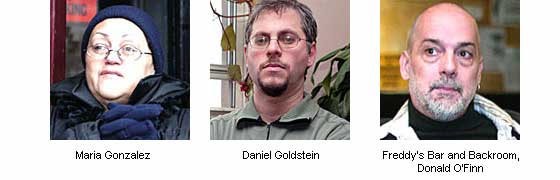
|
Posted by lumi at 9:11 AM
Hello, Neighbor!
Fans For Fair Play stands up to Brooklyn's new "neighbor," Barclays Bank, which sent out a strongly worded defence last week of the banks alleged ties to slavery, apartheid S. Africa and activities during WWII. FFFP lays out more details on the history of Barclays, seeks to clarify the record on one item, and explains the bank's latest hardball tactic:
Of course we're talking about Barclays Bank, who just crawled into a comfy palace four-post bed with Bruce Ratner. Barclays shelled out $400 million or so -- as per the usual secrecy from all things Ratnerian, Bruce and the bank won't exactly say how much.
New neighbors? Hey, let's do what anyone would and walk up the street, say hello, find out a little about them.
Seems that Barclays has a few skeletons in its closets...boney, scrawny evil lookin' things called Slavery, Apartheid, Anti-Semitism, Racism.
Oh...and a quick-trigger forearm to the throat of any newspaper, journalist, blogger, writer or internet site willing to write about their sordid little history.
NoLandGrab: Does anyone else get the feeling that Bruce Ratner's penchant for secrecy goes both ways? Is it possible that Bruce conveniently forgot to tell the British bank that they were about to partner up in one of today's most controversial development projects? Brooklyn's newest "neighbor" can't be happy.
Then again, as cited by Fans For Fair Play, Barclay's spokesperson Peter Truell writes, "As a good neighbor and corporate citizen, we pay close attention to the concerns of any community in which we have a presence...."
Posted by lumi at 8:39 AM
Taking it to the bank
NY Daily News, Editorial
We're getting used to the fact that the Daily News editorial page has pretty much been turned over to the Ratner PR machine.
Today's editorial takes Barclays letter — the one sent last week to individual journalists and grassroots and media organizations — at face value, and goes on the offensive against many local African American community leaders:
The Barclays Centre defence (hey, when in Britain...):
This amounts to what one historian calls a "game of gotcha." And it turns out the accusations are grossly unfair, if not flat out wrong. The bank said in a statement Friday, "We are ... firm in our belief that the partnership bank on which we were founded did not profit from the slave trade or slavery."
Barclays also pointed out that one of its early partners, David Barclay, was a committed abolitionist and an anti-slavery Quaker. After buying a farm that came with 32 slaves, he freed them all.
As for South Africa, Barclays divested eight years before the end of apartheid and now is a member in good standing of the banking community there.
The Daily News (and Forest City Ratner) offence:
Barclays' accusers fall into two categories. Some belong to the crowd that tried to stop Atlantic Yards. In bad faith, they are throwing rhetorical stones at the bulldozers. Other leaders have said they were genuinely troubled by the bank's past as it had been reported. They undercut their moral outrage by pressing Barclays for charitable contributions.
Atlantic Yards Report "Oderizes" the editorial below.
Posted by lumi at 8:27 AM
Looking at the Daily News editorial on Barclays, affordable housing, and apartheid
Atlantic Yards Report
The New York Daily News, in an editorial today (Taking it to the bank) taking Barclays' defensive letter on faith, goes beyond the bank's statement to distort the issues.
Consider the Daily News statement:
The bank's payments - the largest ever for arena naming rights - will help finance thousands of units of affordable housing while fattening Ratner's wallet.
That's a distortion. Yes, any revenue that Forest City Ratner would gain would help the overall enterprise, but the developer has not yet claimed that the Barclays deal was supposed to build subsidized housing. Rather, the affordable housing would be financed significantly by government funds--and the city has been unwilling to reveal the amount.
The Daily News continues:
But some howl that the money is unfit for Brooklyn. They accuse Barclays, founded in the 17th century, of having profited from the slave trade and reprising that bad behavior by doing business in South Africa during apartheid. This amounts to what one historian calls a "game of gotcha."
Actually, the historian quoted in the New York Times confined his "gotcha" comment to the slavery issue, not the more contemporary (and less murky) apartheid issue.
But wait, there's more.
Posted by lumi at 8:21 AM
Times, Daily News pass on $205M story; Doctoroff says construction costs could up city contribution
Atlantic Yards Report sums up the media coverage of the Bloomberg administration's more-than-doubling of the direct cash subsidy for Atlantic Yards, and follows up with Deputy Mayor Dan Doctoroff:
On the media:
The New York Sun and New York Post thought it was news. So did the online components of New York magazine, the New York Observer, and the Village Voice, as well as the online Gotham Gazette. The three Brooklyn weeklies--the Brooklyn Paper, the Courier-Life chain, and the Downtown Star (my story)--have covered it.
The New York Times and the New York Daily News have ignored the story so far. That's inconsistent, given their willingness to prominently play stories that were merely speculative. For example, a 9/5/06 Times article on a rumored six to eight percent cut in the size of the Atlantic Yards project ran on the front page--the lead story in the local edition. And a 12/22/06 Daily News story on the still sketchy possibility of a new Brooklyn Technical High School ran on page 2.
The Doctoroff is in:
...after the symposium on Robert Moses last Thursday, I asked Deputy Mayor for Economic Development Dan Doctoroff a couple of Atlantic Yards questions. I already covered the discussion of public dialogue and Community Benefits Agreements, but I also raised the funding issue: "You probably know there's a $205 billion capital plan for Atlantic Yards--
"Much of that," he intervened, "was stuff that was going to be done in the area regardless."
"Then why is it under the rubric of Atlantic Yards?" I asked.
"Because it happens to be in the area surrounding Atlantic Yards," he responded.
Posted by lumi at 8:13 AM
Seeing beyond Moses
NY Daily News
By Michael Gecan, the senior organizer for the Metro Industrial Areas Foundation.
A guest editorial seeks to dispell the myth being spun by the Bloomberg administration that nothing much was built in NYC after Robert Moses and before Bloomberg. We're linking to this op-ed because Bloomberg and Deputy Mayor Dan Doctoroff use this myth to justify the need for developer-driven mega-projects like Atlantic Yards.
Nothing could be further from the truth. The city is not poised for a second era of major construction, but for a third spurt.
It's the missing - almost invisible - second phase that merits more attention. Without it, the very nature and scale of the city would have become radically reduced, and the coming era of major development would still be gathering dust in the offices of planners and architects.
From 1982 to the present, New York City experienced the most extensive reconstruction of its housing stock of any American city in the modern era. At the start of this period, the city itself was the owner-of-last-resort of more than 100,000 apartments.
Posted by lumi at 8:08 AM
EMINENT DOMAINIA
 The Progress Report, How to Eliminate Eminent Domain
The argument for eminent domain is that when the government builds something long and skinny, such as a road, those who refuse to sell their land make it impossible or very costly to place the road elsewhere or go around the holdout. But eminent domain has also been used to redevelop a neighborhood to build shopping centers and better dwellings that pay a higher property tax. Laws that empower governments to declare that an area has “blight” are abused under the concept “blight makes right,” to allow government to declare any location to have “blight,” even places that are undeveloped.
MidHudsonNews.com, NYRI sues state over eminent domain law
New York Regional Interconnect Inc. Thursday filed a lawsuit in federal district court in Albany that seeks to toss out a recently passed state law that attempts to revoke eminent domain authority under New York's Transportation Corporations Law. NYRI wants to build a power line from Oneida County to Orange County and run it through part of the Upper Delaware River corridor.
NYRI's lawsuit claims that the law attempts to discriminate against it, and therefore violates its rights under the U.S. Constitution.
HighCountyNews.org, Condemned
Two retired engineers are fighting to keep their ranch.
Idaho-based J.R. Simplot Co. plans to expand its phosphate mine on nearby national forest land, and wants to build a road across the ranch. The company offered to buy the Riedes’ land for $2.1 million. The proposed road would permanently scar the hillside and generate heavy truck traffic near the site of their future home.
The Riedes do not want to sell, and plan to fight the mine expansion because they fear the mining upstream could pollute the water on their ranch. They purchased their land for around $645,000 in 1997, but say that replacing it with a comparable parcel today — 467 acres with amenities such as private trout-fishing streams — would cost closer to $6 million, triple Simplot’s offer.
But they might have no choice. Idaho is one of five Western states — including Washington, Wyoming, Colorado and Oregon — whose constitutions extend powers of eminent domain to private entities, such as railroads, mining companies, and oil and gas drillers.
...
But in Idaho and Wyoming, private entities don’t even need the government as a go-between.
The Virginian Pilot, Property rights don’t halt wrongs
While it’s true that Virginia law expressly bans government confiscations for economic development, that hasn’t stopped such things from occurring under other names and pretexts.
The article lists some examples of creative work-arounds in the State of Virginia. Here's a double whammy:
The Supreme Court of Virginia in 2003 allowed Hampton to take far more land than was needed for a new road, then lease the rest to the developer of the Power Plant project. The government used 20 percent of the property owned by Frank and Dora Ottofaro for a road, then leased the other 80 percent to the developer. Such a case opens the door for local governments to condemn land as a pretext for benefiting developers. To add insult, the city bulldozed a house on the property before the case was settled.
Posted by lumi at 7:36 AM
February 4, 2007
City Won’t “Blight” Diverse Southeast Seattle Neighborhood
Institute for Justice
Today, the Institute for Justice Washington Chapter (IJ-WA) hailed the announcement by the City of Seattle to halt its efforts to designate the Rainier Valley neighborhood “blighted” and implement a Community Renewal Plan that would have given the City the ability to condemn private homes and businesses to transfer to private parties. In a letter dated January 18, 2007 to Leslie Miller, the President of the Southeast District Council, Deputy Mayor Tim Ceis stated that the “City of Seattle will no longer consider designation of a Community Renewal Area in the Rainier Valley.”
...
The City faced overwhelming opposition from Southeast residents and business owners to the redevelopment scheme. The reversal follows months of uncertainty for Southeast Seattle property owners, whose homes and businesses could have been designated “blighted” under Washington’s Community Renewal Law. Under that statute, Washington municipalities can designate entire neighborhoods “blighted,” condemn the properties within that neighborhood, bulldoze them, and transfer them to private entities.
Posted by amy at 12:27 PM
Federal Reserve Finding: Eminent Domain for Private Development May Do More Harm Than Good
Institute for Justice
When the government uses eminent domain to take private property for private development projects, it “usually results in zero-sum gain and may actually hinder the area’s development.” That is the finding of an important new report released this month by the Federal Reserve Bank of St. Louis.In “The Taking of Prosperity,” authors Thomas Garrett and Paul Rothstein write, “[T]he taking of private property from one person and giving it to another for economic development . . . is unlikely to create a net benefit to society. It is more likely to create economic inefficiencies and to reduce economic growth.”
Demonstrating an understanding of markets that seems well beyond that of local government officials who abuse eminent domain for private gain, the report states, “When governments interfere in the private market, whether it be a market for apples, cars or property, the likely result is greater economic inefficiency and less economic growth. The reason is that even the most well-intentioned policymaker cannot comprehend or replicate the complex interactions of buyers and sellers that occur in free markets.”
Posted by amy at 12:23 PM
All Drawn Out
The Brooklyn Paper

Posted by amy at 12:15 PM
More from Doctoroff, Carter in post-Moses discussion
Atlantic Yards Report
After going through my tape of the symposium Thursday night on the legacy of Robert Moses, I added numerous verbatim quotes from Deputy Mayor Dan Doctoroff and Sustainable South Bronx founder Majora Carter. Below are exceprts from that expanded article.
...
"We are trying to reach out--we won't get it perfect," said Doctoroff, noting that the city had placed a 2030 plan brochure in every home-delivered newspaper in the city. "This isn't just about big projects," he said, noting that "we spent a year with a task force in Majora's neighborhood." Even in Hunts Point, he said, "as you know, there are big divisions about, on the one hand, environmental issues, versus having more jobs.""That’s not true, Dan, I'm sorry,” she shot back. “We like jobs. We also want to breathe.” Applause.
Posted by amy at 12:09 PM
Looking for Something That Merits the Trump Name in Brooklyn
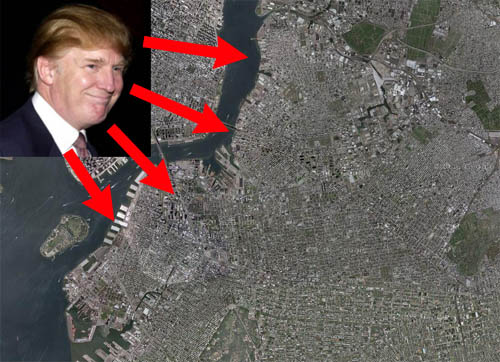
Curbed
Donald Trump is apparently looking at going back to his Brooklyn roots. He expresses what seems to be Ratner Envy to a magazine called City Scoops:That Ratner project is very interesting and a huge undertaking. Brooklyn is now a very viable market … and we think that there is potential for us there. Maybe not now, but down the road. Something along the waterfront would be great.No need to run for cover yet, though. He says that he hasn't seen any projects in Brooklyn "that would merit the Trump name so far.”
Posted by amy at 11:36 AM
February 3, 2007
The Barclays backlash; call for retractions met with resistance, questions
Atlantic Yards Report
Barclays Capital is fighting back, sending strongly-worded letters to journalists who've written about the reported links between the company and slavery, and asking us to "immediately retract and cease making any further misrepresentations of this sort." Barclays two weeks ago announced a more than $300 million deal for naming rights to the Atlantic Yards arena, to be known as the Barclays Center.I received a copy of the letter emailed to two different email addresses as well as hand-delivered to my workplace. The latter was delivered some five hours after I emailed several pointed questions to Barclays, asking for backup information. No response was forthcoming by the end of the day.
...
I haven't written much about the slavery controversy, but here's what Barclays apparently objected to: in my 1/23/07 piece, headlined Barclays and slavery: the Times muddies the issue, I took the New York Times to task for not correcting or clarifying a passage that stated:
They also said Barclays profited from the slave trade yet is aligned with Ratner, who is marketing his team to African-American fans. A company spokesman said Barclays had not been involved in slavery."While Barclays may not have been directly involved in the slave trade, there's evidence that profits from the slave trade were foundational to the bank," I wrote, citing an article from London's Independent about a television series that "tells us that even banks like HSBC and Barclays relied on slaving profits for their foundation."
Posted by amy at 10:31 AM
And where exactly is our cease and desist?
The Daily Gotham is a little jealous of everyone else's threatening letters (none for NoLandGrab either!):
There's an opportunity in this that shouldn't be missed. Clearly, Barclay's could use this as an occasion to engage the community in a dialogue. I'd wager a guess that the bank finds itself surprised and slightly out of its depth in what must have been an unexpected discussion of its past; one suspects that they perhaps, cough, Ratner, cough, weren't told that the project they want to involve themselves with is in itself controversial.Thing is, that controversy isn't going to go away with a cease and desist. If Barclay's wants a dialogue, we're willing to have it.
Posted by amy at 9:57 AM
From the editor: Our Barclays coverage
Brooklyn Paper's Editor insists they checked their facts before publishing their story, and found everything on the up and up. Read the full editorial for a full disclosure of source material.
Barclays has requested a retraction from this newspaper (and others) for stories about the bank’s link to slavery and other dark moments in human history (see the bank’s letter, written by spokesman Peter Truell, by clicking here).Our stories regarding Barclays were based on information acquired from respected sources and, as a whole, do not merit a retraction.
...
Our news stories were not an examination of whether Barclays had profited from slavery — all banks did, so to pretend otherwise is silly. Rather, our initial article — and its follow-up, “Black leaders rip Ratner’s $400M Barclays arena deal” — centered on the outrage that black leaders like Councilwoman Letitia James, Assemblyman Hakeem Jeffries, former Assemblyman Roger Green, and some church pastors — felt after hearing about the Ratner-Barclays contract.We didn’t manufacture their outrage; we reported it, leaving our readers to decide for themselves if the bank’s past bothered them.
Posted by amy at 9:57 AM
Barclays: No ‘blood money’ here
Brooklyn Paper
A British bank that is under fire from black leaders for profiting from the slave trade centuries ago is fighting back, issuing a long-awaited statement that claims the allegation “is simply not true.”In letters sent late Thursday to several journalists — including those at The Brooklyn Paper — Barclays spokesman Peter Truell asked that the newspapers “immediately retract” stories that relied on what Truell called “simply untrue” and “misleading” evidence of the bank’s slavery links.
...
Truell would not provide The Brooklyn Paper with supporting data or citations for his claim that “the partnership bank on which we were founded did not profit from the slave trade or slavery.”
The Brooklyn Paper also reprinted in full the letter sent to them by Barclay's. Read it here.
Posted by amy at 9:46 AM
Marty's State of the Borough: Atlantic Yards, (certain) concerned citizens hailed
Atlantic Yards Report
From Borough President Marty Markowitz's wide-ranging State of the Borough address Thursday night:
The word is out about Brooklyn, no doubt about it. Last month, we learned that Barclays, one of the largest financial institutions in the world, will kick-off its expansion in America by investing $400 million dollars to name the Atlantic Yards arena — the Barclays Center. More proof that nowhere possesses the economic vitality or captures the popular imagination with more power than Brooklyn.
When you dream big these days, you dream Brooklyn!
The naming of the Barclays Center is a major step toward making one of my own dreams for Brooklyn a reality.
With thousands of apartments for Brooklynites of all incomes, new jobs for residents of every skill level — solid, union jobs — an arena for major concerts and events, 8 acres of open space, a new school — plus shopping, a boutique hotel, and world-class architect Frank Gehry designing it — all above one of the largest public-transportation hubs in the metropolitan region — Atlantic Yards will help create the new center of city life that our borough of 2.6 million residents deserves.
And I made a promise that I will continue to keep — to be responsive to the concerns of those in the area surrounding Atlantic Yards, and to make this project one that all Brooklynites are proud of for generations to come.
And I know that before long we’ll all be cheering together when the Brooklyn Nets leave the Manhattan Knicks in the Atlantic Division dust — and bring an NBA championship home to Brooklyn!
...Atlantic Yards is part of an even grander vision for Brooklyn. In 2004, I worked closely with Mayor Bloomberg and others to lay out a comprehensive plan for building a new downtown for Brooklyn. With renewed energy, we’re turning that plan into action.(Note that Atlantic Yards was not part of the Downtown Brooklyn rezoning or the planning process for it.)
Posted by amy at 9:38 AM
Is the tide turning on Paper’s ‘Blood Money’ page one?
Brooklyn Paper's letters section includes much heated commentary about the Barclay's deal. Here's one of our favorites, from Larry Penner of Great Neck, New York - go to the paper to read the rest!
To the editor,Your recent articles concerning Barclays Bank paying $400 million to Bruce Ratner for naming rights to the Nets arena proves my previous observations why taxpayers should just say no to using public funds for any new major sports stadiums (“Blood Money,” Jan. 20).
In ancient Rome, government attempted to curry favor with the masses by offering free bread and circuses. Today, we have sports pork.
How sad that city taxpayers are continually asked to pay for new stadiums. Public dollars on the city, state and federal level are subsidizing a private-sector business. The only real beneficiaries of these expenditures are team owners and their multimillion-dollar players.
It is impossible to judge the amount of new economic activities that these so-called public benefits will generate. Between selling the stadium name (Ratner raised $400 million for himself with that one deal!), season skyboxes and reserve seating, cable, television and radio revenues, concession refreshment and souvenir sales along with rental income for other sports, rock concerts and other commercial events, it is hard to believe that Ratner and other team owners can’t finance their new stadiums by themselves.
The city’s municipal debt has grown to $55 billion. The per-resident capital debt of $6,800 makes the Big Apple number one nationally.
As Raymond Keating wrote in a Cato Institute report, “public subsidies pad the bottom lines of team owners and boost player salaries while offering no real economic benefit to the cities involved.” Scarce taxpayer funds would be better spent elsewhere.
Let the current team owners sell the stadium name, float their own bonds or issue stock to finance new stadiums! Please don’t pick the pockets of taxpayers!
Larry Penner, Great Neck, New York
Posted by amy at 9:25 AM
Old Bars and Luxe New Development
Village Voice
The Bowery, McCarren Park, Atlantic Yards: Every hot-investment neighborhood has at least one hallowed bar clutching to survival despite the encroaching shadows of big development. Question is, how long can these old establishments hang on?
...
In Prospect Heights, Freddy's (485 Dean Street) lies, according to manager Donald O'Finn, "in the footprint" of Bruce Ratner's megalomaniac development. Eight or so years ago this Prohibition-era cop bar was charmingly reborn and redecorated by O'Finn and friends with a mass of thrift-store tchotchkes, books stuck into built-in shelves, and televisions screening O'Finn's videos (reformatted old film and TV clips). In addition to sponsoring its own in-house literary magazine and providing a space for community activist groups like Develop Don't Destroy Brooklyn, Freddy's hosts some of the city's most original readings and performances: Sing and Win a Ham, and the much praised Cringe Reading Night of teenage diary excerpts. What will become of this place once Ratner's fantasy is fully realized? "Last I heard, we were destined to become an escalator," says O'Finn. "Which is kind of ironic."
Posted by amy at 9:11 AM
City doubles down on Ratner’s Atlantic Yards Project, many cry foul
Courier-Life
Stephen Witt
Call it mystery money.Couched in Mayor Bloomberg’s capital budget, released last week, is $205 million earmarked for the Atlantic Yards project.
The line item more than doubles the $100 million that the city has already given toward the Forest City Ratner Companies (FCRC) project for infrastructure costs.
...
“The public costs keep rising, and yet we have a paltry amount of housing that is affordable to the average Brooklynite, and no agreement with the construction trades union to work with local residents who need jobs,” said City Council member Letitia James.
Posted by amy at 9:04 AM
February 2, 2007
Shirtspotting
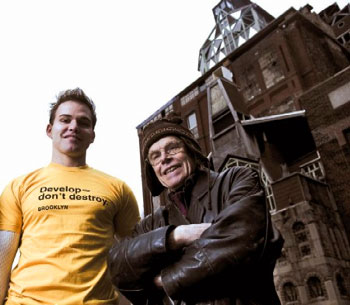 Shahn Anderson sports Brooklyn's hottest T, proving that responsible development does the body good and is oh so sexy!
Check out the story about how Shahn stepped in to help save Broken Angel:
The Real Deal, Broken Angel goes condo in changing Clinton Hill
Brownstoner, More Details on the Broken Angel Project
Posted by lumi at 10:34 AM
Black leaders erupt over Barclays' sports deal
Belfast Telegraph
By Stephen Foley
The Barclays naming-rights deal brouhaha has now reached beyond The Pond:
When Barclays agreed to pay more than $300m (£152m) to get its name on a new basketball stadium in Brooklyn, it thought it had pulled off one of the most exciting marketing coups in American sport.
But just a few weeks on, the British bank is battling to prevent a public relations disaster, as black leaders demand the deal be scrapped because of Barclays' historic support for the apartheid regime in South Africa and what they believe are profits it made from slavery.
Barclays says the allegations about its links to the 18th-century slave trade are "simply not true" - based on an inaccurate book written 60 years ago - and it is now mired in an exchange of historical documents with opponents.
Politicians, churchmen and newspaper columnists say it would be an insult to black residents to name the complex the Barclays Centre, as planned.
NoLandGrab: Barclays's primary cultural concession has been to use the correct spelling of "Centre".
Posted by lumi at 10:28 AM
Small victory over Ratner
The Brooklyn Paper
The next all-too-predictably bizarre tale from "Law & Oder" Ratner-style:
An Atlantic Yards opponent who still owns land in the footprint of the skyscraper-and-arena-project has won a small victory against developer Bruce Ratner — though it may not keep him out of jail.
Lars Williams had been arrested last year for removing a Ratner-installed surveillance camera on a building on Sixth Avenue between Pacific and Dean streets.
But because the camera was actually on Williams’s own property, he retaliated with a civil suit against the developer.
At a pre-trial hearing last month, Ratner’s lawyer made a startling confession: “We made a mistake — the camera was in Mr. Williams’s building,” Williams said.
So you'd think that Ratner would drop the heavy-handed criminal complaint right away and apologize for throwing the property owner in the slammer overnight, right?
[Hint: the headline says it's a "small victory" and it's Bruce, afterall.]
Posted by lumi at 9:41 AM
Barclays Arena Deal Raises a Reputed Link to Slavery
From The NY Times, by Anthony Ramirez:
Hakeem Jeffries, a state assemblyman who supports the $4 billion Atlantic Yards project near Downtown Brooklyn, has denounced an important facet of it — the name for the new arena for the Nets basketball team, which he called an affront to the black community.
Another supporter, Roger L. Green, a former assemblyman, has said the Nets naming deal contributed too little money to help Brooklyn.
With all the public criticism and praise laid at the doorstep of the Atlantic Yards project, the naming of the arena did not figure to be controversial. Last week, Bruce Ratner, the owner of the Nets and the president of Forest City Ratner, the Atlantic Yards developer, announced that the British bank Barclays would pay $400 million over 20 years for naming rights to the 18,000-seat stadium, to be called the Barclays Center.
Barclays’ accusers say the bank’s early founders had ties to the African slave trade in the 18th century. More recently, they say, the bank cooperated with the apartheid regime of South Africa. A spokesman for Barclays denied both claims.
Posted by lumi at 9:28 AM
Gehry to unveil new Miss Bklyn - She’s shorter, but still the star of the show, he says
Courier-Life Publications
Originally, “Miss Brooklyn” was a mammoth 600-foot, 60-story structure at the Flatbush/Atlantic Avenue intersection, dwarfing the borough’s current tallest building – the Williamsburgh Bank Building at 512 feet high and 34 stories.
“Miss Brooklyn – she’s gone. She’s a new one now. I have a new Miss Brooklyn. I haven’t showed it yet and she’s better,” said Gehry, one of the world’s pre-eminent architects.
Gehry explains the genesis of "Miss Brooklyn:"
“Miss Brooklyn got named when one of my guys was bringing the model from LA to New York and they had to buy a seat on the airplane, and when they sold the seat they needed a name so he said, ‘call her Miss Brooklyn’ and it stuck,” said Gehry.
Gehry also took umbrage to critics who charge the Atlantic Yards project is the “Manhattanization of Brooklyn.”
“It will be the Brooklynization of Brooklyn not the Manhattanization."
NoLandGrab: Groan... now Brooklyn is a vicitm of a bad inside joke.
Posted by lumi at 8:29 AM
More blacks insulted by Bruce
The Brooklyn Paper
By Ariella Cohen
“I’m troubled and concerned with this project’s ties to this bank,” said Rev. Clinton Miller of Brown Baptist Memorial Church, who will lead a protest this Sunday.
Unlike other prominent blacks who have questioned Ratner’s partnership with Barclays — including former state Assemblyman Roger Green, his successor Hakeem Jeffries and the Rev. Herbert Daughtry — Miller is a strong critic of the $4-billion megadevelopment.
But like others who objected to the naming-rights deal, Miller has called on Ratner to either terminate the agreement or kick back more money to local residents.
The global investment firm has promised to give $2.5 million to renovate basketball courts in the borough, but Miller, like Green and Jeffries, said it wasn’t enough.
Posted by lumi at 8:20 AM
Why they lie
The Brooklyn Paper explains why NoLandGrab can't even squeeze in a vacation, much less retire:
Lately, it seems that no matter which development story we cover — Atlantic Yards, the so-called “Brooklyn Bridge Park,” the redevelopment of Coney Island — one common theme emerges.
Developers don’t tell the truth.
And the simple reason is that they don’t want you — the taxpayers who subsidize most development going on today — to know how much of your money they’re taking.
We write about this subject a lot, but it bears repeating because the lies and subterfuge blinds many of our readers to the hidden costs of some of Brooklyn’s biggest projects.
With Atlantic Yards, developer Bruce Ratner once boasted that his project would generate $100 million in tax revenues for the city every year for 30 years. That figure is now down to $15 million. Fifteen million! That’s coffee money for a city with a $57 billion annual budget.
The city once said it would only spend $100 million on “infrastructure improvements” at the Atlantic Yards site. That figure is now $205 million — and the mayor told our reporter this week that the final figure will be higher.
Posted by lumi at 8:15 AM
City deaf to Railroad’s call
The Brooklyn Papers
By Christie Rizk
Downtown Brooklyn is still under siege from eminent domain:
It’s easy to ridicule Bruce Ratner for partnering with a slavery-linked British Bank on his Atlantic Yards mega-project.
But as Lewis Greenstein and Joy Chatel are finding out, Ratner isn’t the only one ignoring America’s slave-owning past.
Greenstein and Chatel live on Duffield Street in Downtown Brooklyn. And like a couple of lone Yankee soldiers battling General Lee’s troops, these two activists are fighting to keep the city from destroying their buildings, which they claim were once stations on the Underground Railroad.
The city would rather have an underground parking lot.
...
In 2004, an Economic Development Corporation official was caught lying at a hearing to determine the houses’ historical value. He testified that he had consulted with dozens of experts and black culture research institutions and that they had agreed that the Duffield Street homes didn’t deserve to be saved.But he hadn’t and they didn’t.
The lie was bad enough, but what really bothers Greenstein is that the city would tear down his building simply to create a parking lot for the New Brooklyn, chasing, as he called it, “the Almighty dollar.”
Posted by lumi at 7:48 AM
What's in a name? Money, that's what
The Journal News
Sports columnist Rick Carpiniello resists becoming a mass-marketing device, but is puzzled by Bruce Ratner's Barclays naming-rights deal:
There are words I'd like to say I'll never use. Like Red Bulls - not because I don't like soccer, but because I'm not going to promote somebody's beverage.
Unfortunately, I have to use Barclays when the golf tournament comes to town, but I'm not going to use it when referring to the Brooklyn Nets' arena, and I'd like to try to avoid the word "Citi" when talking about the Mets' new ballpark. It would be great if newspapers everywhere realized that, hey, these sponsors aren't paying us to use their names; that the arenas aren't actually named for the sponsor, but rather that the sponsor is paying somebody else to have its name sprayed everywhere on the building and to get publicity from us without paying us.
That said, I don't understand a lot of things, but one of them is this: How is it that New York City is coming in $100 million or so over budget on the Brooklyn arena, and Bruce Ratner and his Nets get to cash the $200 million worth of Barclays money for the naming rights? How does that money not go to NYC until all the bills are paid?
NoLandGrab: We don't mean to "Norman Oderize" Rick Carpiniello, but that's $105 million over budget for the NYC direct cash subsidy and more than $300 million (published rumors say closer to $400 million) all for Ratner from Barclays for the naming rights to the arena.
Posted by lumi at 7:32 AM
News Analysis: City's Atlantic Yards Bill Keeps Growing
Brooklyn Downtown Star
By Norman Oder
Since a February 2005 Memorandum of Understanding (MOU), the City of New York committed to spending $100 million on infrastructure and other costs for the Atlantic Yards project in Brooklyn, helping to prepare a complicated site - including a railyard - for an arena and also to help developer Forest City Ratner pay for properties that would be on the arena site footprint.
However, last week, a little more than a month after the project received its final public approval (via the state Public Authorities Control Board, or PACB), Mayor Mike Bloomberg's proposed capital budget included $205 million on the line for Atlantic Yards. ...
However much the $205 million might raise eyebrows, [Kate Suisman, chief of staff for Council Member Letitia James] noted, when it comes to the budget, the Council "can't say no to parts of it; you have to accept or reject the whole thing." She said that the totality of the spending "should have been made public prior to the PACB vote."
Posted by lumi at 7:30 AM
City Yards cost skyrockets; Opponents scream as Bloomy quietly doubles taxpayer subsidy
The Brooklyn Papers
By Ariella Cohen
Mayor Bloomberg explains the soaring costs of new sports venues to the taxpayers:
At a press conference on Wednesday, Bloomberg attributed the higher allocation to the “rising cost of cement and steel.”
“We have a commitment to pay for infrastructure costs and we will meet that commitment,” the mayor said.
Hizzoner dismissed the notion that taxpayers would be stunned to hear that the city was spending more than it anticipated on Atlantic Yards and new stadiums for the Yankees and the Mets, both of which also received multi-million infusions last week.
“We are fundamentally where we thought we would be,” Bloomberg said.
The Atlantic Yards adjustment is the largest of the three hikes in funding. In total, capital funding for the three projects has risen to nearly $600 million — up from the $360 million initially promised.
The Papers puts the figures in context:
A Bloomberg spokesman said the extra spending was a small price to pay for the largest development project in the history of Brooklyn.
“This project will create jobs, provide affordable housing and generate billions of dollars in tax revenue and represents a solid investment of taxpayer resources,” the spokesman said.
Unlike the city contribution, the tax revenue that Atlantic Yards is expected to generate has gone down. Over the summer, state officials said the project would generate $1.5 billion over 30 years. It is now projected to generate $944 million over the same time period — or just $15 million per year for the city and state, whose annual budgets are in the tens of billions.
NoLandGrab: Blooomberg blows off taxpayers with this quote: "We are fundamentally where we thought we would be [just not where we told you we'd be]."
However, the Mayor is right; taxpayers aren't "stunned" because most local media haven't covered the issue. Q: If an activist "screams" in a forest, but hardly anyone covers it, does the activist actually make a sound?
Posted by lumi at 7:19 AM
Making omelets without breaking eggs? Doctoroff posits post-Moses era
Atlantic Yards Report
Though revisionists argue that, on balance, Robert Moses’s efforts to build infrastructure, parks, and housing were good for the city, Deputy Mayor Dan Doctoroff isn’t about to claim Moses’s mantle.
Indeed, leading off a symposium tied to three simultaneous exhibitions under the rubric Robert Moses and the Modern City, Doctoroff last night declared that, yes, Moses deserves a rethink but safely observed that the master builder was “definitely an ends over means kind of guy.”
Speaking at a panel organized by the Museum of the City of New York, Doctoroff acknowledged Moses’s insensitivity to public opinion, towers-in-the-park design, and dislocation of hundreds of thousands of people. However, asserted the deputy mayor for economic development, after Moses, for 40 years, “pretty much nothing happened” in terms of new projects and major infrastructure.
...
And, contra Moses, he declared, “We definitely do not believe you have to break eggs to make omelets.”
NoLandGrab: Lately, it has become fashionable to blame preservationists and the Uniform Land Use Review Procedure (ULURP) for the fact that "nothing happened" in the 40 post-Moses years. How soon we forget NYC's fiscal woes: taxpayers were not eager to assume more bond debt and NYC was hemorrhaging human and economic resoucres. And aren't we forgetting Ratner's crown jewel, Metrotech?
New Yorkers deserve a more complete picture to counter Doctoroff's sound bites.
Posted by lumi at 7:05 AM
MTA panel eyes cost cuts
MetroNY
By Patrick Arden
Metropolitan Transportation Authority officials admitted yesterday that the agency’s 2005-09 capital program is running over budget, but they refused to say whether any scheduled projects would be delayed or scrapped.
...
“They don’t deny that it’s a problem,” [Gene Russianoff, senior attorney for the Straphangers Campaign] said, but “they are going to have to look for additional revenue. This is an agency that’s awash in red ink, both on the operating side and on the capital side.”
NoLandGrab: Snap! MTA officials are probably damn sorry they approved Bruce Ratner's low-ball bid for the Vanderbilt Railyards in 2005.
Posted by lumi at 6:56 AM
Blight Study May Pave Way For Columbia Expansion
The NY Sun
By Leora Falk
While Harlem is the midst of a real estate boom, a plan for Columbia University's expansion assumes that part of the area will be designated as blighted, paving the way for the university to use eminent domain to acquire property in the proposed expansion zone.
Hmm... sound familiar? Try this remix:
While Brooklyn is the midst of a real estate boom, a plan for expansion of Bruce Ratner's local real estate empire assumes that part of the area will be designated as blighted, paving the way for the real estate mogul to use eminent domain to acquire property in the proposed expansion zone.
The Sun article continues:
The university has hired an outside organization to determine if the area is blighted. Such a determination would likely cause friction in part because the definition of blight is unclear and because the university is funding the study.
NoLandGrab: It is well known that NY State's definition of blight is developer-friendly and allows for buildings that are underutilized and outdated to be targeted.
Posted by lumi at 6:40 AM
Celebrity Architects Reveal a Daring Cultural Xanadu for the Arab World
The NY Times
Starchitect Frank Gehry's wet dream is in the desert. Gehry, who once publicly relished the opportunity to "build a neighborhood practically from scratch" and described the Atlantic Yards footprint as "an empty site," has finally found a tabula rasa:
“It’s like a clean slate in a country full of resources,” said Mr. Gehry, who appeared at the exhibition to show off his model for the Guggenheim Abu Dhabi.
By "resources," we think that Gehry means "money."
Posted by lumi at 6:32 AM
February 1, 2007
Markowitz Set To Unveil More New Projects In State Of The Borough
NY1
By Jeanine Ramirez
Brooklyn's Beep goes "bling":
"Now what I want to do is to have the Parachute Jump reflect more of the Coney Island ambiance, which means 'in your face'. And that's a good thing – bling, bling, bling," said Markowitz.
After taking credit for the idea of pro basketball in Brooklyn...
Markowitz says he's looking forward to the day the Brooklyn Nets take on the Manhattan Knicks. While there may still be obstacles in the way, like an eminent domain lawsuit to stop the project, he's hopeful there will be a groundbreaking for the new arena this year.
Posted by lumi at 6:49 PM
BP MARKOWITZ TO DELIVER ANNUAL STATE OF THE BOROUGH ADDRESS AT STEINER STUDIOS
 |
7:00 P.M.
THURSDAY, FEBRUARY 1, 2007
STEINER STUDIOS — STAGE 5
15 WASHINGTON AVENUE, AT FLUSHING AVENUE
BROOKLYN NAVY YARD
In 2006, Brooklyn saw a major increase in tourism, a hotel construction boom, the opening of the new Brooklyn Cruise Terminal, the approval of the Atlantic Yards project, progress on Brooklyn Bridge Park, and the first phase of the revitalization of Coney Island. Borough President Markowitz will discuss these projects, as well as the renewed effort to transform Downtown Brooklyn, including plans for the BAM Cultural District, new parks, and housing.
Posted by lumi at 8:30 AM
"Time to build again," as Moses controversy gets airing
Atlantic Yards Report recaps the discussion on yesterday's Brian Lehrer show about the legacy of Robert Moses.
“New York is in the biggest building boom since the heyday of Robert Moses,” as WNYC radio host Brian Lehrer put it on his show yesterday. One of the questions was whether Deputy Mayor Dan Doctoroff is today’s Robert Moses, given major projects like Shea Stadium, Atlantic Yards, and the construction of the Second Avenue subway.
Lehrer posed that to Majora Carter, founder and executive director of Sustainable South Bronx, who observed that “everyone has a little bit of Moses in them…. But I do think it would be wise for the Bloomberg administration to pay a bit more attention to where people are coming from…. I think it would be great if we didn’t take that kind of Moses-like attitude any further than it’s already gone.”
Carter was speaking of her neighborhood, but some in Brooklyn faced with the Atlantic Yards project would have echoed her concerns. Still, Doctoroff was unable to appear on the program—he’ll be on a panel today sponsored by the Museum of the City of New York—which instead focused on the battle over Moses’s legacy.
...
Given the run-up—the exclusion of Robert Caro, author of the epic Moses biography, The Power Broker, from the main panel and symposium—the discussion yesterday was notably decorous, despite some provocative points.
Posted by lumi at 8:18 AM
It came from the Blogosphere...
 Nah Right, Jay-Z Supports Slavery
An indy hip-hop blog runs a pretty damned inflammatory headline.
SoundSlam, Jay-Z's New Nets Stadium To Be Funded By Former Slave-Trade Bank
Things are getting pretty silly in the Hip-Hop-o-sphere when Jay-Z is getting credit for the Barclays deal:
Recently, Jay had poured further money into the franchise by securing 400 million in funding from British bank Barclays to build a new stadium for the team, to be called the Barclays Center.
EURweb.com, BEYON-JAY SUBJECT OF BAD PRESS: Beyonce accused of paying dancers chump change; Jay-Z’s Nets accused of taking money from slave owners.
Now we're speechless:
When it rains, it pours for lovebirds Beyonce and Jay-Z, as their latest round of bad press swings from slave wages, to slave money.
The Grammy-winning singer is being accused of paying her tour dancers pennies, while the rap mogul is catching flack because his New Jersey Nets basketball team is taking money from a bank that profited from the slave trade.
Brooklyn Record, The Barclays Center Saga Continues
But what exactly do [Roger Green and Hakeem Jeffries] want from Barclays Bank? Well, Jeffries told The Brooklyn Paper, “All options should be on the table, including payment for past wrongs and termination of the agreement." Green, is a strong supporter of Atlantic Yards, said that the $2.5 million that Barclays will be paying to repair public basketball courts throughout Brooklyn (as part of the $400-million naming-rights deal) is “not enough.” But if we're talking about paying reparations for the slave industry, is it even possible to come up with a dollar amount that would be "enough"?
Majikthise, NYC quietly doubles contribution to Atlantic Yards mega-project
I have no doubt that the infrastructure costs associated with the Atlantic Yards project will be extraordinary in the sense of being huge. On the other hand, I wonder why the city didn't anticipate these costs when it made its initial commitment.
So these "extraordinary" infrastructure costs include things the city would have had to do anyway? Sure.
BarbaraCorcoran.com, Brooklyn Matters
I’ve lived in Brooklyn for nearly 4 years now and ever since I moved into the neighborhood the Atlantic Yards project has filled me with deep ambivalence.
"I am not Barbara, I am Simon" doesn't like eminent domain to take peoples' homes, but feels the neighborhood is "barren," hates basketball (all sports, for that matter), loves Freddy's AND Frank Gehry, doesn't like dark shadows (is there any other kind?), but likes the idea of a lot of affordable housing (for whom?).
It seems all of my reasoning is entirely selfish, just like everyone else’s I suppose. On balance I’d have to be with the ‘no’ camp, for Freddy’s more than anything else. If I were the man in charge I’d make the whole thing much smaller, scrap the sports and not steal anybody’s home. Sadly I am not the man in charge so whatever happens, happens and I remain deeply ambivalent.
Perhaps I need to see this documentary.
Queens Crap, Brooklyn Matters
Brooklyn Matters is a documentary that chronicles the struggle of people to save their neighborhood from the Atlantic Yards project. The film will be screened at several locations over the next month. Crappy encourages you to watch. Hopefully the film will make its way across the border soon. Heck, maybe we'll even sponsor it!
The Gowanus Lounge, Atlantic Yards Property Update: Where the Eminent Domain Hammer Would Fall
What you're looking at above is a map of the Atlantic Yards site, color-coded to show who owns what. While the entire thing makes a pretty, multi-colored map and diagram of the project, what's of particular interest here are the areas in red. Those, according to Develop Don't Destroy, are properties that are still privately owned. In total, more than five acres of the proposed site are still privately owned or controlled.
Daily Intelligencer, Neighborhood Watch
Prospect Heights: Turns out there are still five privately owned acres smack in the path of Atlantic Yards. [Develop Don’t Destroy Brooklyn]
OnNYTurf, Eminent Domain at Atlantic Yards Mapped
Regular readers will know that no one appreciates a good map like OnNYTurf:
DDDB.net has a nice new map showing just how much property Bruce Ratner and the State of New York need to take from people to build the Atlantic Yards project.
5 acres of property are in the hands of private owners. Clearly a victory for property owners, in what is an epic battle with Mr Ratner, would completely scuttle the project and Mr Ratner would need to create a new development plan from scratch.
Posted by lumi at 6:46 AM
NYC Guide: Develop Don’t Destroy
The Village Voice
Tuesday, 2/6:
Whichever take people might have on the debate over Brooklyn’s Atlantic Yards project, no one seems to be laughing about it. [NoLandGrab: Hey, we do funny!! At least we thought we did. Besides there's always something funny going on at Bruce Ratner's Atlantic Yards.] But here at last is a group of comics (for the record, they’re unimpressed with Ratner’s plans) bringing some levity to the proceedings. Michael Showalter (The Baxter, Wet Hot American Summer), Chelsea Peretti (co-founder of “The Rejection Line”—hey, Ratner-ites, you’re welcome to call!), Gilad Foss (his blog site boasts that he’s been “inspiring platonic feelings in members of the opposite sex since he was a teenager”), and a handful of others gather tonight to raise money for community group Develop Don’t Destroy. Ratner himself is not expected to attend, though, reportedly, he is laughing (all the way to the bank). (Grossman)
link (scroll down)
Posted by lumi at 6:11 AM